
REVIEW · FUSHIMI INARI SHRINE TOURS
Fushimi Inari Hidden Hiking Tour (Private Option Available)
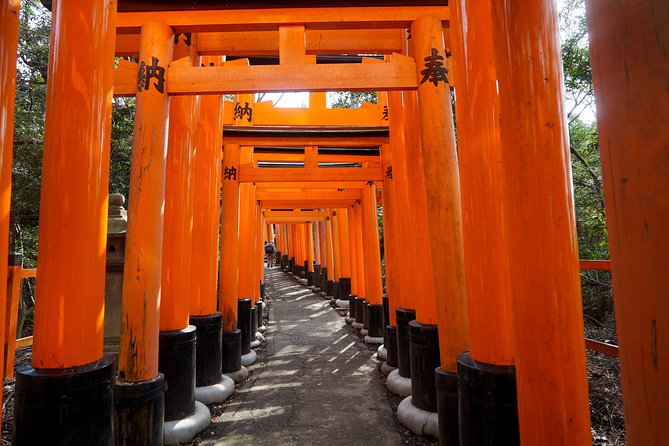
Fushimi Inari is famous for its orange torii gates, but the best part of this tour may be the quiet approach. Instead of joining the thick stream at the main entrance, you walk through residential lanes, forest trails, bamboo, and small shrines before reaching the mountain paths from behind.
I like two things right away: the route avoids much of the crowd, and the guide handles turns that would be easy to miss alone. I also like the personal scale. With no more than seven people, guides such as Naru, Hina, Yuko, Matt, and Shin can answer questions, adjust the pace, and take photos along the way.
The catch is simple: this is a hike, not a gentle shrine stroll. The route covers about 7 kilometers, includes uphill sections and stairs, and may be slippery. You need shoes with firm grip, water, and enough fitness for a moderate mountain walk.
Key points to know before you book
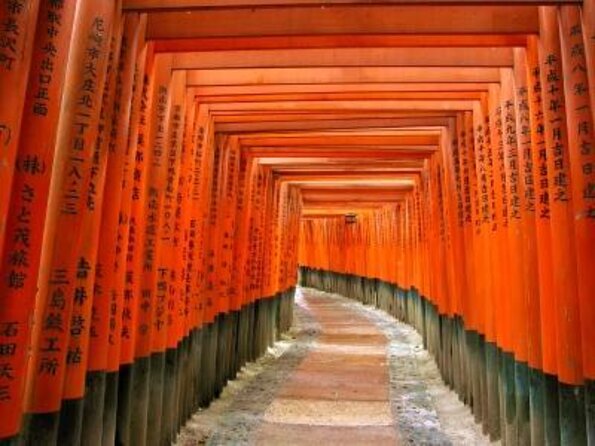
- A quiet back route to Fushimi Inari: Approach the torii gates from the upper or rear side instead of starting amid the busiest entrance crowds.
- A real forest hike: Expect narrow paths, stairs, uphill walking, bamboo, and uneven ground rather than paved sightseeing all the way.
- Small groups capped at seven: The guide can keep an eye on the pace and answer questions without shouting across a large group.
- About three hours and 7 kilometers: This fits well into a Kyoto morning or afternoon, but it uses more energy than the short duration suggests.
- Useful local guidance: Guides explain fox imagery, inscriptions, shrine customs, and the history of places such as Fushimi-Momoyama Castle.
- Weather matters: Summer heat, humidity, rain, mosquitoes, and slippery ground can change the feel of the walk.
Why this route makes Fushimi Inari more enjoyable
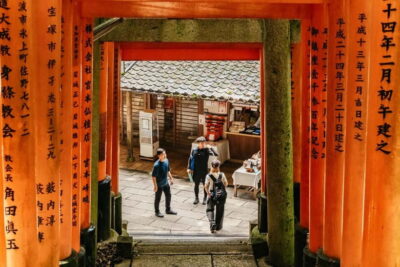
Fushimi Inari-Taisha is one of Kyoto’s most recognizable sights. Its long corridors of orange torii gates climb Mount Inari, drawing a steady flow of people near the main shrine and lower paths.
That popularity can work against the experience. At the entrance, you may spend more time following other people than noticing the gates, stone foxes, forest, or small details around the shrine. This tour takes a different approach. You meet near FamilyMart Nakai Tofukuji, then walk toward Fushimi Inari through a less obvious route.
The walk may pass through a residential area before reaching the forest. That transition is useful. You see a quieter side of Kyoto first, then gradually leave the streets behind. It feels less like checking off a famous sight and more like reaching it by foot.
Some departures have taken the route in reverse, beginning near the upper section and finishing closer to the main entrance. That can be a smart way to deal with crowd patterns, especially during foliage season or a Japanese holiday. The exact route and direction can vary, so think of the main benefit as the back-country approach rather than a guaranteed crowd-free visit.
More Private Temple Tours in Japan
- Kyoto: Zen Meditation at a Private Temple with a Monk
★ 5.0 · 202 reviews - Kyoto Early Bird English Tour: Fushimi Inari & Gion(Private opt)
★ 5.0 · 139 reviews - Kyoto: Fushimi Inari Hidden Hike (Private)
★ 5.0 · 31 reviews
The forest trail, bamboo, and small shrines
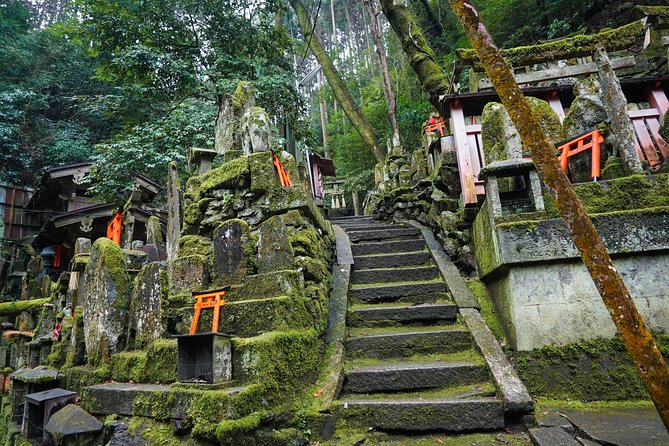
The first major part of the experience is the uphill path through the wooded side of Mount Inari. You leave the broad paved routes and follow a narrow mountain trail where roots, stones, and damp ground may slow your step.
This is where a local guide earns the fee. Turns on a forest route are not always obvious, and the route is not one I would choose for a first solo visit without a map and good preparation. Your guide leads the way, watches the group, and points out places you could easily pass without noticing.
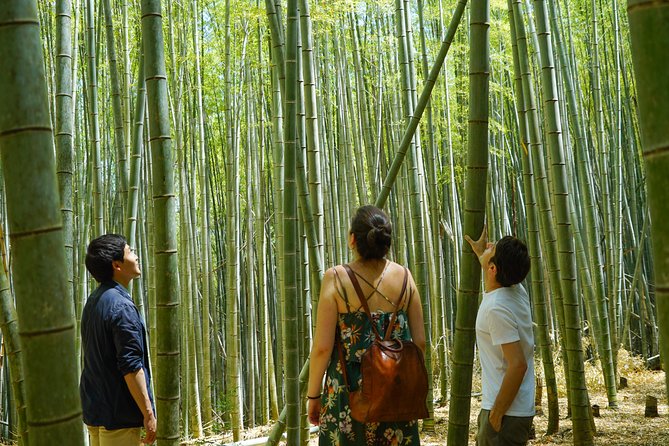
A natural bamboo forest is one of the memorable stops. It is not the same as simply walking down a busy photo path. Here, bamboo forms part of a longer woodland walk, with the sound and feel of the forest doing much of the work. You also visit a smaller Inari shrine away from the main tourist flow.
The quiet can be the strongest part of the tour. At times, you may find yourself walking with very few other people around, even though one of Kyoto’s most famous shrines is nearby. That contrast is the reason to choose this outing over a standard visit.
Still, do not mistake quiet for easy. The path can include steep climbs and technical sections. One account describes scrambling on parts of the trail, while another points out the stairs on the way down. Most people who are in regular walking condition should understand the demands, but this is not a good pick if you have trouble walking or rarely exercise.
Reaching Fushimi Inari from the upper side
The route eventually brings you into the Fushimi Inari shrine area, often from the back or upper mountain side. This changes the order in which you experience the place.
Instead of first seeing the largest crowds at the main entrance, you encounter gates and smaller religious features along the mountain. The orange torii still provide the signature Kyoto scene, but the approach gives you more time to notice how the shrine extends through the woods.
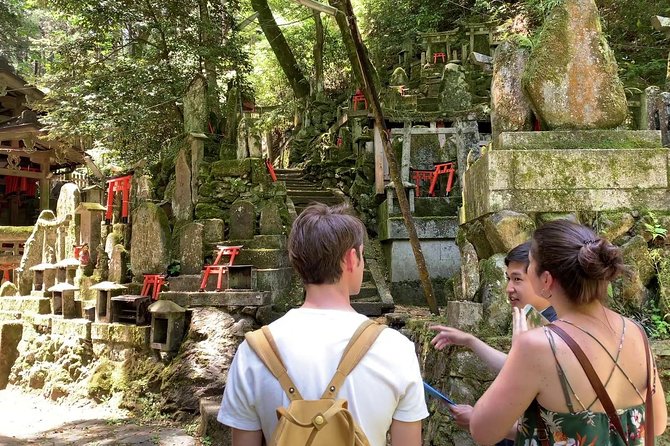
Your guide may explain the fox figures associated with Inari worship, the meaning of shrine customs, and inscriptions on the gates. Naru has been praised for reading inscriptions and explaining the symbolism, while other guides, including Hina, Yukari, Shin, and Skito, have been noted for answering questions and adding historical context.
The famous gates do become busier as you descend toward the main shrine. That is important to understand. This tour does not promise an empty Fushimi Inari from start to finish. Its value is that you spend much of the walk, especially the upper section, away from the main flow and reach the crowded areas after enjoying the quieter mountain.
You finish in front of the main shrine at Fushimi Inari Taisha, where the tour ends. That makes the outing easy to combine with your own time at the shrine, nearby food, or onward transport. One guide even helped a couple find the subway after the walk, though post-tour assistance will depend on the guide and the day.
The castle view from Mount Inari
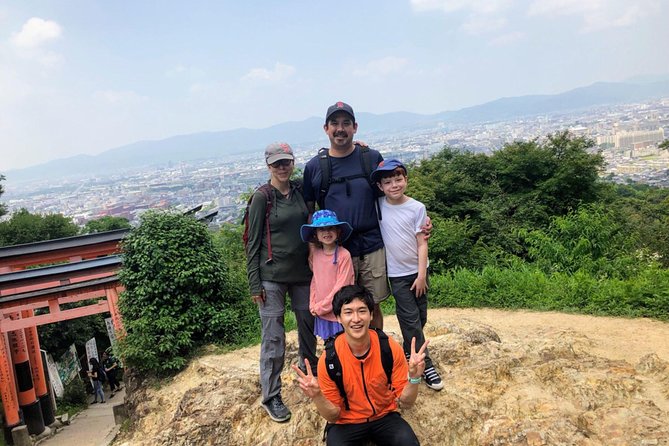
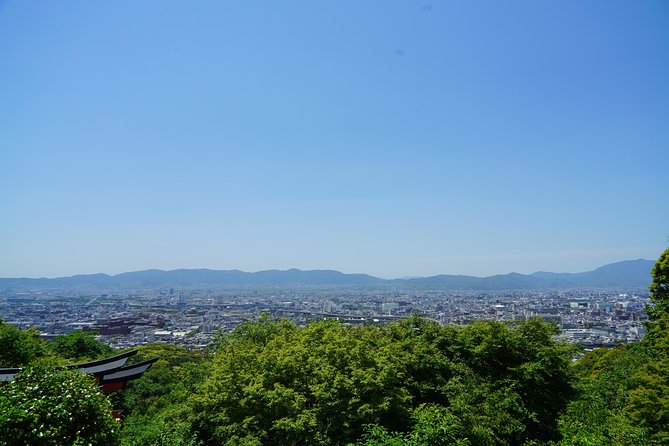
After the forest and shrine sections, the route includes a viewpoint toward Fushimi-Momoyama Castle. From the mountain, you get a broader view across the area rather than another close-up of torii gates.
The castle adds useful historical context. It was associated with Hideyoshi and later rebuilt by Ieyasu, and the area became known for peach trees after the castle was reconstructed. You do not visit the castle itself on this tour, so treat this as a scenic and historical viewpoint, not a castle tour.
This stop also gives the walk some variety. You have forest, bamboo, shrine architecture, gates, and a distant view, all within a short outing. The scenery may be especially appealing in clear weather, while rain or heavy summer haze can reduce the view.
More Private Temple Tours in Kyoto
- Kyoto to Arashiyama Day Trip – Private & Personalized
★ 4.2 · 22 reviews - Kyoto: Nara, Todaiji, Kasuga Taisha Shrine Private Full Day
★ 4.9 · 18 reviews - Kyoto: Half-Day Private Tour Gion Geisha District & Kiyomizu
★ 4.4 · 7 reviews - Kyoto: Private Walking Tour with Kiyomizu Temple & Gion
★ 5.0 · 7 reviews
How hard is the 7-kilometer hike?
The tour lasts about three hours and covers roughly 7 kilometers. That works out to a steady outing with regular stops, but the number alone does not tell the whole story.
The challenge comes from the surface and elevation. You may walk on narrow mountain paths, climb uphill sections, negotiate stairs, and descend over slippery ground. The tour provider describes the activity as moderate and says it is not extremely difficult, but also warns that it is not a simple walk.
I would prepare as if this were an active half-day. Wear shoes with good grip, not smooth-soled sneakers or casual sandals. Bring water, especially in summer, when Kyoto can be hot and humid. A hat helps in the heat, and long sleeves and long pants are useful protection from mosquitoes and other insects.
Rain does not automatically ruin the experience, but it can make the trail less comfortable and less secure. Several people have completed the walk in rain and still enjoyed it, yet wet steps and forest ground demand more care. The activity requires good weather, and if the operator cancels for poor conditions, you can choose another date or receive a full refund.
The guide makes regular stops and can add more if needed. Some guides have adjusted the pace for the group, offered options based on energy levels, and brought extra water on hot days. That flexibility matters, but it does not turn a mountain trail into a flat walk.
Small-group attention and guide quality
The maximum group size is seven. That is small enough for a more relaxed exchange, especially on a narrow path where a large group would feel cumbersome.
The guide is a certified MagicalTrip guide, and the individual style can vary. Naru has been praised for shrine explanations and family photos. Yuko is known for energy on the more technical sections and for carrying mosquito repellent. Matt has helped with pacing, hydration, and practical questions. Hina, Josh, Yukari, Shin, Skito, Emi, Usuke, Duncan, and Woohee have also led outings described as friendly, informative, or attentive.
The point is not to expect a particular guide every time. The useful pattern is that the guide does more than lead the way. You can ask about the shrine, Japanese customs, the gates, local history, or the route itself. Guides have also taken photos during the walk, which is handy when you want a record of the bamboo forest or the torii gates without constantly stopping to manage your phone.
A small group can also make the hike feel social. You may meet other people from different countries, but the group remains compact enough that conversation is possible. Private options are available if you want your own pace and more direct time with the guide.
Is the $63.14 price good value?
At $63.14 per person, this is not the cheapest way to visit Fushimi Inari. The shrine itself does not charge an admission fee, so you are paying for route-finding, guiding, cultural explanation, photos, and the chance to see the site in a less crowded way.
I think the value is strongest if you are short on Kyoto time, dislike busy sightseeing routes, or would not feel comfortable finding a forest trail alone. The guide removes the guesswork and gives structure to a place that can otherwise become a long walk through repeated gates.
The price is less compelling if you only want the main torii corridor and do not care about hiking, bamboo, smaller shrines, or the castle view. You can visit Fushimi Inari independently, and the most famous entrance is free. You are paying for access to a different experience, not for entry to the shrine.
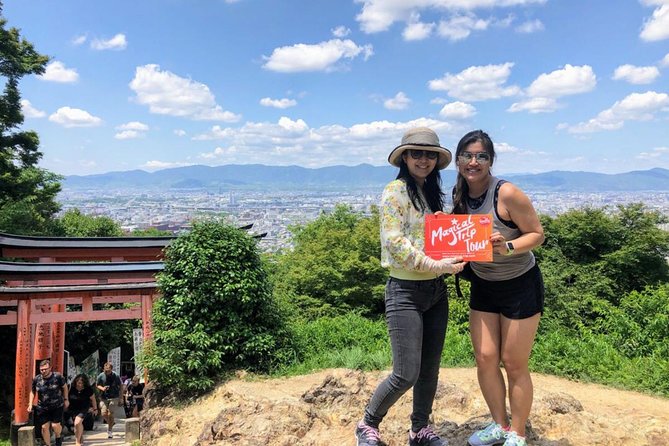
The included tour photos add a small practical benefit. Food and drinks are not included, so eat beforehand or plan a stop after the tour. Because the outing lasts three hours and uses real effort, I would not arrive without water or expect to rely on buying refreshments along the forest route.
Who should book this Kyoto hike?
This tour suits you if you want a calmer, more active way to see Fushimi Inari. It is particularly good for people who enjoy woodland walking, small shrines, local explanations, and scenic routes that are not obvious from the main entrance.
Families with older children or adult children can enjoy it, provided everyone is comfortable with a moderate hike. Couples and solo visitors also benefit from the small group, especially if you want photos or prefer not to manage navigation.
I would skip it if you have walking difficulties, are not in regular physical condition, dislike stairs, or want a flat cultural tour. Hot weather can make the route much harder, and people sensitive to mosquitoes should bring repellent and wear covering clothing.
Book early if the small group matters to you. The experience can take up to seven people, and the private option may be worth considering for a family or group with different walking speeds.
Practical details that affect your day
The meeting point is FamilyMart Nakai Tofukuji at 12-chōme-232 Honmachi in Kyoto’s Higashiyama Ward. The tour ends in front of the main shrine at Fushimi Inari Taisha, at 68 Fukakusa Yabunouchicho in Fushimi Ward.
The meeting and ending points are different, which is useful because you finish at the sight you came to see. Check the route to the starting point before leaving your hotel, and allow enough time to arrive without rushing into the hike.
Mobile tickets are accepted, and confirmation is provided when you book. Free cancellation is available up to 24 hours before the start time. Changes or cancellations made inside that window are not refunded, and the cut-off follows local Kyoto time.
Should you book the Fushimi Inari Hidden Hiking Tour?
Book it if you want to see Fushimi Inari through its forested upper paths instead of simply joining the crowd at the main gate. The bamboo, small shrine, quiet trail, rear approach to the torii gates, and view toward Fushimi-Momoyama Castle give the famous site more depth.
Skip it if your ideal Kyoto morning is a short, easy shrine visit. The route asks for proper shoes, water, and moderate fitness, and summer heat or rain can change the experience quickly.
For an active visitor who wants a guide, local context, and a quieter route, the $63.14 cost is fair. Just treat it as a mountain hike with a shrine at the finish, not as a casual walking tour.
FAQ
How long does the Fushimi Inari Hidden Hiking Tour last?
The tour lasts approximately three hours.
How far do you walk?
The hike is approximately 7 kilometers in total.
Is this tour difficult?
It is described as a moderate hike rather than a simple walk. You should expect uphill sections, stairs, narrow mountain paths, and potentially slippery ground.
What should I wear?
Wear shoes with good grip. Long sleeves and long pants are recommended because there may be mosquitoes and other insects. In summer, bring water and wear a hat.
Where does the tour begin and end?
It begins at FamilyMart Nakai Tofukuji in Kyoto’s Higashiyama Ward. It ends in front of the main shrine at Fushimi Inari Taisha.
How large is the group?
The tour has a maximum of seven people. A private option is also available.
What happens if bad weather cancels the tour?
If the activity is canceled because of poor weather, you can choose a different date or receive a full refund.
More Hikes and Treks in Kyoto
- Kyoto: 3-Hour Fushimi Inari Shrine Hidden Hiking Tour
★ 4.9 · 270 reviews - From Barcelona: Montserrat Monastery, Easy Hike, Cable Car
★ 4.9 · 1,021 reviews - From Barcelona: Montserrat Monastery & Scenic Mountain Hike
★ 4.9 · 978 reviews - Chiang Mai – Doi Suthep Temple & Wat Pha Lat Hike
★ 4.6 · 740 reviews
More Fushimi Inari Shrine Tours in Kyoto
- Kyoto: Tea Ceremony in a Traditional Tea House in Kiyomizu
★ 4.9 · 3,519 reviews - Osaka/Kyoto:Kinkakuji,Arashiyama,FushimiInariShrine,NaraPark
★ 4.1 · 1,596 reviews - Kyoto/Osaka: Nara, Fushimi Inari Taisha, Arashiyama Bus Tour
★ 4.7 · 1,275 reviews - Osaka/Kyoto: Arashiyama, Nara & Fushimi Inari Shrine w/Lunch
★ 4.4 · 754 reviews
Just added around Kyoto
- Osaka/Kyoto: Katsuoji, Kinkakuji, Arashiyama 1-Day Bus Tour★ 4.6 · 33 reviews
- Kyoto:Kiyomizu-dera Temple Rent a kimono and ride a rickshaw★ 4.8 · 7 reviews
- Kyoto: Wagashi (Japanese sweets) Cooking near Fushimiinari★ 5.0 · 40 reviews
- Kyoto: Kimono/Yukata Rental 5 Minute from Kiyomizu-dera★ 4.7 · 89 reviews
- KYOTO: Tempio Kiyomizu Pagode Gion “Geisya” (Guida Italiana)★ 4.7 · 17 reviews
- Kyoto Fushimiinari:Wagashi Making & Small Group Tea Ceremony★ 5.0 · 14 reviews
- Kyoto: Samurai Sword & Kimono Action Filming Experience★ 4.8 · 78 reviews
- Best of Kyoto: Red Gates of Fushimi Inari & Kiyomizu Temple★ 4.8 · 36 reviews
Fushimi Inari Shrine Tours, compared.
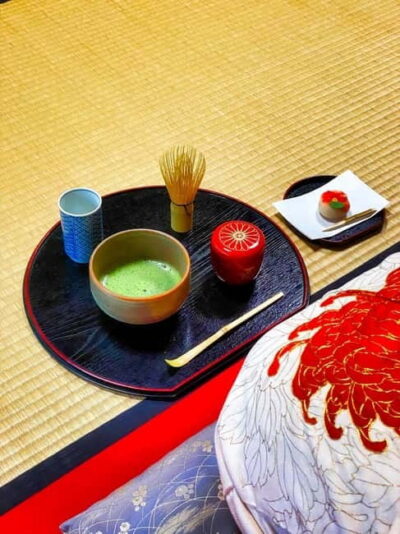
Tea Ceremony in a Traditional Tea House in Kiyomizu
Read our review →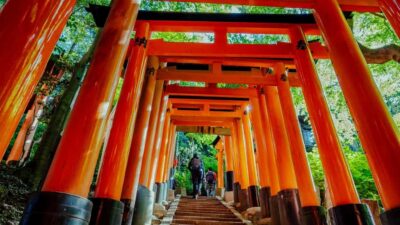
Osaka/Kyoto:Kinkakuji,Arashiyama,FushimiInariShrine,NaraPark
Read our review →
Kyoto/Osaka: Nara, Fushimi Inari Taisha, Arashiyama Bus Tour
Read our review →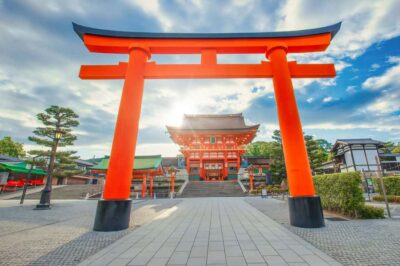
Osaka/Kyoto: Arashiyama, Nara & Fushimi Inari Shrine w/Lunch
Read our review →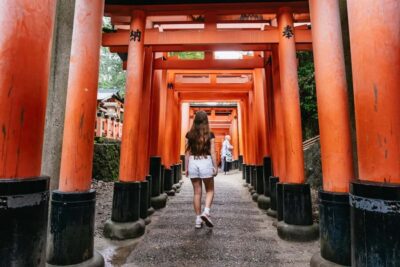
Nijo Castle, Kiyomizu & Fushimi Inari Guided Tour
Read our review →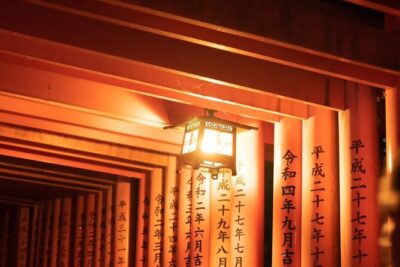
Kyoto/Osaka: Kinkakuji, Bamboo Forest, and Nara Deer Park
Read our review →Browse the lists this tour appears in