
REVIEW · KYOTO TEMPLE TOURS
Kyoto: Calligraphy class at Buddhist temple in city center
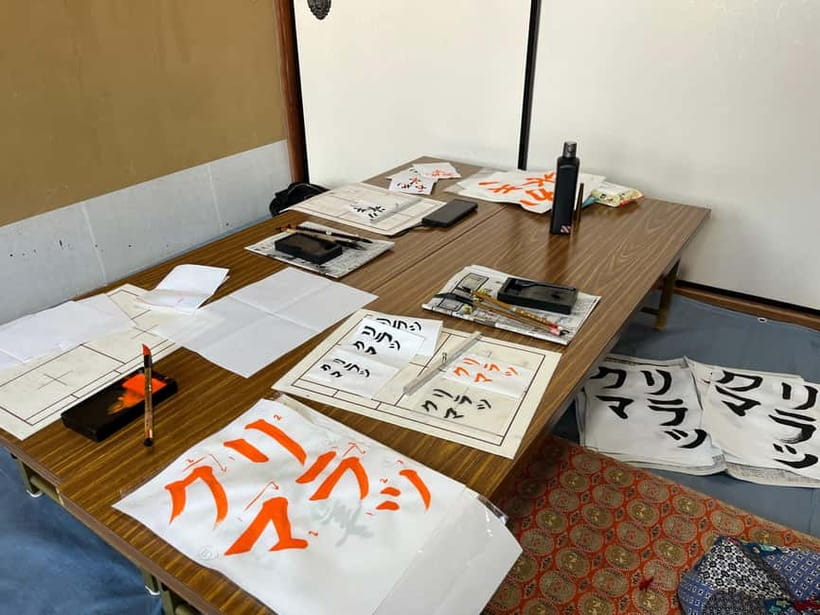
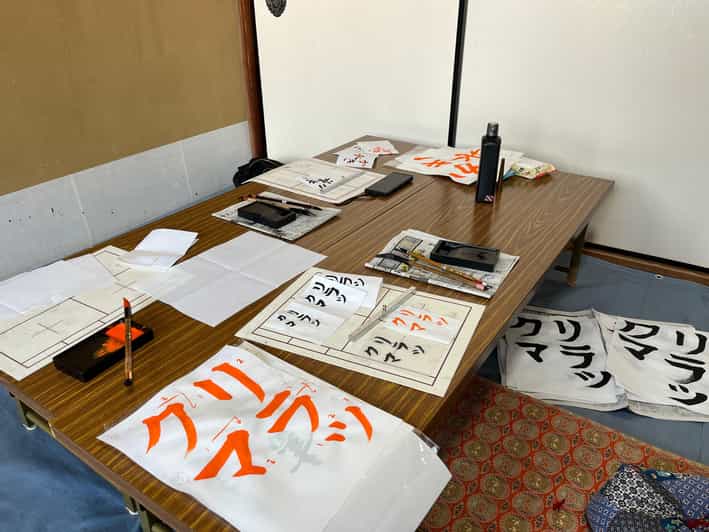
A brush, a pool of black ink, and a quiet room on tatami give this Kyoto activity more weight than a standard souvenir stop. You learn basic Japanese calligraphy inside Seigan-ji Temple, choose a word or kanji, and finish with your own piece on a square shikishi board. The setting, with a Great Buddha nearby, adds a real sense of place.
I like the small group size, which allows the teacher and translator to correct your strokes instead of leaving you to copy a demonstration from across the room. I also like the personal souvenir: your finished artwork comes home with you, along with a character key-chain made by the teacher.
The main caution is practical rather than cultural. Most people sit on the floor with a zabuton, and desks are limited, so anyone with stiff knees or trouble getting down and up should plan carefully. Calligraphy also looks easier than it is. Your first few strokes may be charmingly uneven.
Key points at a glance
- A real temple setting: Practice in a Japanese-style room at Seigan-ji Temple, in the covered Shinkyogoku shopping street.
- A finished keepsake: Write your chosen word or kanji on a shikishi board and take it home.
- Guided from the first stroke: Learn how to handle the brush, ink, and supporting tools before writing your final piece.
- Limited to six people: The small format allows for individual tips and encouragement.
- Several language options: Instruction and translation are available in English, Spanish, Japanese, and Dutch.
- A thoughtful extra: The teacher makes a small key-chain featuring your chosen character.
A calm art lesson in the middle of Kyoto
This is a good way to slow down without leaving central Kyoto. Shinkyogoku is a shopping street, but the workshop takes you into a traditional temple room with tatami flooring and Japanese sliding doors. The contrast is part of the appeal: shops and city movement are close by, while the class itself tends to be quiet as everyone concentrates.
The activity lasts about 70 minutes. That is long enough to learn the basic method and produce a final piece, but not so long that the lesson takes over your day. I would place it between sightseeing stops near the central shopping streets, rather than treat it as a full-day cultural program.
The class is not a silent meditation session. You will receive explanations, ask questions, and work alongside other people. Still, the room usually settles into a peaceful rhythm once the brushes come out. That makes it a useful break after a busy morning in Kyoto.
More Workshops in Kyoto:
- Kyoto Home Cooking Class &Supermarket tour near Fushimiinari
★ 5.0 · 31 reviews - Bali: Silver Jewelry Making Class in Kuta or Uluwatu
★ 4.9 · 380 reviews - Bali: Uluwatu Silver Jewelry Making Workshop with Creation
★ 4.9 · 260 reviews
Finding Seigan-ji Temple without confusion
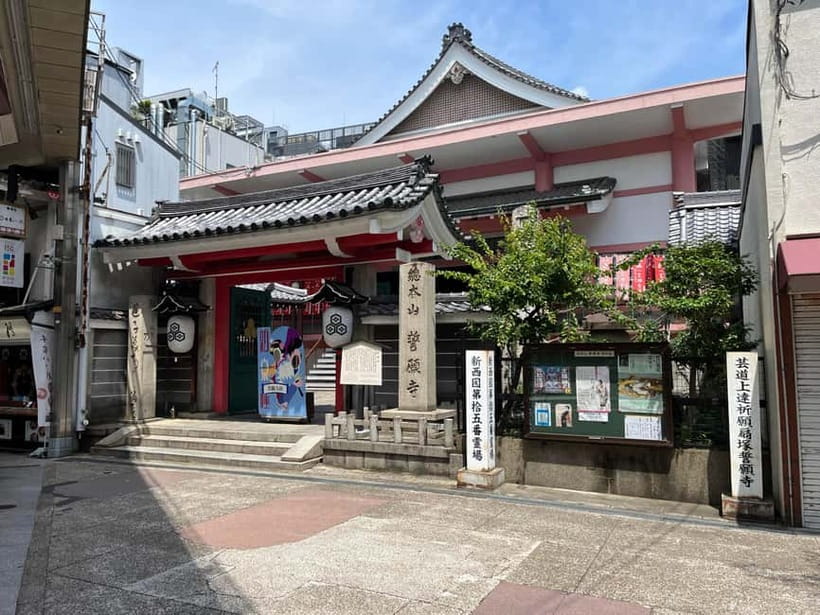
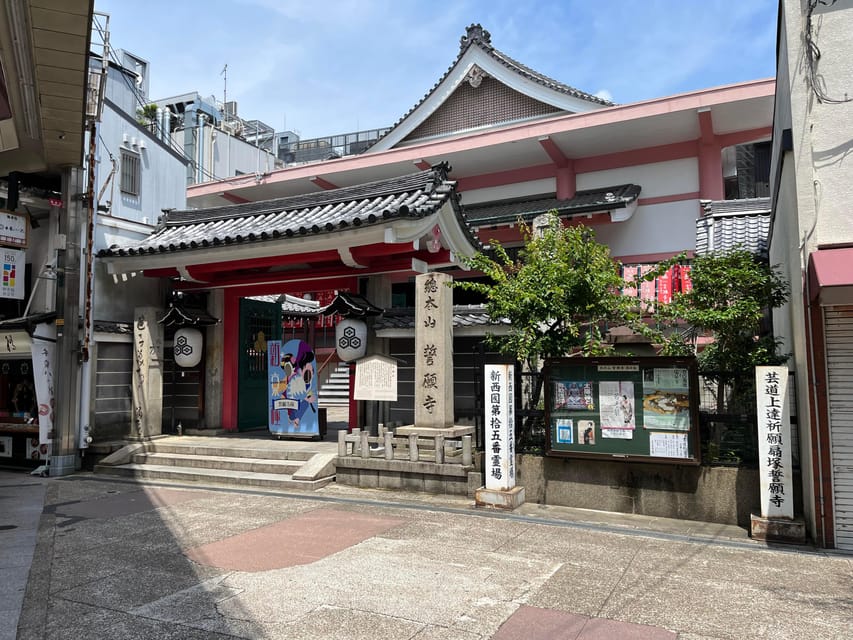
The meeting point is in front of Seigan-ji Temple, under the roofed section of Shinkyogoku shopping street. Look for the person holding a red lantern on a stick.
This detail matters. Do not climb the temple stairs looking for the class, and do not ask the monks or other temple staff whether you are in the right place. Wait at the front for the person with the lantern. The voucher contains the essential meeting instructions, so read it after booking rather than relying on a quick glance at the confirmation email.
The central location is convenient, but the shopping street can make the meeting point easy to miss. Give yourself enough time to find the temple entrance. If you have a question about the location, use the provider’s email or listed phone number rather than interrupting temple workers.
Meeting the teacher and translator
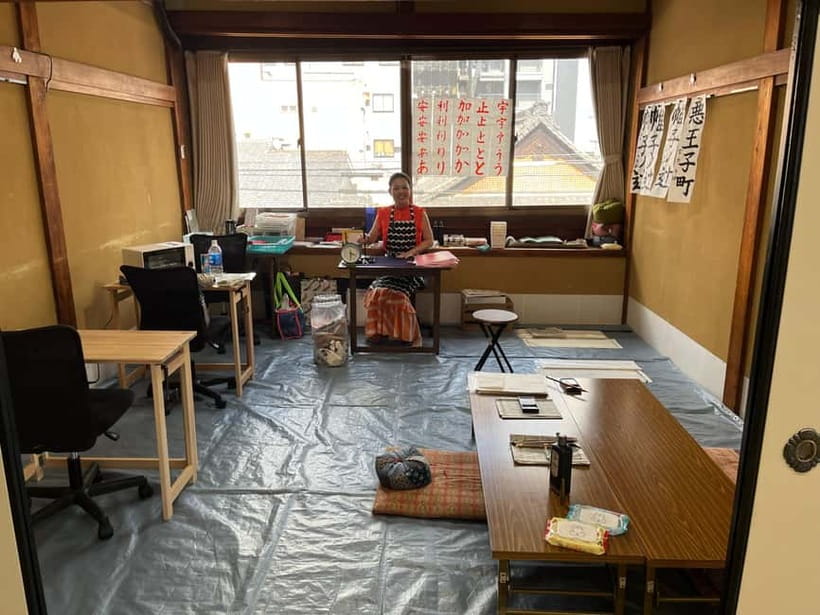
The class begins with introductions to the Japanese calligraphy teacher and the translator or guide. The teacher has more than a decade of calligraphy experience, with one review identifying Imai Sensei as having practiced for 15 years. The translator explains the lesson and helps connect the teacher’s demonstrations with your questions.
Jose has served as both guide and translator on some sessions, and Saskia has also been mentioned as part of the welcoming team. Their roles go beyond translating individual words. They help explain what you are doing, offer practical pointers, and often take photographs during the practice and final work. Language availability includes English, Spanish, Japanese, and Dutch, though you should select the language you need when booking.
The Japanese teacher may not speak English, so the translator is an important part of the lesson. The arrangement works well for a hands-on class because you can watch the teacher’s brush movement while the translator explains the reason for each step.
The tools and the first brush strokes
You will use traditional materials including washi paper, a brush, ink, bunchedi, and shitakami. The unfamiliar names may sound intimidating, but the lesson starts with a plain explanation of what each item does and how to place or hold it.
First, you choose the word or kanji you want to write. Examples are available, but I strongly suggest arriving with two or three ideas. Picking a character in advance gives you something personal to work toward and saves valuable class time. You might choose a word connected to family, travel, nature, strength, peace, or your own name, provided the teacher can accommodate it.
Next comes brush handling and basic lines. You practice the strokes that form kanji before attempting the full character. This is the most useful part for beginners because it shows why calligraphy is not simply handwriting with a larger brush. Pressure, angle, speed, and the way you finish each line all change the result.
The teacher demonstrates the movements, then watches your attempts. You may receive individual corrections about how to hold the brush or how much ink to use. The instruction builds gradually, so you do not need previous art experience.
A few more temple visits around Kyoto worth a look
- Kyoto: Tea Ceremony Ju-An at Jotokuji Temple
★ 4.9 · 3,207 reviews - Kyoto/Osaka: Nara, Fushimi Inari Taisha, Arashiyama Bus Tour
★ 4.7 · 1,275 reviews - Arashiyama Bamboo, Temple, Monkeys, or Secret Sake Brewery
★ 4.8 · 886 reviews - Kyoto: Arashiyama Bamboo Forest, Monkeys, Matcha & Temple Tour
★ 5.0 · 759 reviews
Why the final kanji takes patience
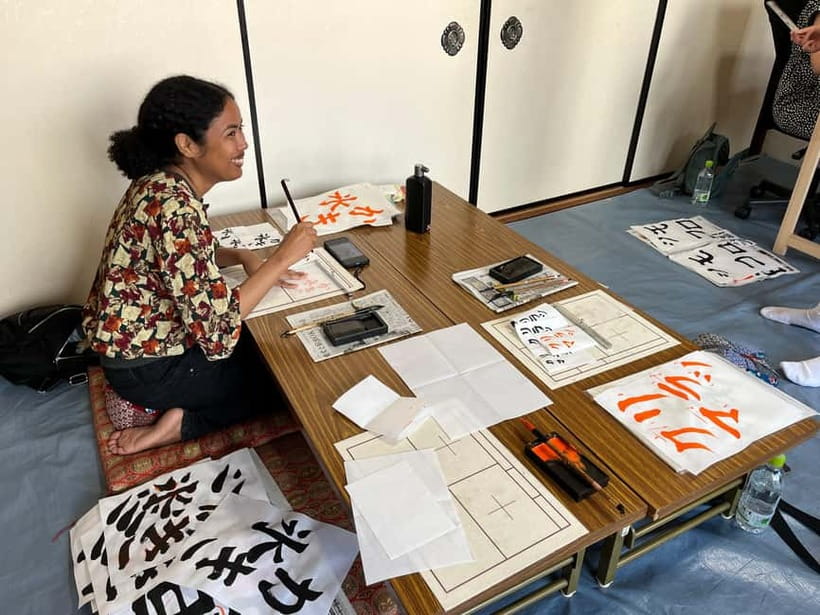
The final character often looks simple on the page. Producing it well is another matter. Calligraphy depends on controlled movement, and the brush does not behave like a pencil. A line can become too thick, too thin, too wet, too dry, too fast, or too hesitant.
That difficulty is part of the value. You are not merely watching a master create a perfect character. You are learning enough of the process to make your own attempt, and the teacher encourages you to improve without expecting professional results.
There is one useful warning: practice, but do not exhaust your arm. The session includes repeated attempts, yet too much writing can make your hand and shoulder tired. A tired arm is less likely to produce your best final work. Treat the practice as preparation, not a test of endurance.
Left-handed participants may find some movements harder because traditional brush technique often favors the right hand. One participant found it useful to try both hands. If you are left-handed, tell the teacher or translator early so they can offer practical help.
Creating your shikishi souvenir
After practicing the basic strokes and your chosen character, you move to the final artwork. You write the kanji on a shikishi, a special square cardboard board commonly used for calligraphy and autographs. It gives your work a finished, displayable format rather than leaving it on ordinary practice paper.
This is where the lesson becomes personal. Everyone begins with the same basic tools, but the final pieces will differ in brush pressure, spacing, and style. Your board may not look exactly like the teacher’s example, and that is fine. The point is to take home something you made under guidance.
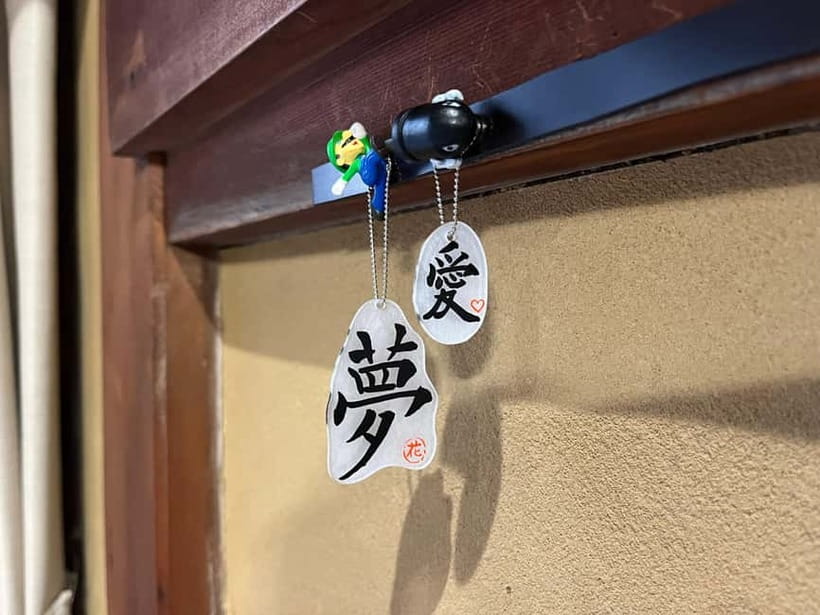
The provider also gives you a key-chain featuring your chosen character, made by the teacher. It is a small extra, but a useful one. The shikishi board is the more substantial souvenir, while the key-chain gives you a compact reminder of the class.
Photography is also part of the experience in some sessions. Guides such as Jose have taken pictures during the lesson and at the end, which can be helpful when your hands are occupied with ink and paper. I would still focus first on the process. The photos matter more after you have finished your piece.
The temple setting adds more than decoration
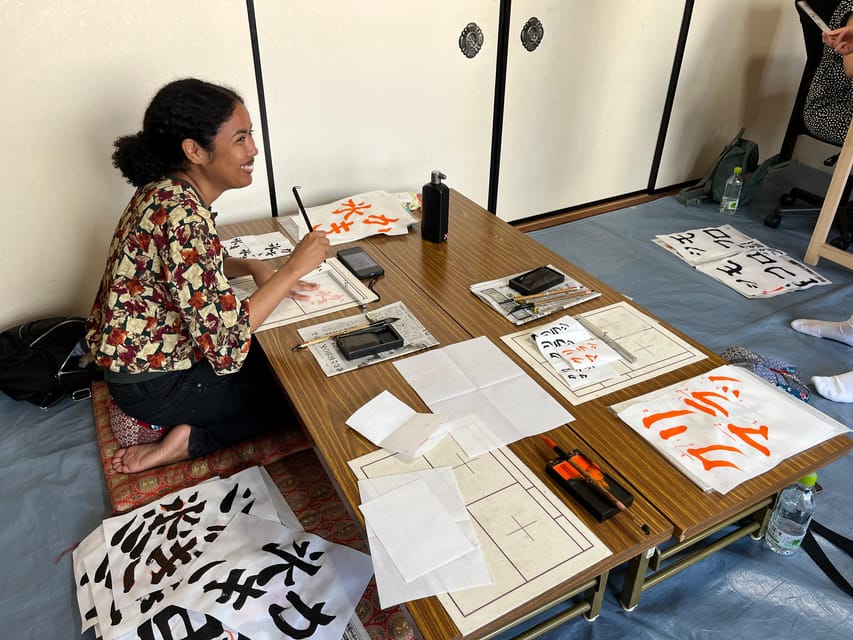
You could learn basic calligraphy in many places, but the temple setting changes the mood. The room has tatami flooring, and you may see traditional Japanese architectural features such as sliding doors. You are brought into a private or less commonly accessible part of the temple rather than simply standing outside for a photograph.
The class also gives you a small window into why calligraphy matters in Japan. Shodo is not only a decorative craft. Calligraphy is part of school education, and practice can teach the structure and origin of kanji, the use of traditional tools, and ways to express an idea through form.
The workshop does not attempt to teach the entire history of Japanese writing in 70 minutes. Instead, it gives you direct contact with the materials and discipline behind the art. That hands-on approach is more memorable than a short explanation followed by a demonstration.
Be respectful of the setting. Smoking, vaping, alcohol, and drugs are not allowed, and you must not arrive barefoot. Food and drinks are not served. Vending machines are available outside the temple if you need water, but it is best to drink before entering the room.
Floor seating and accessibility
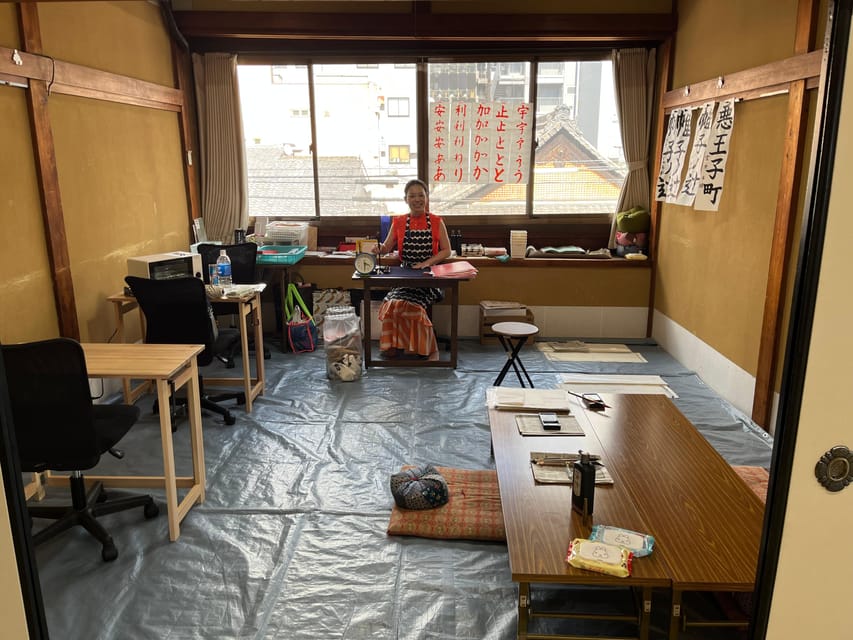
Most seating is on the floor with a zabuton, a Japanese cushion. A few desks are available, but they are limited. Sitting on the floor can put pressure on your knees, hips, and ankles, especially if you are not used to it.
The activity is listed as wheelchair accessible, but the seating information deserves attention. If you use a wheelchair or need a desk rather than floor seating, contact the provider before booking so the available arrangement is clear for your session. The data also lists visual impairment as a reason the activity may not be suitable.
The age restrictions are unusually repetitive, listing children under one, two, three, four, and five years old as unsuitable. In practical terms, this is not an activity for babies or very young children. Older children who can sit quietly, follow instructions, and handle ink carefully may fit better, but the supplied information does not give a specific minimum age beyond those restrictions.
Is $55 a fair price?
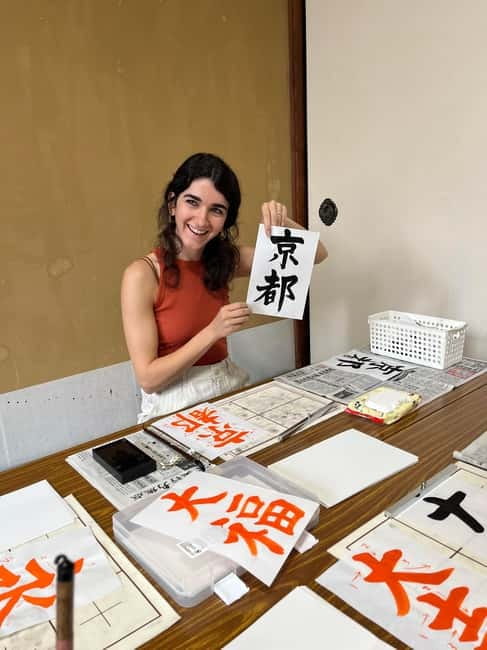
At $55 per person, this is not the cheapest souvenir activity in Kyoto. You are paying for more than paper and ink, though. The price includes the teacher’s instruction, translation, use of the materials, practice time, a finished shikishi board, and the character key-chain.
The small group limit is important to the value. With no more than six participants, the teacher and translator can look at your work and offer individual guidance. A large class would make the lesson cheaper to run, but it would also make it harder to correct your brush technique.
I consider the price fair for someone who wants an activity rather than another purchased object. You spend 70 minutes learning a traditional art, then take home a personal piece that cannot be duplicated exactly. If you only want a professionally made calligraphy souvenir, buying one may cost less and look better. If you want to understand how the marks are made, this workshop earns its price.
Who will enjoy this Kyoto class most
I would recommend it to couples, solo visitors, families with older children, and anyone looking for a quieter cultural activity near central Kyoto. It suits people who like making things with their hands and do not mind a little trial and error.
You do not need to be artistic. The instruction starts with basic lines, and the teacher guides you through the selected character. Still, you should be open to making imperfect marks. The class is more rewarding when you treat the process as the point, rather than expecting a flawless piece on the first attempt.
It is also a good fit if you want a souvenir with a story. Your board will remind you of the word you chose, the temple room, and the effort behind each stroke. That gives it more meaning than a standard shop purchase.
I would think twice if you have difficulty sitting on the floor, need a fully quiet setting, or want a long historical lecture. The workshop is calm but not silent, practical rather than academic, and short enough to fit into a packed Kyoto schedule.
Booking details worth knowing
The experience is offered in English, Spanish, Japanese, and Dutch. It is a small-group activity limited to six people, with a 70-minute duration. You can cancel up to 24 hours ahead for a full refund, and the reserve-now, pay-later option keeps your plans flexible.
Read the voucher carefully after booking, especially the meeting point. Bring a few ideas for your word or kanji, and wear something that allows comfortable floor sitting. Bare feet are not allowed, so make sure your footwear is appropriate for entering the temple room.
The activity does not include food or drinks. Buy water beforehand or use the vending machines outside the temple.
Should you book it?
Book this class if you want to make something yourself and experience Japanese culture from inside a traditional temple room. The strongest reasons are the patient step-by-step teaching, the small group, and the final shikishi board you can display at home.
Skip it if you want a polished professional artwork without practice, or if floor seating would be painful. For most people who can manage the tatami room and approach the brush with patience, $55 buys a personal Kyoto memory rather than just another hour on the sightseeing circuit.
FAQ
How long does the calligraphy class last?
The experience lasts about 70 minutes, including introductions, tool instruction, practice, and creation of your final artwork.
Where does the activity meet?
Meet in front of Seigan-ji Temple in the Shinkyogoku shopping street. Look under the covered street for the person holding a red lantern on a stick.
Should I enter the temple or ask the monks for help?
No. Do not go up the stairs into the temple to look for the class, and do not ask or disturb the monks or other temple workers. Wait at the front for the person holding the red lantern.
What languages are available?
The activity is available in English, Spanish, Japanese, and Dutch.
What will I make during the class?
You will practice basic calligraphy lines and your chosen word or kanji, then write the final character on a shikishi board. You can take the finished artwork home.
Do I receive anything besides the artwork?
Yes. You will receive a key-chain featuring your chosen character, made by the teacher.
Do I need to bring a word or kanji?
You should think of a word or kanji before the class. Examples are available, but arriving with a few ideas is recommended.
Is the class suitable for wheelchair users or people who cannot sit on the floor?
The activity is listed as wheelchair accessible, but most seating is on the floor with a zabuton and desks are limited. Contact the provider before booking if you need a desk or a particular seating arrangement.
Just added around Kyoto
- Osaka/Kyoto: Katsuoji, Kinkakuji, Arashiyama 1-Day Bus Tour★ 4.6 · 33 reviews
- Kyoto:Kiyomizu-dera Temple Rent a kimono and ride a rickshaw★ 4.8 · 7 reviews
- Kyoto: Kimono/Yukata Rental 5 Minute from Kiyomizu-dera★ 4.7 · 89 reviews
- Kyoto: Wagashi (Japanese sweets) Cooking near Fushimiinari★ 5.0 · 40 reviews
- Kyoto Fushimiinari:Wagashi Making & Small Group Tea Ceremony★ 5.0 · 14 reviews
- Kyoto: Samurai Sword & Kimono Action Filming Experience★ 4.8 · 78 reviews
- KYOTO: Tempio Kiyomizu Pagode Gion “Geisya” (Guida Italiana)★ 4.7 · 17 reviews
- Best of Kyoto: Red Gates of Fushimi Inari & Kiyomizu Temple★ 4.8 · 36 reviews
Kyoto Temple Tours, compared.
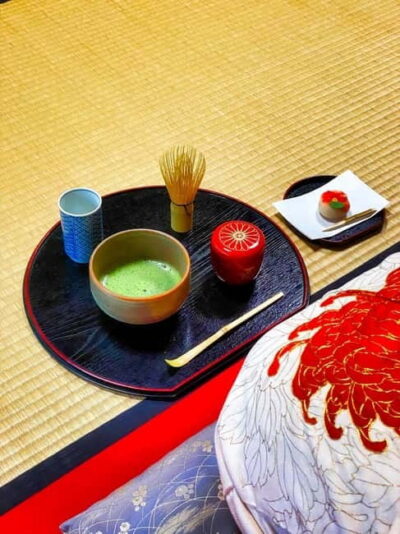
Tea Ceremony in a Traditional Tea House in Kiyomizu
Read our review →
Fushimi Inari Hidden Hiking Tour (Private Option Available)
Read our review →
Osaka/Kyoto:Kinkakuji,Arashiyama,FushimiInariShrine,NaraPark
Read our review →
Kyoto/Osaka: Nara, Fushimi Inari Taisha, Arashiyama Bus Tour
Read our review →
Kyoto Arashiyama Walking Tour: Bamboo, Monkeys, Gardens & Secrets
Read our review →
Arashiyama Bamboo, Temple, Monkeys, or Secret Sake Brewery
Read our review →
Arashiyama Bamboo Forest, Monkeys, Matcha & Temple Tour
Read our review →Browse the lists this tour appears in