
REVIEW · SIGIRIYA & DAMBULLA TEMPLE TOURS
Private City Day Tour in Anuradhapura
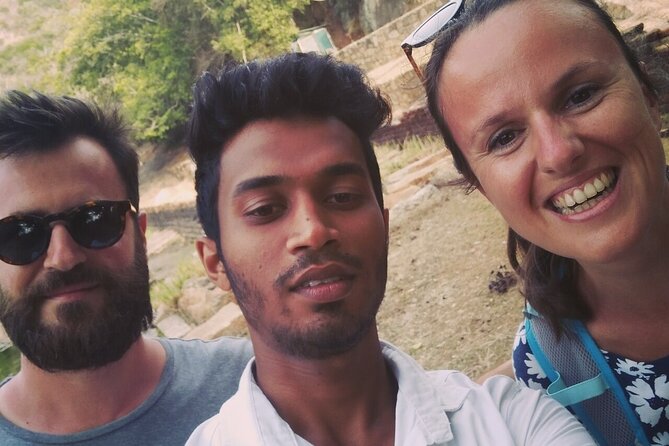
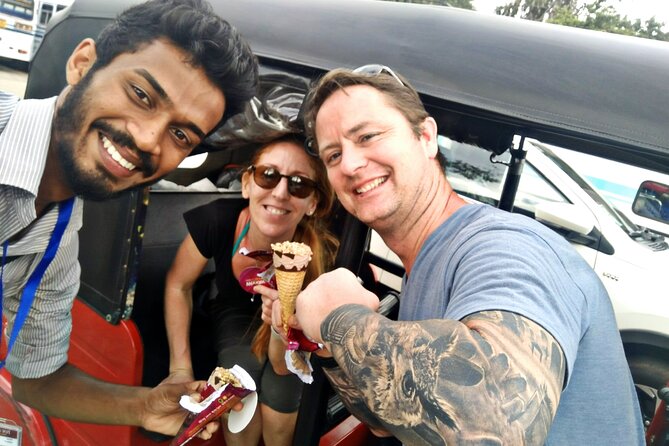
Anuradhapura is too spread out for a casual walk between its major monuments. This private tour links 12 important sites in four to five hours, with guide Navin explaining the Buddhist meaning, royal history, and local customs behind what you see. The route moves by private transport, with tuk-tuk travel featured in the tour experience.
I like the way the tour combines the famous stupas with smaller details such as the Moonstone, guardstones, and ancient bathing pools. I also like having Navin on hand for questions about Buddhism and Sri Lankan culture, rather than simply being driven from one monument to the next.
The main consideration is pace. Twelve stops in half a day means you will see many places, but you may not have long at each one. The $30 price is attractive, though the Old Town entrance fee adds another $30 per person, payable locally.
Key points to know before booking
- Twelve major stops in one private route: You visit Anuradhapura’s best-known stupas, temples, pools, statues, and architectural details.
- Navin is the named guide: His role goes beyond transport, with explanations about Buddhism, Sri Lankan culture, and the history of the ancient city.
- Private transport makes the spread-out site manageable: The route is suited to a tuk-tuk-style sightseeing day, with hotel pickup offered.
- Budget for the entrance fee: The tour costs $30 per person, but the Old Town admission fee is an additional $30 per person.
- Plan for temple etiquette: Shoes are not permitted at temple areas, and the paving can become very hot, so thick socks are a smart addition.
- Four to five hours is efficient, not leisurely: You cover a great deal of ground, but the schedule favors breadth over long, quiet visits.
Why a private tour helps in Anuradhapura
Anuradhapura is not a single compact ruin with one clear walking route. Its sacred area covers a wide district, and the important monuments are separated by roads, trees, open ground, and temple compounds. You can visit on your own, but arranging transport between 12 sites and understanding what you are looking at takes time.
This tour solves that problem with private transportation and a personal guide. You do not have to wait for a group or follow a fixed public bus route. You can ask questions as you go, and the private format makes it easier to adjust the pace within the time available.
The strongest part of the experience is the combination of movement and explanation. A stupa can look like a huge white or brick dome from the outside, but its religious purpose, construction, and place in Sri Lankan history are not always obvious. Navin’s role is to connect the monument to Buddhism, royal patronage, and everyday culture.
The tour is also a good fit if you have only one afternoon or morning in Anuradhapura. It gives you a useful first look at the ancient city without asking you to plan a complicated route yourself.
More Private Temple Tours in Sri Lanka
- Anuradhapura Private Ancient City Day Tour
★ 5.0 · 39 reviews - Anuradhapura: Full-Day Wilpattu All Inclusive Private Safari
★ 4.5 · 24 reviews - Private Day Trip to Sigiriya , Dambulla and Pidurangala Rock
★ 4.5 · 14 reviews
Jaya Sri Maha Bodhi, the spiritual heart of the route
The first stop is Jaya Sri Maha Bodhi, a sacred fig tree in the Mahamewna Gardens. It is treated as a living link to Gautama Buddha and is one of the most important religious places in Anuradhapura.
This is not simply a botanical sight. The tree is part of an active sacred setting, so you should expect a more devotional atmosphere than at a silent archaeological ruin. Navin can help explain the tree’s importance and the customs you see around it.
The scheduled visit is about 25 minutes. That is enough for an introduction and a respectful look, but you may want more time if this is the place you most want to experience slowly.
Lowamahapaya and the scale of the old monasteries
Lowamahapaya, also called the Brazen Palace, recalls the size and organization of ancient monastic life. The original structure was built under King Dutugamunu and is described as a nine-story complex with spaces including a refectory, assembly hall, and chapter house.
Today, the appeal is partly architectural and partly imaginative. You are looking at a site tied to a huge monastic institution, not just an isolated monument. The stop helps you picture Anuradhapura as a major religious and political center.
Allow about 25 minutes here. Since much of the original building is no longer intact, a guide adds real value by explaining what the complex once contained.
Ruwanwelisaya, one of Anuradhapura’s great stupas
Ruwanwelisaya is one of the city’s most recognizable Buddhist monuments. King Dutugamunu began it in the second century BC, and the stupa was completed by his younger brother.
This is one of the places where the scale can be hard to grasp until you approach it. The broad dome, white surface, and surrounding sacred setting make it a major visual stop, but its religious importance matters just as much as its appearance.
Give yourself time to take in the monument before rushing to photographs. As with the other temple sites, dress and behavior should be respectful, and you should be ready to remove your shoes where required.
More Sigiriya and Dambulla Temple Tours in Anuradhapura:
- Explore & Ride the history of anuradhapura with Vogel Tours
★ 5.0 · 62 reviews - Delve Into Ancient Anuradhapura with Optional Visit to Mihintale
★ 5.0 · 42 reviews - Anuradhapura Heritage Mountain bike / bicycle Tour
★ 5.0 · 34 reviews - Half day tour – in Sacred city of Anuradhapura Or sacred city of Mihintale.
★ 4.5 · 24 reviews
Abhayagiri Stupa and the ancient monastery complex
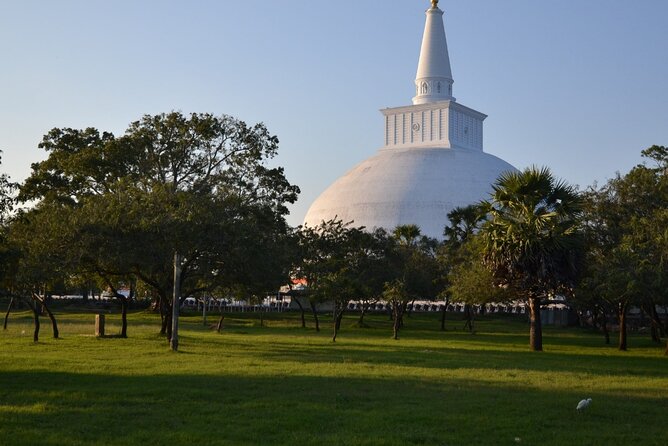
Abhayagiri Stupa was once 122 meters high, making it the tallest stupa in the world and the third tallest structure anywhere when it was built under King Mahasena.
That fact gives the stop a useful sense of scale. This was not a minor regional shrine. It belonged to a powerful monastic complex and represented the engineering skill and religious ambition of ancient Anuradhapura.
The current monument is a major brick structure, and the surrounding setting gives you a strong idea of how extensive the old city was. The 25-minute stop is enough for an overview, though the site rewards anyone who enjoys ancient construction and Buddhist architecture.
Kuttam Pokuna, the Twin Baths
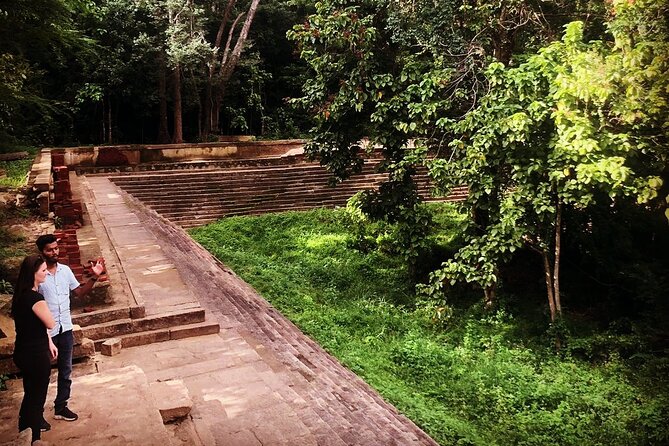
The Twin Baths are among the most graceful pieces of practical architecture on the route. These carefully built bathing pools served the ancient monastic community and are unusually well preserved.
Look closely at the stonework and the shape of the pools. This is a useful reminder that Anuradhapura was not made only of grand stupas. Water management, bathing, daily routines, and comfort were also part of monastic life.
The site is easier to appreciate with context. On your own, you might simply see two old pools. With Navin’s explanation, you can connect them to the organization of the Abhayagiri complex.
The calm face of the Samadhi Statue
The Samadhi Buddha is shown in a seated meditation posture associated with deep concentration. It is located in Mahamevnawa Park and is one of Anuradhapura’s best-known Buddha images.
This stop changes the rhythm of the tour. After several large monuments, the focus turns to a single figure and the expression, posture, and symbolism of the statue. It is a good place to slow down for a moment, even on a fairly full schedule.
Navin’s background in Buddhism is especially useful here. You can ask about the meditation position and how the image fits into Sri Lankan Buddhist practice.
Jethawanaramaya and the power of brick
Jethawanaramaya was built during King Mahasena’s reign and once rose more than 120 meters. It was among the tallest brick structures in the ancient world.
The monument shows how ambitious Anuradhapura’s builders were. A brick stupa on this scale required enormous resources, planning, and labor. It also gives you a useful comparison with Abhayagiri and Ruwanwelisaya, since each major stupa has its own story and visual character.
This is another stop where a guide prevents the visit from becoming a quick photograph and a departure. Ask Navin to compare the monuments, their builders, and their place in the old capital.
Moonstone and the details beneath your feet
The Sandakada pahana, or Moonstone, is a carved semicircular stone slab placed at the bottom of stairways and entrances. It is one of the most distinctive details in ancient Sri Lankan architecture.
The Moonstone rewards close attention. It is smaller than the great stupas, but its carved design carries symbolic and artistic meaning. You may find that it becomes one of the most memorable parts of the route because it asks you to look down rather than up.
This is also where practical footwear matters. Shoes are not permitted at temple areas, and the stone paving can become very hot. Bring thick socks, or even two pairs, especially if you are visiting during a bright part of the day.
Guardstones, Rathna Prasadaya, and carved protection
The Rathna Prasadaya area includes guardstones and other architectural elements that show how Anuradhapura’s builders gradually used stone instead of wood. Stone lasted longer and allowed more detailed work at entrances, stairways, and sacred buildings.
Guardstones were not just decoration. They helped mark and protect the approach to important spaces, while balustrades and Moonstones created a formal transition into the monument.
This is a stop for people who enjoy details. If you focus only on the biggest ruins, you could miss the craftsmanship around them. Navin’s explanations help turn these fragments into part of a larger architectural story.
Eth Pokuna, the Elephant Pond
Eth Pokuna is a massive ancient reservoir, measuring about 159 meters in length and 52 meters in width. Its size makes it one of the more surprising stops on the route.
The name refers to its scale, and the pond gives you another look at the practical side of the ancient kingdom. Religious centers needed water, sanitation, and organized daily life. A large reservoir such as this helps explain how a major monastic community functioned.
This is a good place to consider the difference between a monument and an ancient system. The stupas show belief and royal power. Eth Pokuna shows the infrastructure needed to support them.
Thuparamaya, one of Sri Lanka’s oldest stupas
Thuparamaya is considered the oldest stupa in Sri Lanka, dating to the third century BC. It was built by King Devanampiya Tissa and is associated with a sacred collarbone relic of the Buddha.
The structure is smaller in visual impact than some of the enormous stupas, but its age and religious importance make it essential. This is a place where chronology matters. The stop links Anuradhapura’s monuments to the early establishment of Buddhism in Sri Lanka.
Because the schedule includes many locations, listen for the distinctions between the stupas. Their sizes, dates, builders, and relic traditions are not interchangeable.
Isurumuniya Temple and its stone carvings
Isurumuniya Temple is a rock temple built in the third century BC. It was originally connected with Buddhist monks and is known for its carved stone work.
The rock setting gives this stop a different feel from the broad stupa compounds. Instead of focusing on one immense dome, you are looking at a temple shaped by stone, carvings, and religious use.
This is a fitting final stop because it brings together several themes from the day: early Buddhism, royal support, monastic life, and close attention to craftsmanship. It is also a good point to ask any final questions before returning to your hotel or meeting point.
What the $30 price really covers
The advertised cost is $30 per person. That includes private transportation, bottled water, and a professional licensed tourist guide. Hotel pickup is offered, and the activity returns to the starting meeting point.
The important extra cost is the Old Town entrance fee, listed as $30 per person and payable on-site by cash or card. That makes the practical total $60 per person before any personal spending.
For a private half-day route with transport and a dedicated guide, the base price is reasonable. The entrance fee, however, changes the budget calculation. Compare the full cost rather than judging the tour by the $30 headline price alone.
The private format matters most if you value questions, flexible attention, and avoiding the work of arranging transport. If you are already comfortable hiring local transport and researching each monument, you may prefer to explore independently. If you want the main sites explained in one organized outing, the cost is easier to justify.
Timing, heat, and temple etiquette
The activity lasts approximately four to five hours, with each listed stop allocated about 25 minutes. Since travel between sites also takes time, you should expect an efficient route rather than a slow archaeological study.
An early start is a smart idea. The morning is generally less warm and less busy, and this matters when you are walking over open ground or hot paving without shoes.
Wear clothing suitable for Buddhist religious sites. You should be prepared to remove shoes where required, and thick socks can protect your feet from heated stone. Bottled water is included, but keep drinking it throughout the outing.
The tour is private, so your group is the only group participating. That makes it easier to ask for clarification, keep children engaged, or adjust how much time you spend looking at a particular monument, though the full list of stops still creates a fairly tight schedule.
Who will enjoy this tour most
You should consider booking if this is your first visit to Anuradhapura and you want to see the main sights without planning a large, spread-out route. It also suits anyone interested in Buddhism, Sri Lankan culture, ancient engineering, and royal history.
Families may appreciate the private setting. Children can ask questions directly, and the movement between sites breaks up the day. The tour also works well for couples and small groups who prefer a friendly guide rather than a large coach.
It may be less suitable if you want to spend an hour at every monument, take an unhurried archaeological walk, or focus on photography. Twelve stops in four to five hours is a lot. You are buying a well-organized overview, not a full-day research visit to each site.
Navin’s approach, as reflected in the experience details, includes humor, clear explanations, practical help, and wide-ranging conversation. He has also been described as comfortable answering questions from children and discussing subjects beyond the monuments. That makes the tour a good match if you want a guide who talks with you, not simply at you.
Should you book the Anuradhapura private tour?
I would book this tour if you want a well-planned introduction to Anuradhapura and value having Buddhism and local culture explained as you go. The route covers the essential monuments, private transport saves time, and Navin’s friendly style appears suited to curious visitors who like to ask questions.
Before booking, budget for the separate $30 Old Town admission fee, wear temple-appropriate clothing, and accept that each stop will be fairly short. If those conditions suit you, this is a practical way to see the ancient city in half a day.
Free cancellation is available up to 24 hours before the start time. Changes made within 24 hours are not accepted, and poor weather or failure to meet the minimum number of participants can lead to a different date or a full refund.
FAQ
How long does the Anuradhapura private city tour last?
The tour lasts approximately four to five hours.
How much does the tour cost?
The listed price is $30 per person. The Old Town entrance fee is separate and costs $30 per person.
Is hotel pickup available?
Yes. Hotel pickup is offered for this activity.
What is included in the tour price?
Private transportation, bottled water, and a professional licensed tourist guide are included.
Is the tour private?
Yes. Only your group participates in this private activity.
Which places are included?
The route includes Jaya Sri Maha Bodhi, Lowamahapaya, Ruwanwelisaya, Abhayagiri Stupa, Kuttam Pokuna, the Samadhi Statue, Jethawanaramaya, the Moonstone, Rathna Prasadaya and its guardstones, Eth Pokuna, Thuparamaya, and Isurumuniya Temple.
Do I need to pay an entrance fee?
Yes. The Old Town entrance fee is not included and is payable on-site by cash or card.
Can I cancel for a full refund?
You can cancel at least 24 hours before the experience start time for a full refund. Cancellations made less than 24 hours before the start time are not refunded.
What happens if the weather is poor?
If the tour is canceled because of poor weather, you will be offered a different date or a full refund.
More Private Temple Tours in Anuradhapura
- Ubud: Waterfalls, Water Temple & Rice Terraces Private Tour
★ 5.0 · 5,484 reviews - Montserrat Monastery Small Group or Private Tour Hotel pick-up
★ 5.0 · 5,144 reviews - Full-Day Angkor Wat Sunrise Private Tour with Guide from Siem Reap
★ 5.0 · 2,920 reviews - Siem Reap: Angkor Wat Private Tuk-Tuk Tour
★ 4.9 · 2,222 reviews
Just added around Anuradhapura
- One Day Tour – Sacred city of Anuradhapura & Sacred city of Mihintale. (Sunset)★ 4.5 · 23 reviews
- Visiting the Historical Polonnaruwa Ruins and Minneriya Safari★ 5.0 · 16 reviews
- Day tour trips from Anuradhapura to multiple cities as your choice★ 5.0 · 14 reviews
- Day Tour from dambulla to Sigiriya & Polonnaruwa★ 5.0 · 13 reviews
- Private Day Trip to Sigiriya , Dambulla and Pidurangala Rock★ 4.5 · 14 reviews
- Anuradhapura: 14 Ancient City Sites Tuk Tuk Tour★ 5.0 · 8 reviews
- Anuradhapura ancient city tour with Travandgo tours★ 5.0 · 7 reviews
- Anuradhapura Heritage Mountain bike / bicycle Tour★ 5.0 · 34 reviews
Sigiriya & Dambulla Temple Tours, compared.
Kandy to Sigiriya Day Tour and Dambulla cave temple with private vehicle
Read our review →
Private Day Trip to Sigiriya & Dambulla from Kandy – Aaliya Tours
Read our review →
Private Dambulla Sigiriya Tour from Kandy with Lunch
Read our review →
Browse the lists this tour appears in