
REVIEW · SIGIRIYA & DAMBULLA TEMPLE TOURS
Half day tour – in Sacred city of Anuradhapura Or sacred city of Mihintale.
Anuradhapura is not a place to rush through with a map and a camera. Its sacred area spreads across old monasteries, enormous stupas, carved stones, pools, and living religious sites. This private tour gives you a licensed guide, Lampa, to explain the Buddhist traditions and Sri Lankan history behind what you see.
I like the small private format, since your group can ask questions instead of following a large crowd. I also like the range of stops: the ancient Sri Maha Bodhi and Ruwanwelisaya are the big draws, while places such as the Twin Baths, Wessagiriya, and the moonstone show how daily monastic life worked.
The main catch is time. Eleven stops in three to four hours means some visits will be brief, and admission fees are extra. You also meet at Jaya Sri Maha Bodhi rather than receiving an air-conditioned vehicle, so plan your transport to the start point.
Key things to know before you book
- Lampa explains Buddhism and Sri Lankan history: The tour is built around interpretation, not just monument photos.
- The Sri Maha Bodhi begins the morning: Allow time for a respectful visit to one of Sri Lanka’s most sacred living religious sites.
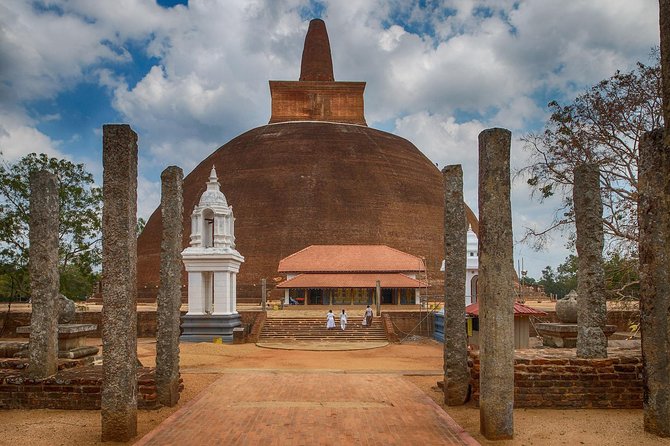
- You see both major monuments and quieter ruins: Ruwanwelisaya and Abhayagiri provide scale, while Wessagiriya and the Twin Baths add detail.
- It is a private activity: Only your own group takes part, which makes questions and pacing easier.
- The $30 price covers guidance, water, and snacks: Admission fees and an air-conditioned vehicle are not included.
- Mihintale may be an alternative: The experience is described as taking place in Anuradhapura or the sacred city of Mihintale, so confirm the exact plan before booking.
Why a guide matters in Anuradhapura
Anuradhapura is easy to underestimate. You can recognize a giant stupa, but without context, the site can become a string of names and photographs. A guide helps connect the monuments to Buddhism, kingship, monastic life, and the arrival of Buddhism in Sri Lanka.
Lampa is a licensed Sri Lankan tourist guide who explains monuments and historical places across the country. The information provided for this tour specifically highlights his English, storytelling, and explanations of Buddhism. That matters here because many of the most interesting details are not obvious from the stonework alone.
The private setup also gives you room to ask direct questions. If you want more time at the Sri Maha Bodhi, or need a clearer explanation of the difference between a dagoba and a monastery complex, you can ask as you go. The tradeoff is that a private guide does not automatically mean a leisurely tour. With eleven listed stops, the morning has a tight rhythm.
The meeting time is 8:30 am at Jaya Sri Maha Bodhi. This is a sensible starting point because the monument is one of the spiritual centers of the old city, but you must arrange your own way there. The tour ends back at the same meeting point.
More Sigiriya and Dambulla Temple Tours in Anuradhapura:
- Private City Day Tour in Anuradhapura
★ 5.0 · 383 reviews - Explore & Ride the history of anuradhapura with Vogel Tours
★ 5.0 · 62 reviews - Delve Into Ancient Anuradhapura with Optional Visit to Mihintale
★ 5.0 · 42 reviews
Starting at Jaya Sri Maha Bodhi
The first stop is Jaya Sri Maha Bodhi, a sacred fig tree in the Mahamewna Gardens. It is described as the closest living link to Gautama Buddha, making it more than an old tree or a botanical curiosity. For many visitors, this is the most important religious stop of the morning.
You have about 30 minutes here. That is enough for an introduction, a respectful visit, and questions about the tree’s place in Sri Lankan Buddhism. Your guide can help explain why a living object receives such devotion and how it fits into the wider story of Anuradhapura.
Because this is an active sacred place, dress and behavior matter. The supplied tour details do not list a formal dress code, so you should still approach it with the usual care expected at Buddhist religious sites. Keep your visit calm and follow local instructions.
Admission is not included. The tour price is therefore not the complete cost of the morning, and you should budget for entrance fees at the sites that charge them.
Lovamahapaya and the great stupas
Lovamahapaya, also called the Brazen Palace, receives a short 15-minute visit. It lies between Ruwanwelisaya and Sri Mahabodhi and was once a major building associated with the ancient monastery complex. Its name refers to a roof connected with the old palace’s description.
This is a quick stop, but it helps you see that Anuradhapura was not made up only of isolated stupas. It was also a working religious city with halls, monasteries, residences, bathing places, and gathering spaces. Ask Lampa to place the building within that larger plan.
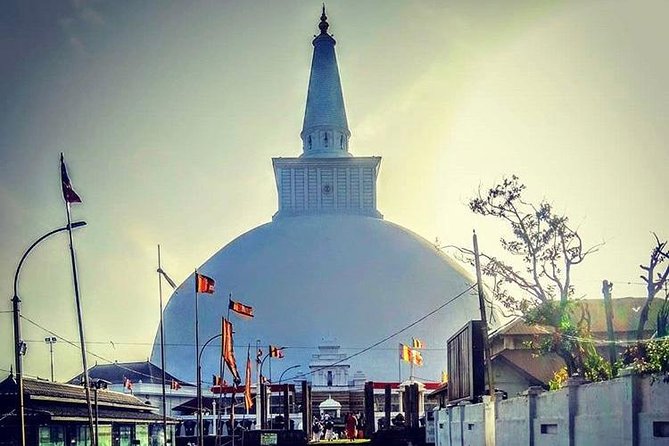
Next comes Ruwanwelisaya, one of Anuradhapura’s most famous stupas. You have about 20 minutes here. The great white dome and surrounding religious activity make it a strong visual counterpoint to the tree at the first stop.
Ruwanwelisaya is associated with Buddhist relics, including a large share of the Buddha’s relics according to the traditional account. A guide’s explanation is useful because the structure’s size and religious purpose are closely linked. You are not simply looking at a large rounded monument. You are seeing a reliquary with a central role in Sri Lankan Buddhist worship.
The short visit means you may not have much free time to linger. If photography is important to you, keep your camera ready, but give the religious setting priority.
Jetavanarama, Abhayagiri, and the scale of old monastic life
The itinerary includes stops described as Abayagiriya Stupa and Abhayagiri Dagaba. The description attached to the first refers to Jetavanarama, while the second concerns the Abhayagiri monastery area. Since these names can be confusing, confirm the exact monuments with Lampa at the start.
Jetavanarama is associated with the Jetavana monastery and is one of the major stupa sites in the UNESCO-listed ancient city. You have about 30 minutes here. The point of this visit is scale. Huge Buddhist monuments were part of large monastic communities, not isolated objects placed in empty fields.
The Abhayagiri stop lasts about 20 minutes. Abhayagiri Vihara was a major Buddhist monastery connected with Mahayana, Theravada, and Vajrayana traditions. That gives the site a wider religious story than a simple label such as old temple.
These two stops are useful for understanding that Buddhist practice in ancient Sri Lanka included different schools and a wide range of buildings and customs. You may find the names and chronology hard to keep straight, which is another reason the guide’s role matters.
The time allowed at both sites is limited. I would treat them as focused introductions rather than full archaeological visits. If one complex interests you more than the others, tell Lampa early and ask how the timing can be handled.
Same country, a different morning at the gates:
- Anuradhapura Private Ancient City Day Tour
★ 5.0 · 39 reviews - Anuradhapura Heritage Mountain bike / bicycle Tour
★ 5.0 · 34 reviews - Anuradhapura: Full-Day Wilpattu All Inclusive Private Safari
★ 4.5 · 24 reviews - One Day Tour – Sacred city of Anuradhapura & Sacred city of Mihintale. (Sunset)
★ 4.5 · 23 reviews
Thuparama and the Samadhi Buddha
Thuparamaya is identified as the first Buddhist temple built in Sri Lanka after Mahinda Thero brought Buddhism to the island. The stop lasts about 20 minutes and takes place in the sacred area of Mahamewna Park.
That origin story gives Thuparama a special place in the tour. The monument may not have the same immediate scale as Ruwanwelisaya, but its importance comes from its place in the early spread of Buddhism in Sri Lanka. This is a good point to ask about Mahindagamanaya and the connection between religion, royal support, and the growth of Anuradhapura.
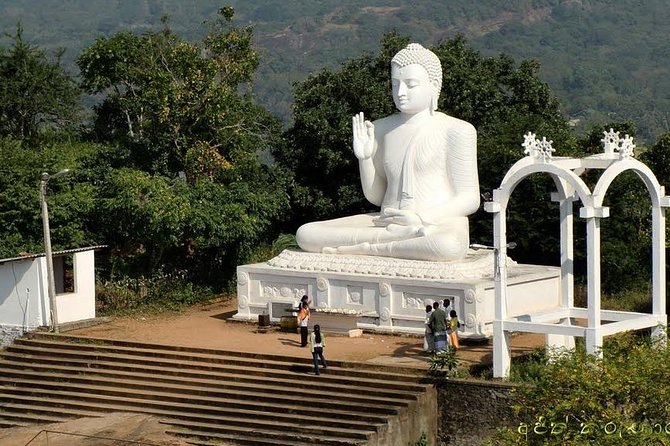
The Samadhi Buddha follows with a 15-minute stop. The statue shows the Buddha in a meditation posture, with the hands placed in Dhyana Mudra. It is one of the best-known Buddha images in the ancient city.
This visit is brief, so take a moment to look closely at the pose rather than treating it as another quick photo stop. Lampa’s Buddhist explanations should help you understand why the seated form matters and how meditation is represented in the statue.
Isurumuniya and the human side of the ruins
Isurumuniya Temple, visited for about 30 minutes, was originally known as Meghagiri Vihara or Meygiri Vihara. It was built by King Devanampiya Tissa, who ruled the ancient capital from 307 to 267 BC.
This stop brings you back to the early period of Anuradhapura and gives the tour a change of pace. The sacred city can sometimes feel dominated by very large monuments. Isurumuniya helps you consider the smaller religious settings in which monks and worshippers lived and practiced.
The site is also useful for connecting names, dates, and rulers. Those details can become a blur when you visit many monuments in one morning, so let the guide set out the basic sequence. You do not need to memorize every king. You do need a clear sense of how long Anuradhapura served as a major capital and why its religious sites grew so large.
Thirty minutes is a fair amount of time for this stop, though it will still feel short if you want to study every feature.
Twin Baths, Wessagiriya, and the moonstone
The Twin Baths, or Kuttam Pokuna, receive about 15 minutes. These two carefully built bathing pools formed part of the Abhayagiri monastic complex. They show a practical side of ancient religious life: water management, bathing, and the daily needs of a large community.
This is one of the stops I like most in a tightly scheduled tour because it adds something different. Stupas tell you about devotion and relics. The baths tell you about the systems needed to support a monastery.
Wessagiriya, visited for around 20 minutes, was an ancient Buddhist forest monastery also known as Issarasamanarama. Its setting and purpose help broaden your idea of Anuradhapura. The city was not only a royal center with grand public monuments. It also included places linked with quieter monastic practice.
The final listed stop is the moonstone, or Sandakada pahana, with about 20 minutes allowed. This carved semicircular stone usually appears at the bottom of a staircase and is a distinct feature of ancient Sinhalese architecture.
Look at the moonstone as a piece of design, not just a doorway detail. Its carved bands and placement show how movement into a sacred building could be marked and shaped. With a guide beside you, this small feature can become one of the more memorable parts of the tour.
What the $30 price really covers
At $30 per person, the tour offers a reasonably priced way to get a private guide for a concentrated visit to Anuradhapura. The value is strongest if you care about explanations and want help sorting out the many religious and historical names.
Water and snacks are included. That is useful during a morning spent moving among open-air monuments, though the supplied information does not specify the type or amount of food.
All fees and taxes are excluded. An air-conditioned vehicle is also not included. Pickup is offered in the general feature list, but the stated meeting point is Jaya Sri Maha Bodhi, so clarify transport before you pay. Do not assume the $30 includes a private car.
The tour is best understood as a guided visit rather than a full transport package. If you already have a way to reach the meeting point, the price is easier to judge. If you need a vehicle between scattered monuments, ask exactly what is arranged.
Who will get the most from this morning
I would choose this tour if you have only part of a day in Anuradhapura and want a guide to explain Buddhist sites in clear English. It suits first-time visitors, people interested in Sri Lankan history, and anyone who prefers a private group to a set public tour.
It also suits visitors who want variety. You see a sacred tree, a palace site, several stupas, a Buddha statue, a temple, bathing pools, a forest monastery, and carved architecture.
I would be more cautious if you want long, quiet periods at each monument. Eleven stops in three to four hours is ambitious. You may also prefer another arrangement if air-conditioned transport is essential or if you do not want to pay site fees separately.
The tour has a 4.6 rating from 24 ratings and is recommended by 92 percent of bookers. More important for your decision, the strongest praise focuses on Lampa’s English, his explanations of the city and Buddhism, and his ability to make the sightseeing enjoyable. One booking experience also paired Anuradhapura with Mihintale over a full day, so ask if you want the sacred city of Mihintale rather than the half-day Anuradhapura route.
Should you book it?
Book this tour if you want a clear introduction to Anuradhapura with a licensed local guide, especially when your time is limited. Lampa’s role is the main reason to choose it: the monuments make more sense when someone explains the beliefs, rulers, and monastic life behind them.
Before booking, confirm three points: Anuradhapura or Mihintale, the exact monuments included, and how you will move between them. Also budget for entrance fees and do not expect an air-conditioned vehicle unless the provider confirms one.
Free cancellation is available up to 24 hours before the start time. Within 24 hours, the payment is not refunded, and poor weather may lead to a new date or a full refund. For a focused morning of Buddhist history and ancient architecture, the tour offers good value, provided you are comfortable with a brisk schedule.
FAQ
Where does the tour start?
The tour starts at Jaya Sri Maha Bodhi, at 89VW+VV5 in Anuradhapura, Sri Lanka.
What time does the tour begin?
The stated start time is 8:30 am.
How long does the experience last?
The tour lasts approximately three to four hours.
Is the tour private?
Yes. Only your group participates in the activity.
Is pickup offered?
Pickup is listed as an available feature, but the stated meeting point is Jaya Sri Maha Bodhi. Confirm the exact pickup arrangement before booking.
Are admission tickets included?
No. Admission tickets, fees, and taxes are not included in the tour price.
Is an air-conditioned vehicle included?
No. An air-conditioned vehicle is specifically excluded.
What is included in the price?
Water and snacks are included, along with the guided experience. The price is listed as $30 per person.
Can I cancel for a full refund?
Yes, if you cancel at least 24 hours before the local start time. Cancellations within 24 hours are not refunded. If poor weather causes the tour to be canceled, you will be offered another date or a full refund.
Just added around Anuradhapura
- One Day Tour – Sacred city of Anuradhapura & Sacred city of Mihintale. (Sunset)★ 4.5 · 23 reviews
- Visiting the Historical Polonnaruwa Ruins and Minneriya Safari★ 5.0 · 16 reviews
- Day tour trips from Anuradhapura to multiple cities as your choice★ 5.0 · 14 reviews
- Day Tour from dambulla to Sigiriya & Polonnaruwa★ 5.0 · 13 reviews
- Private Day Trip to Sigiriya , Dambulla and Pidurangala Rock★ 4.5 · 14 reviews
- Anuradhapura ancient city tour with Travandgo tours★ 5.0 · 7 reviews
- Anuradhapura Heritage Mountain bike / bicycle Tour★ 5.0 · 34 reviews
- Anuradhapura: 14 Ancient City Sites Tuk Tuk Tour★ 5.0 · 8 reviews
Sigiriya & Dambulla Temple Tours, compared.
Kandy to Sigiriya Day Tour and Dambulla cave temple with private vehicle
Read our review →
Private Day Trip to Sigiriya & Dambulla from Kandy – Aaliya Tours
Read our review →
Private Dambulla Sigiriya Tour from Kandy with Lunch
Read our review →
Browse the lists this tour appears in