
REVIEW · VALLEY OF THE TEMPLES TOURS
Paestum Tour: Best Preserved Temples in the World (UNESCO)
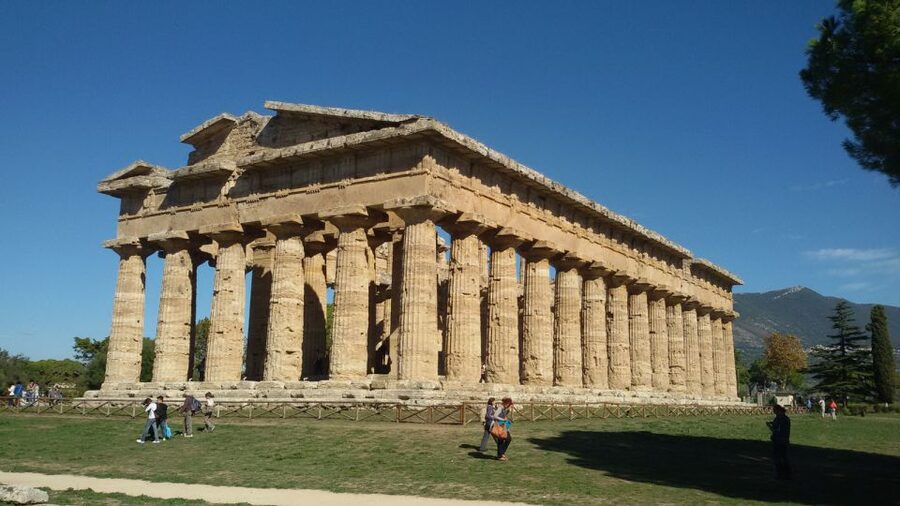
Paestum gives you something rare: three Greek temples still standing with enough detail to make their original purpose and power easy to grasp. The Temple of Hera, the huge Temple of Poseidon, and the Sanctuary of Athena form the heart of this two-hour walk through ancient Magna Graecia.
I like the private format and the licensed guide’s focus on architecture and history. I also like that the visit includes both the outdoor ruins and the Archaeological Museum, where the painted Tomb of the Diver adds a more personal note. The main drawback is practical: tickets, transport, and food are not included, so you must arrange those yourself.
Key points to know before booking
- Three major Greek temples: See Hera’s Basilica, the Temple of Poseidon, and the Sanctuary of Athena in one guided visit.
- A private group of up to 25: The guide can answer questions for your party, though the value is strongest when shared by several people.
- The Temple of Poseidon is the visual centerpiece: Built around 460 BCE, it is the largest and most imposing of Paestum’s temples.
- Roman Paestum is part of the walk: Follow the Via Sacra to the Roman forum and amphitheater.
- The museum adds the human touch: Look for the Tomb of the Diver, the Hera Argiva metopes, a statue of Zeus, and the Europa crater.
- Plan the extra costs: Entrance tickets, meals, and transportation are separate from the guide fee.
Why Paestum is worth the trip
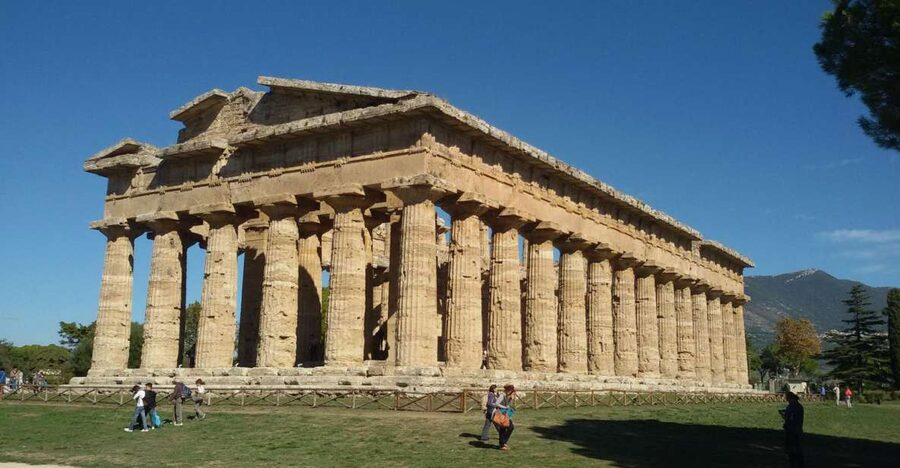
Paestum was founded by Greek settlers under the name Poseidonia and later became Paestum under Roman rule. Its temples are connected with Hera, Poseidon, and Athena, although the city’s religious life was not limited to one god. That mix of Greek and Roman history is what makes the site more than a simple temple stop.
I find Paestum especially rewarding because the main buildings are not reduced to scattered columns. You can see complete rows of columns, strong foundations, and broad temple shapes that still explain how these places dominated ancient public life. The scale is easier to understand when a guide points out the proportions, the Doric style, and the relationship between the temples and the old city streets.
The setting also gives the visit breathing room. You are not rushing from one isolated monument to another. The tour links the temples with the Via Sacra, Roman public buildings, and the museum, creating a clearer picture of Paestum as a functioning city.
More Valley of the Temples Tours in Italy:
- Agrigento: Valley of the Temples Skip-the-Line Sunset Tour
★ 4.5 · 1,512 reviews - Palermo: Agrigento and the Valley of the Temples Day Tour
★ 4.2 · 1,240 reviews - Agrigento: Valley of the Temples Ticket & App Audioguide
★ 4.3 · 1,160 reviews
Meeting your guide at the Archaeological Museum
The tour begins at the entrance of the National Archaeological Museum in Paestum. This is useful because the museum is also the final stop, so you return to the same meeting point at the end rather than arranging a second pickup location.
Your guide is licensed and can lead the tour in Spanish, English, French, German, or Italian. The private setup means the visit is reserved for your group, with a maximum of 25 people. That is a generous limit, so if you are traveling with only two or three people, ask yourself how much you value a private guide compared with a larger shared tour.
The stated duration is two hours. That is enough for a focused introduction to the main monuments, but it is not a slow, all-day archaeological study. You will need to keep moving, especially because the itinerary covers the park and the museum. If you like a brisk overview with professional explanations, the timing works well. If you prefer long pauses for photographs or detailed examination of every display, you may want extra independent time after the guided visit.
Entrance tickets are not part of the price. That matters because the $325.13 group cost pays for the private guide, not admission to the Archaeological Park or museum. Check the current ticket arrangements before you arrive, and allow room in your budget for those separate fees.
Hera’s Basilica, Paestum’s oldest temple
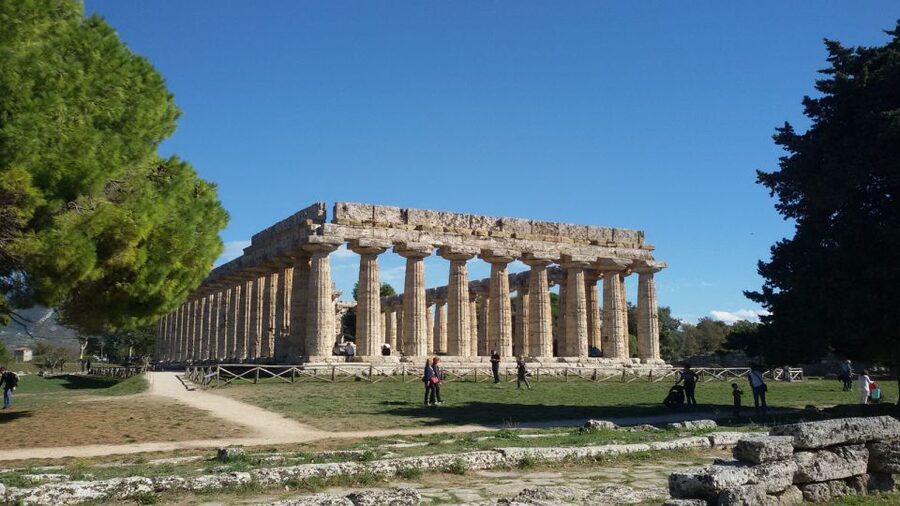
The first major temple is dedicated to Hera and is also called the Basilica. It is the oldest of the three featured temples and follows the Doric style, with plain, sturdy columns and a strong horizontal shape.
The dimensions help explain its effect. The building is about 26 meters wide and 55 meters long, so it is broad as well as substantial. A guide can make those measurements meaningful by showing how the columns and surviving plan fit together. Without that context, it is easy to see only stone. With it, you begin to understand the engineering and civic ambition behind the building.
The name Basilica can confuse modern visitors. Today, the word often suggests a Christian church, but here it is a later name used for this ancient temple. The original dedication was to Hera. That difference is worth asking about during the visit because Paestum’s labels reflect layers of archaeological interpretation, not always the building’s first use.
I like this opening stop because it lets you adjust to the site gradually. The temple is old, broad, and somewhat less imposing than the next one, but it provides a useful introduction to Paestum’s Doric design. Look closely at the regular rhythm of the columns and the way the remaining structure gives you a sense of the original enclosed temple.
The Temple of Poseidon and the grandest view
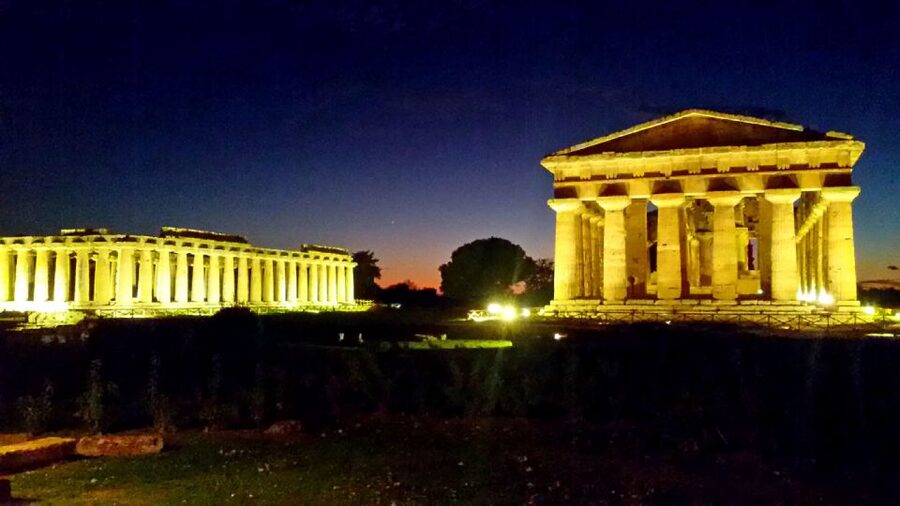
The largest temple on the route is the Temple of Poseidon, also called the Temple of Neptune. It was built around 460 BCE and is often compared with the Temple of Zeus at Olympia. This is the monument most likely to define your impression of Paestum.
The building’s size is only part of its appeal. Its preservation allows you to read the basic structure with unusual ease. You can see the heavy Doric columns, the broad steps, and the formal balance of the design. The temple does not need much decoration to make its point. Its power comes from mass, order, and proportion.
This is where the guide’s architectural explanations are most useful. A good explanation can show you why Doric temples look so solid and why the builders relied on repeated forms rather than elaborate ornament. The guide can also place the temple in its fifth-century BCE setting, when Greek architectural ideas were being expressed with great confidence.
Give yourself a moment to look without taking a photograph. The temple is large enough that a quick picture rarely captures its full shape. Then ask questions. The guide is there to explain both the structure and the historical changes that affected Paestum.
The possible limitation is time. With only two hours for the entire park and museum, you will not have unlimited time around the Temple of Poseidon. If this is your main reason for coming, tell your guide early so you can give this monument the attention it deserves.
A few more temple visits around Italy worth a look
- Pantheon Elite Guided Tour – Rome’s Iconic Ancient Temple
★ 5.0 · 1,447 reviews - Rome’s Iconic Temple: Pantheon Audio Guided Tour with Fast Access
★ 4.0 · 1,188 reviews - Colosseum Special Access Tour, with Ancient Temples & Tombs
★ 4.8 · 747 reviews - Agrigento: Valley of the Temples E-Scooter Tour
★ 4.6 · 557 reviews
The Sanctuary of Athena, also called Ceres
The third temple is known as the Temple of Ceres and is identified as a sanctuary dedicated to Athena. It is smaller than the Temple of Poseidon, but do not treat it as a minor stop. Its more modest size makes it useful for comparison.
Seeing the three temples together helps you notice that Greek sacred buildings were not all built to one scale. The Sanctuary of Athena has its own proportions and character. After seeing the massive Temple of Poseidon, you can look at this structure with a better eye for how design changes according to purpose, period, and setting.
The different names can also prompt a helpful discussion. Ceres is a Roman goddess, while Athena is Greek. Paestum passed through Greek and Roman phases, and the names attached to its buildings reflect that long story. I would ask the guide to clarify which names are ancient and which were assigned later.
This stop rewards careful comparison. Look at the columns, the footprint, and the overall height. You are not simply ticking off a third temple. You are seeing how a sacred complex developed and how later interpretation can shape the way a monument is presented.
Walking the Via Sacra to the Roman forum
After the temples, the tour follows the Via Sacra, the ancient sacred road. This section helps connect the monumental buildings to the city that surrounded them.
The Roman forum is an important change of tone. The Greek temples often draw all the attention, but the forum points to Paestum’s later life under Rome. It was a public space tied to civic activity, administration, and community life. The remains may not have the instant visual force of the Temple of Poseidon, yet they add context that a temple-only visit would miss.
I like this part because it keeps Paestum from becoming a collection of beautiful ruins without a city behind them. You can ask how Greek and Roman use overlapped, what changed after Roman control, and how the public center differed from the sacred areas.
The Via Sacra also gives the tour a natural route between major stops. You are not simply being driven or led from one isolated highlight to the next. The movement through the old city makes the site easier to picture as a place where people walked, worshipped, traded, and handled public business.
The amphitheater and the city’s public life
The Roman amphitheater is another reminder that Paestum continued to matter after its Greek foundation. Its remains are less complete than the great temples, but they show a different type of public architecture.
Here, the guide can explain how Roman entertainment spaces fit into civic life. The amphitheater was not a sanctuary. It was built for public gatherings and spectacles, giving you a look at the social world that developed after the Greek period.
Do not expect the same visual impact as the Temple of Poseidon. The amphitheater is valuable because it broadens the story, not because it is the best-preserved structure in the park. If you have limited independent time, prioritize the temples first, then use the amphitheater and forum to understand Paestum’s Roman phase.
The museum and the Tomb of the Diver
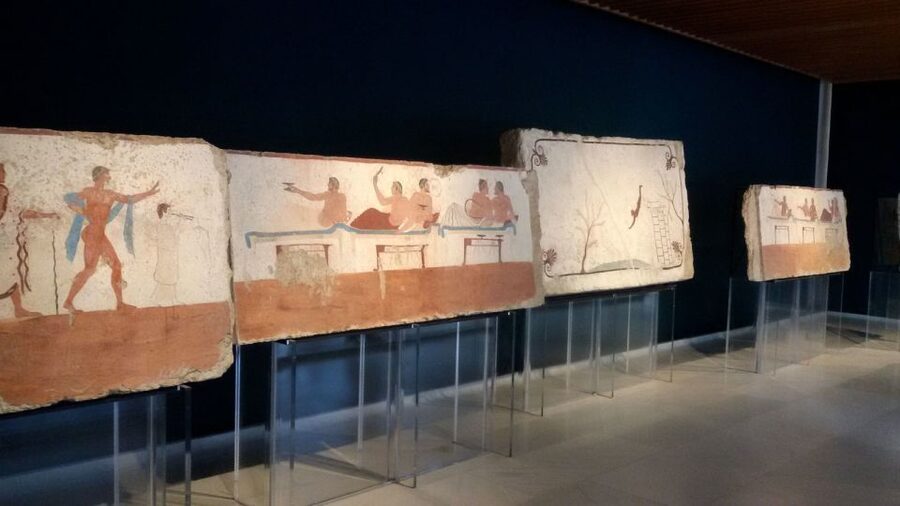
The final part of the tour takes place in the National Archaeological Museum. This is where the stones gain a more human scale. Instead of looking mainly at architecture, you see objects and paintings connected with the people who used and remembered Paestum.
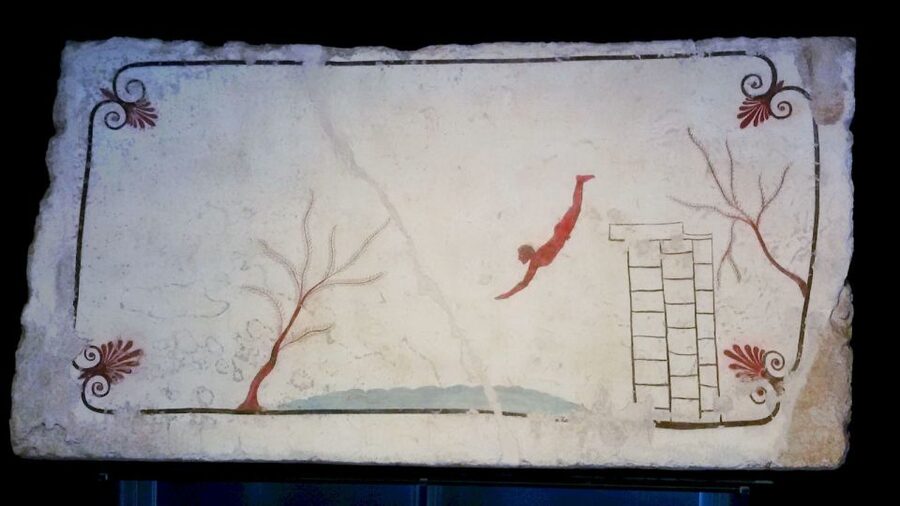
The museum’s most famous piece is the Tomb of the Diver. It is made from five limestone slabs of local travertine. The slabs were plastered and decorated with figurative wall paintings using the fresco technique. The painted image of the diver has made this tomb one of Paestum’s best-known discoveries.
The Tomb of the Diver is especially striking because it is not another giant monument. It is a burial chamber with a focused, intimate design. The image gives the museum a different emotional register after the massive temples and Roman public buildings.
The collection also includes 33 metopes from the Temple of Hera Argiva. These carved panels help you connect the museum’s objects with the architecture you have just seen outdoors. You can also see a statue of Zeus and a crater depicting the abduction of Europa, often referred to as the crater with the rape of Europa.
I like ending in the museum because the route moves from large public monuments to smaller works that reveal belief, art, and burial customs. The museum is not an optional afterthought. It completes the visit, especially if you want more than photographs of columns.
Is the $325.13 group price good value?
The cost is $325.13 per group of up to 25 people. That pricing model makes the most sense for a family, school group, wedding party, or larger circle of friends. Split among 10 people, the guide fee is about $32.51 each before admission. Shared by 20 people, it becomes about $16.26 each.
For one or two people, the value is harder to judge. You are paying for privacy and a dedicated licensed guide, but the per-person cost rises quickly. The guide’s ability to answer questions and adjust explanations to your group may justify that cost if architecture and ancient history are central interests.
Remember to add entrance tickets to your calculation. Transportation is also separate, and there is no pickup or drop-off service. Food and drinks are not included either. The tour is best viewed as a professional guiding service at the site, not as a full-day package.
The strongest value comes from the combination of the park and museum. A basic walk through the ruins may show you the temples, but it can leave you unsure how the Greek and Roman periods connect. Here, the guide links Hera, Poseidon, Athena, the forum, amphitheater, and the museum’s objects in one compact visit.
Who will enjoy this private Paestum tour?
I would choose this experience if you want structure and explanation rather than a self-guided look at ruins. It suits people who enjoy asking questions, comparing architectural styles, and understanding why a monument matters.
It is also a good fit for groups that want to stay together. The private format removes the need to match another party’s pace, though the two-hour schedule still keeps the visit focused.
Families may appreciate the clear sequence. The temples provide scale, the Roman buildings add variety, and the Tomb of the Diver gives the museum a memorable centerpiece. The tour also works well for first-time visitors who want a strong introduction before spending more time on their own.
I would think twice if you want transportation included, a meal, or a relaxed half-day visit with long pauses. Those are not part of this experience. You will also need to purchase admission separately and get yourself to the museum entrance in Paestum.
Practical details before you go
The tour starts and ends at the Archaeological Museum entrance in Paestum. Since the endpoint is the same as the meeting point, you can continue exploring from there once the guided portion finishes.
You can cancel up to 24 hours before the activity for a full refund, and you can reserve now while paying later. Those terms are useful if your Campania plans are still shifting.
The guide languages are English, Spanish, French, German, and Italian. The provider is Italygonia Travel T.O. No individual guide names are supplied, so you should not book this expecting a particular named guide.
The tour has an overall rating of 4.5 from 11 ratings, with especially strong praise for clear explanations of architecture and history, thoughtful answers to questions, and cordial, enriching exchanges. That points to the main strength of the experience: interpretation, not extras.
Should you book it?
Book this tour if you want the temples explained rather than simply photographed, especially if you can share the group price with several people. The combination of the three temples, Roman forum, amphitheater, and museum makes the two hours productive.
Skip it if you already know Paestum well, prefer exploring alone, or need transport and admission bundled into one booking. For most first visits, though, a licensed private guide gives the site a clear shape, and the Tomb of the Diver provides a memorable finish.
FAQ
Where does the Paestum tour begin?
The tour begins at the entrance of the National Archaeological Museum in Paestum.
Where does the tour end?
The activity ends back at the meeting point, at the Archaeological Museum entrance.
How long does the tour last?
The guided tour lasts two hours. Starting times depend on availability.
Is this a private tour?
Yes. It is a private group experience for up to 25 people.
Which languages are available?
Live guiding is available in English, Spanish, French, German, and Italian.
Are entrance tickets included?
No. Tickets for the Archaeological Park and the National Archaeological Museum are not included.
Is transportation included?
No. Transportation, pickup, and drop-off are not included.
Does the tour include food or tastings?
No. Tasting, lunch, and dinner are not included.
Can I cancel for a refund?
Yes. You can cancel up to 24 hours in advance for a full refund. The booking also offers a reserve-now-and-pay-later option.
Just added around Italy
- Cooking Class in a former Artist Monastery in the Heart of Monopoli★ 5.0 · 18 reviews
- Agrigento Valley of the Temples Archaeological Area★ 4.0 · 33 reviews
- Private transportation to the Valley of the Temples + Agrigento★ 5.0 · 8 reviews
- Agrigento: Valley of the Temples Entry Ticket & Audio Guide★ 3.0 · 40 reviews
- Rome underground hidden temples, ruins, and secret basilicas★ 3.7 · 21 reviews
- Rome: Temples, Squares & Markets Guided Walking Tour★ 4.8 · 26 reviews
- Paestum: Temples and Museum Tour with Archaeologist Guide★ 5.0 · 14 reviews
- Paestum: 2-Hour Greek Temples & Archaeological Museum★ 4.8 · 19 reviews
Valley of the Temples Tours, compared.
Agrigento: Valley of the Temples Skip-the-Line Sunset Tour
Read our review →
Palermo: Agrigento and the Valley of the Temples Day Tour
Read our review →
Agrigento: Valley of the Temples Ticket & App Audioguide
Read our review →
Agrigento: Valley of the Temples E-Scooter Tour
Read our review →
Palermo: Valley of the Temples and Scala dei Turchi Day Trip
Read our review →
Catania: Valley of the Temples and Turkish Steps with Snack
Read our review →
From Palermo: Villa Romana and Valley of the Temples Trip
Read our review →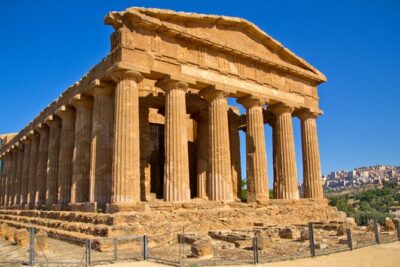
Agrigento: Valley of the Temples Entry Ticket & Audio Guide
Read our review →Browse the lists this tour appears in