
REVIEW · TEMPLE WALKING TOURS
Arequipa: Walking Tour and Santa Catalina Monastery
Arequipa’s best stories are tucked into its side streets, not just displayed around the Plaza de Armas. This three-hour tour leads you through San Lazaro, the Barrio del Solar, two old tambos, and the vast Santa Catalina Monastery, all built around the city’s pale volcanic sillar stone.
I like the mix of local neighborhoods and major sights, and I like that the monastery visit gets a full hour rather than a rushed photo stop. Guides such as Gisela, Milei, and Sline have been praised for clear explanations, kindness, and careful answers to questions. The main consideration is the walking: uneven colonial streets and steps make this a poor choice for wheelchair users.
Key points to know before booking
- San Lazaro gives you Arequipa’s oldest urban setting, with narrow lanes, white sillar walls, little squares, and links to pre-Inca, Inca, and early Spanish settlement.
- The Barrio del Solar and its tambos show working colonial Arequipa, including Tambo El Matadero, where families still live.
- Tambo La Cabezona preserves a communal housing layout and the site of one of Arequipa’s first mills.
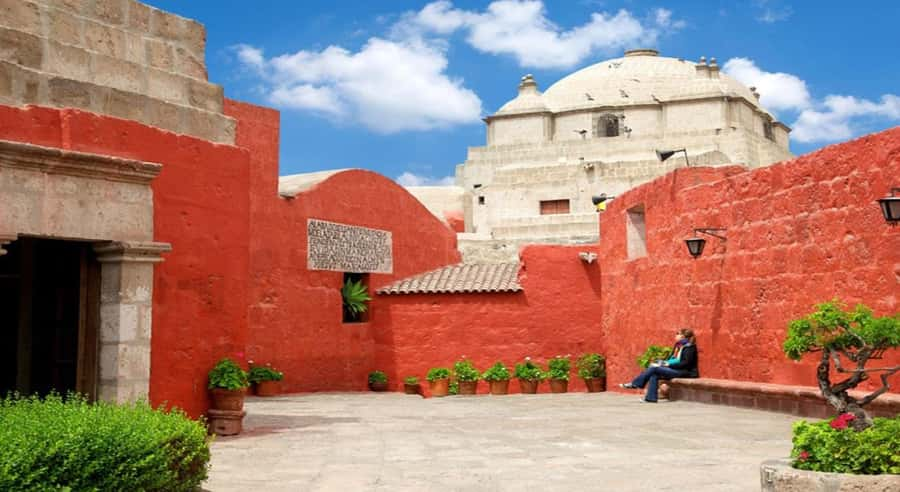
- Santa Catalina Monastery covers about 20,000 square meters, with cloisters, patios, streets, a church, and a bell tower.
- The $35 price can be good value if your option includes the monastery entrance, guide, transport, and hotel pickup within the historic center.
- Pickup rules matter: hotels outside the historic center are not covered, and some booking options require you to meet at Calle Zela 301.
Why this walk shows you more than the Plaza de Armas
Arequipa is often introduced through its grand central square, but the city makes more sense when you first see how its older neighborhoods fit together. This route begins in San Lazaro, moves toward the Chili River through the Barrio del Solar, and finishes at Santa Catalina Monastery.
That order works well. You begin with small-scale streets and domestic buildings, then see colonial lodging houses and public spaces before reaching the city’s most famous religious complex. By the time you enter Santa Catalina, you have some sense of how Arequipa was built and why sillar matters so much.
The walking is broken into short sections, with guided stops of about 20 to 30 minutes. The tour also includes short van rides at the start and end. At about three hours total, it gives you a useful first look without taking an entire day away from Arequipa.
More Temple Walking Tours in the world:
- Bangkok: City Highlights Temple and Market Walking Tour
★ 4.5 · 3,990 reviews - Bangkok: Grand Palace and Wat Phra Kaew Guided Walking Tour
★ 4.4 · 2,417 reviews - Bangkok: Wat Pho and Wat Arun Guided Walking Tour
★ 4.6 · 1,720 reviews
San Lazaro: white stone, small lanes, and early Arequipa
The first walking stop is Barrio de San Lazaro, about five blocks from the Plaza de Armas. A van ride of roughly 10 minutes gets you there, depending on the pickup point and traffic.
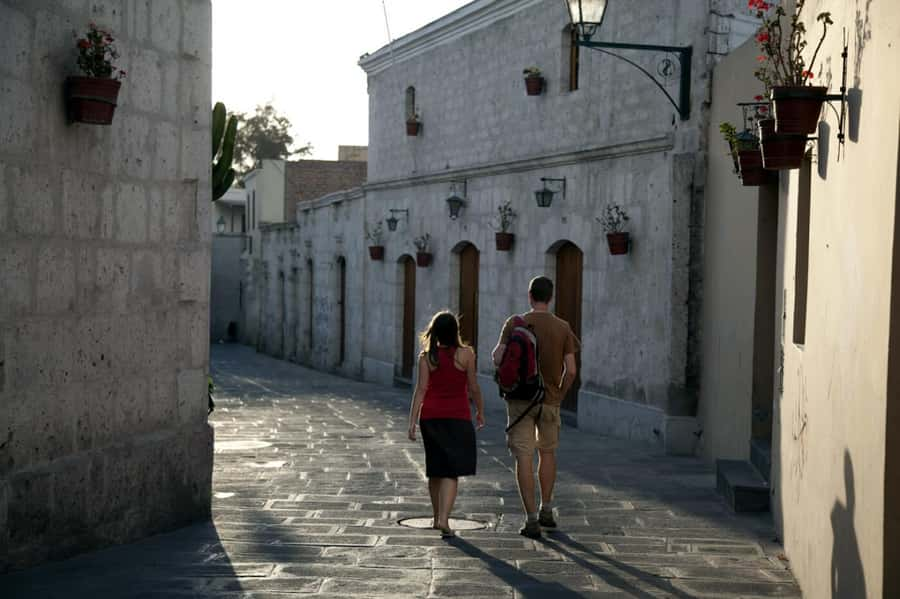
San Lazaro feels more intimate than the main square. Its lanes are narrow, its walls are made from pale sillar, and small squares break up the old residential fabric. Sillar is a volcanic stone that became one of Arequipa’s defining building materials, giving the city its familiar light-colored appearance.
Your guide explains that this area was occupied by pre-Inca and Inca cultures before the Spanish conquest and the foundation of the colonial city. That context makes the neighborhood more than a pretty backdrop. You are looking at an area with several layers of settlement, where the modern streets follow an older pattern.
Allow about 20 minutes here. That is enough time for photos and a short orientation, but not enough for a slow architectural study of every lane. Keep your camera ready, since the small squares and white walls are among the most attractive parts of the route.
The streets also mean uneven footing. Wear shoes with a firm sole, especially if you plan to continue exploring Arequipa on your own afterward.
Barrio del Solar and Tambo El Matadero
From San Lazaro, you walk for about 15 minutes toward the Barrio del Solar near the Chili River. The route moves from the quieter residential quarter into an area known for colonial buildings and old lodging houses called tambos.
A tambo was a place where merchants could stop and rest during the colonial period. These were practical buildings, not grand palaces. Their value lies in showing how trade and movement shaped everyday city life.
The first tambo on the route is Tambo El Matadero, a seventeenth-century building whose original use involved slaughtering animals. Today, about 30 families live there. That detail changes how you view the site. You are not entering a preserved shell emptied of daily life. You are seeing an old building still used as a home.
The stop lasts about 20 minutes and includes a guided visit and time for photos. Be respectful here. People live in the building, so this is a place for quiet observation rather than loud group conversation or intrusive photography.
Tambo El Matadero also adds balance to the tour. Santa Catalina is carefully arranged for visitors, while the tambo offers a more ordinary look at old Arequipa. You see both the city’s famous monuments and the buildings where people still live.
Tambo La Cabezona and the city’s early mill
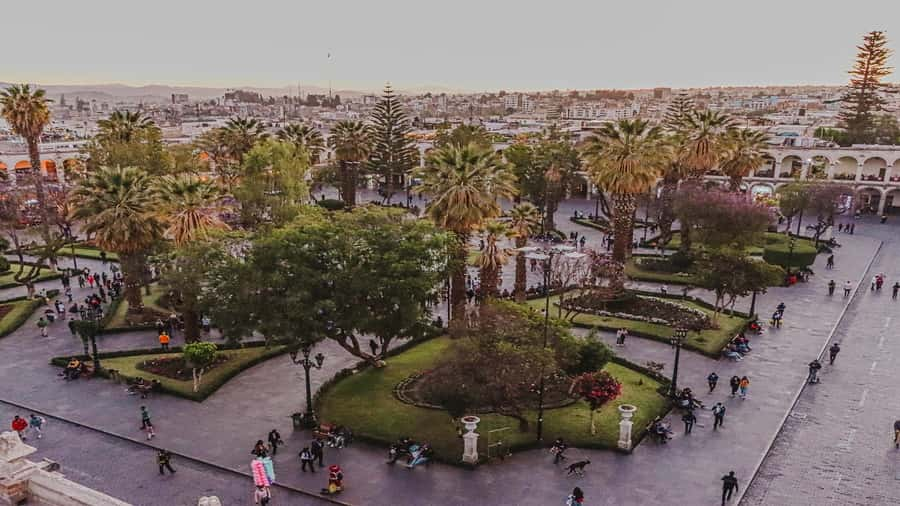
After another short walk of about 10 minutes, you reach Tambo La Cabezona. This colonial group of houses has a communal entrance and dates from the sixteenth century.
The communal layout is important. Instead of imagining colonial Arequipa as a collection of isolated private mansions, you see how several households could share access and movement through a single complex. Your guide can help explain how this arrangement worked and how the site relates to the city’s early growth.
Tambo La Cabezona is also connected to one of Arequipa’s first mills. That makes it useful for understanding the city as a working center, not only as a place of churches and wealthy homes.
You spend about 20 minutes here. The stop includes walking and guided sightseeing, so expect a little more movement than at El Matadero. If you enjoy architecture, this may be one of the more rewarding parts of the tour because the building’s layout tells a story that a simple facade cannot.
The tour does not give you unlimited time at either tambo. That is the tradeoff of fitting several sites into three hours. You receive a clear introduction, but travelers who want extensive architectural notes or long photo sessions may prefer to revisit the area independently.
A few more temple visits around the world worth a look
- Lisbon: Jerónimos Monastery Entrance Ticket
★ 4.1 · 14,164 reviews - Angkor Wat Sunrise or Sunset Tour with Guide from Siem Reap
★ 5.0 · 12,109 reviews - Teotihuacan, Guadalupe Shrine & Tlatelolco Day Tour with Lunch
★ 5.0 · 11,603 reviews - From Bangkok: Ayutthaya Temples Guided Tour with Lunch
★ 4.7 · 10,535 reviews
Plaza de Armas: Arequipa’s grand public room
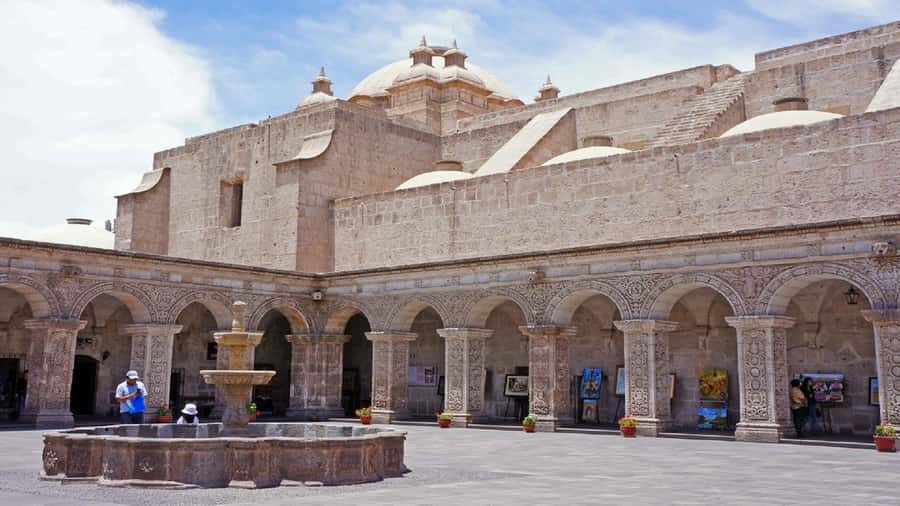
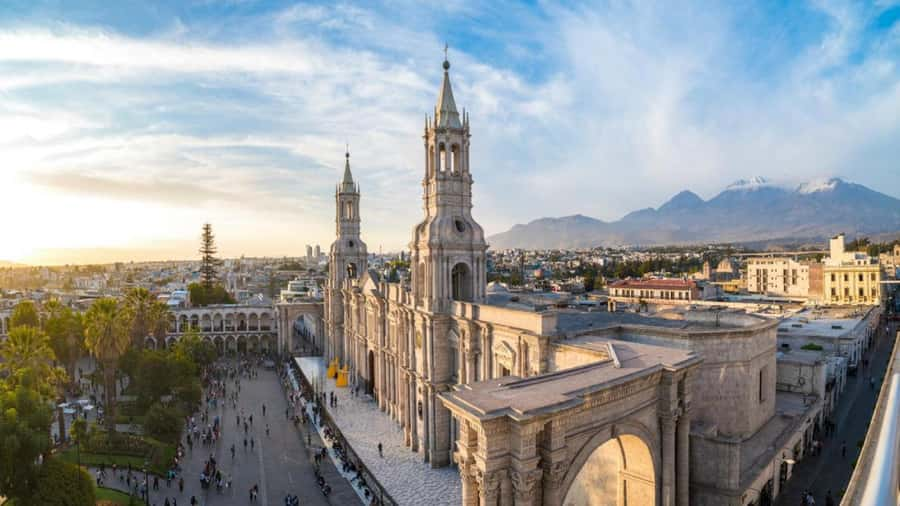
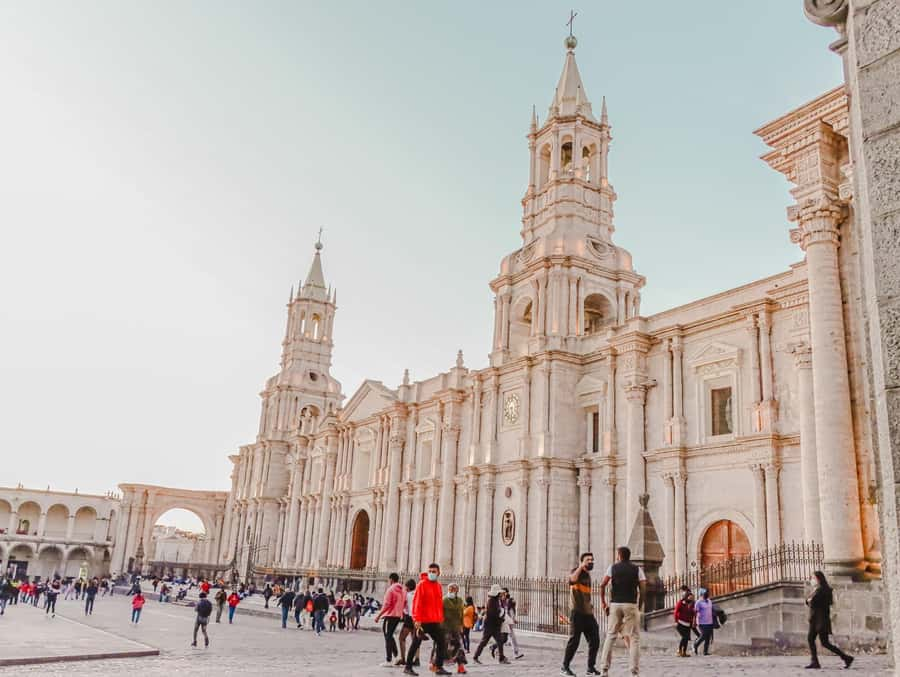
A 15-minute walk brings you to the Plaza de Armas, followed by about 30 minutes at the square. This is the largest and most open space on the route, and it provides a useful change after the tight lanes of the old neighborhoods.
The plaza is Arequipa’s main meeting point. The Cathedral occupies one side, while elegant portals frame the other sides. A bronze fountain sits in the center. The square’s proportions and surrounding arcades make it easy to see why this is the city’s main public stage.
Your guide gives you the basic history and points out the key buildings. This is also the best place to pause and take in Arequipa’s famous sillar architecture at a broader scale.
Do not expect a long cathedral interior visit from the information provided. The stop is described as a panoramic visit to the plaza, so the emphasis is on the square, its portals, fountain, and exterior setting.
The plaza is only five minutes on foot from Santa Catalina Monastery. That short final stretch keeps the tour moving and avoids wasting time on transport between the two main sights.
Santa Catalina Monastery: a city within the city
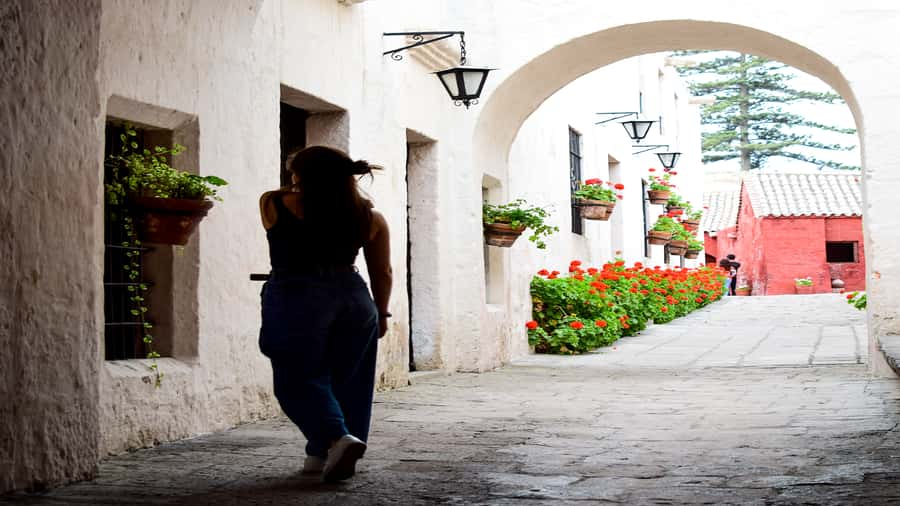
Santa Catalina is the main event. Founded in 1579, the monastery covers about 20,000 square meters. It includes cloisters, patios, small squares, streets, a bell tower, and a church.
That scale is what makes the visit memorable. You do not simply enter one quiet religious building. You walk through a large enclosed complex with its own streets and distinct areas. The design gives Santa Catalina the feel of a small city set inside Arequipa.
The monastery was connected with Doña Maria de Guzman, a wealthy woman who donated her properties and began life as a cloistered nun. During the viceroyalty, many women who entered the convent came from wealthy families. Cloistered nuns still live there today.
Your guided visit lasts about one hour. That is a sensible amount of time for seeing the main courtyards and understanding the convent’s purpose, though the complex is large enough that you could easily spend longer if independent entry were allowed within your schedule.
One of the named areas is the Patio del Silencio. Nuns gathered there to pray and read the Bible in silence. The name helps you picture the space as more than a colorful courtyard. It was part of a strict daily routine shaped by prayer, separation, and community life.
You will also see streets made from ashlar and areas with naturally colored red walls. The change from pale stone to red-painted surfaces gives the complex visual variety. It is a good place for photographs, but the architecture matters more when you understand that these were working spaces tied to the daily life of the convent.
The monastery entrance is optional, depending on the package you choose. If entrance is not included, the stated local fee is 45 PEN for adults and 25 PEN for people aged 7 to 21. Children aged 4 and younger are complimentary. Check the selected option carefully, because the advertised $35 price does not necessarily cover the same items in every booking choice.
What the $35 price really covers
At $35 per person, this is not the cheapest way to see Arequipa’s center, since you can walk around the Plaza de Armas and some neighborhoods without a guide. The value comes from the route, the explanations, and the chance to enter Santa Catalina with a local guide.
The package may include:
- A professional guide in Spanish or English
- Hotel pickup and drop-off within the historic center
- Entrance to Santa Catalina Monastery with a local guide, if that option is selected
- Short van transfers at the beginning and end
The price is strongest when you choose the option that includes the monastery entrance and transport. If you choose without entrance fees, add the local ticket price to your budget and meet at the designated point instead of expecting hotel pickup.
For a first afternoon or morning in Arequipa, I think the cost is reasonable. You cover several historic areas, avoid having to plan the route yourself, and receive background that would be hard to gather from a quick self-guided walk.
The value is lower if you already know the historic center well or want to linger at each site. The tour keeps a set pace, and three hours is enough for an overview rather than detailed research.
Pickup, walking pace, and practical details
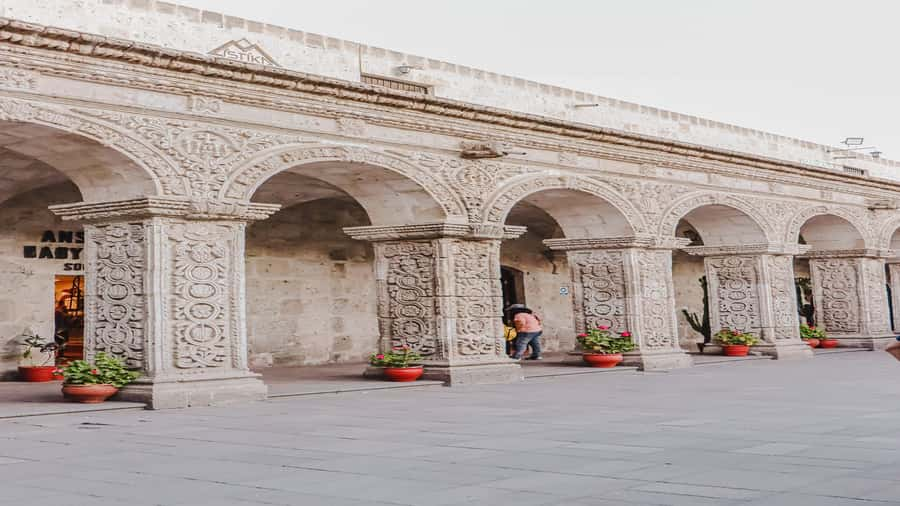
Pickup is available only for hotels in Arequipa’s historic center. If your hotel is elsewhere, go to Calle Zela 301, beside Santa Catalina Monastery at Hotel Mirador del Monasterio. The exact meeting time is confirmed after booking.
The listed pickup and drop-off points include Calle Zela 301, the historic center, and Mirador del Monasterio. If your hotel has poor vehicle access, or is not properly within the historic center, the van may leave you nearby rather than directly outside.
The route includes about 15 minutes of walking between San Lazaro and the Barrio del Solar, 10 minutes between the two tambos, 15 minutes before the Plaza de Armas, and five minutes from the plaza to the monastery. Those intervals are manageable for most people who are comfortable walking, but the surface may not always be smooth.
Bring sunglasses, sunscreen, a hat, comfortable clothing, and insect repellent. Food and drinks are not included, so eat beforehand or carry what you need. The tour does not suit wheelchair users.
The visit order can change. Santa Catalina closes on December 25 and Good Friday, so do not book this exact experience for those dates.
English and Spanish guiding is available. Guide names connected with the experience include Gisela, Milei, and Sline. The strongest comments about the guiding focus on friendly treatment, precise explanations, and the ability to answer questions, which are especially useful at the tambos and monastery where the buildings need context.
Who should book this Arequipa walk?
I would choose this tour if you have limited time in Arequipa and want a guided introduction to the historic center. It works particularly well for first-time visitors who want more than the Plaza de Armas but do not want to arrange separate visits to San Lazaro, the tambos, and Santa Catalina.
It also suits anyone interested in religious history, colonial housing, and architecture made from local stone. The route is not just a series of postcard stops. It shows how neighborhoods, trade buildings, public squares, and convent life fit together.
You may prefer to explore independently if you want a slower pace, extensive photography, or long visits inside each site. You should also think twice if uneven walking is difficult or if your hotel is outside the center and you want door-to-door service.
Should you book it?
Book this tour if you want a well-shaped introduction to Arequipa in three hours, especially if the price option includes Santa Catalina’s entrance and historic-center transport. The monastery alone is worth careful attention, and the earlier walk gives it useful context.
Skip it if you already know the center, dislike guided pacing, or want to spend a full morning inside Santa Catalina. For most first visits, though, the combination of San Lazaro, the working tambos, Plaza de Armas, and the monastery makes the $35 fare a practical way to get oriented.
FAQ
How long does the Arequipa walking tour last?
The experience lasts three hours, including the walking route, Santa Catalina Monastery visit, and short van transfers.
Where does the tour begin?
There are three listed pickup or meeting options: Calle Zela 301 in the historic center, the historic center area, and Mirador del Monasterio.
Is hotel pickup included?
Hotel pickup and drop-off are available as an optional package for hotels located within Arequipa’s historic center. Hotels outside the center should use the meeting point at Calle Zela 301.
What languages are available?
The live guide is available in Spanish and English.
Is the entrance fee to Santa Catalina Monastery included?
It depends on the option selected. If entrance is not included, the local fee is 45 PEN for adults and 25 PEN for people aged 7 to 21.
How much walking is involved?
The tour includes several walking sections between San Lazaro, the Barrio del Solar, the tambos, Plaza de Armas, and Santa Catalina. The route includes historic streets and is not suitable for wheelchair users.
What should I bring?
Bring sunglasses, sunscreen, insect repellent, comfortable clothes, and a hat. Food and drinks are not included.
Are children charged?
Children aged 4 and younger are complimentary.
When is Santa Catalina Monastery closed?
The monastery is closed on December 25 and Good Friday. The order of visits may also change.
Just added around the world
- Chiang Mai Temples & City★ 5.0 · 10 reviews
- Full Day Chiang Rai 3 Temples White, Blue,Big Bhudha Temples★ 4.5 · 11 reviews
- Chiang Mai Old City & Temples 3 hour Twilight Walking Tour★ 5.0 · 9 reviews
- Chiang Mai Temples & Old City Hidden Gems Small Group Tour 2 Hrs★ 5.0 · 6 reviews
- Chiang Mai City and Temples Half-Day Tour★ 4.5 · 136 reviews
- Chiang Mai Old City & Temples Guided Walking Tour – 3 Hrs★ 4.5 · 34 reviews
- The Best Chiang Mai City Private Tour: Famous Temples & Viewpoint★ 4.5 · 7 reviews
- Half Day Chiang Mai City Temples & Museum Tour – Group or Private★ 5.0 · 11 reviews
Temple Walking Tours, compared.
City Highlights Temple and Market Walking Tour
Read our review →
Grand Palace and Wat Phra Kaew Guided Walking Tour
Read our review →

Asakusa Walking Tour with Sensoji Temple Visit
Read our review →
3 Hour Old City and Temples Guided Walking Tour
Read our review →
Kyoto Arashiyama Walking Tour: Bamboo, Monkeys, Gardens & Secrets
Read our review →
Belém Walking Tour with Jerónimos Monastery Ticket
Read our review →Browse the lists this tour appears in