REVIEW · ANGKOR WAT TOURS
Angkor 2-Day Sunset & Sunrise Small-Group Tour
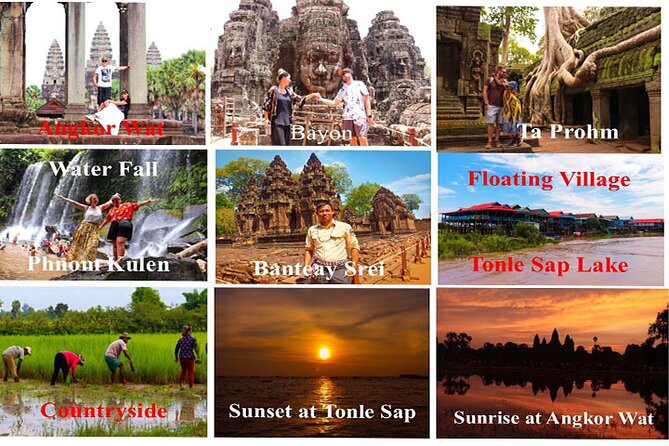
Angkor is best seen with enough time to let the temples feel different from one another. This two-day tour gives you sunrise at Angkor Wat, a sunset stop, the giant faces of Bayon, tree-covered Ta Prohm, and the fine carvings of Banteay Srei, all without relying on an open-air tuk-tuk in Cambodia’s fierce heat.
I especially like the air-conditioned vehicle, cold water, and cool towels waiting after temple walks. I also like the range of sites: you get the famous monuments, but you also reach Preah Khan, Neak Pean, and Banteay Srei. The catch is the pace. Day one can run from about 8 a.m. to 7 p.m., and day two starts around 4:10 to 4:30 a.m.
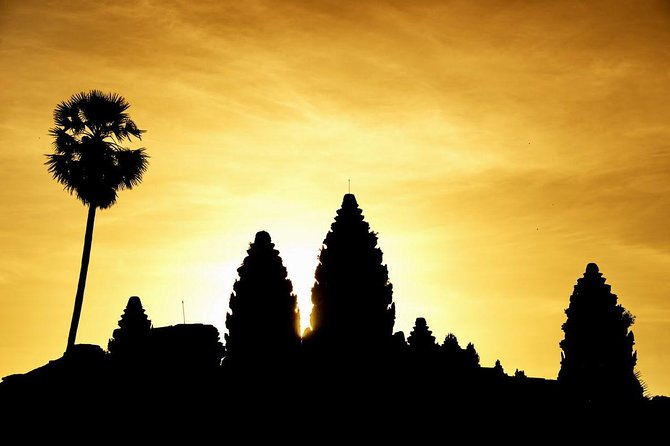
- Sunrise at Angkor Wat: Arrive before dawn and enter from the quieter eastern side.
- Banteay Srei included: See some of Cambodia’s finest sandstone carving outside the main temple circuit.
- Comfort between stops: Ride in an air-conditioned vehicle with bottled water and cool towels.
- Small group size: The vehicle carries no more than 15 people, with some departures much smaller.
- Strong guide service: Guides such as Pal, Sak, Sokpee, Pi, and Chhay are praised for clear explanations and helping with photos.
- Important extra cost: The $49 tour price does not include the required $62 temple pass.
Two days that make Angkor easier to understand
This tour is designed for you to see a lot without squeezing every major temple into one exhausting day. Day one heads toward the outer and northern parts of the Angkor area, then finishes with sunset. Day two begins before dawn at Angkor Wat and continues through Angkor Thom and Ta Prohm.
That order works well. The first day introduces you to smaller and less crowded sites before the main event. On the second day, you see Angkor Wat when the light is soft and the crowds are still gathering, then move into the great royal city and its famous temples.
The $49 price looks low until you add the $62 temple pass, which must be paid directly at the site. Your basic cost is therefore $111 per person before meals. That is still a fair price for two days of transport, a licensed English-speaking guide, hotel pickup and drop-off, water, towels, and a carefully arranged route through a huge archaeological area.
Meals are not included. You choose where and what to eat, which keeps the tour price down, though you should budget for lunch and snacks.
Day one: Preah Khan, Neak Pean, and the road to Banteay Srei
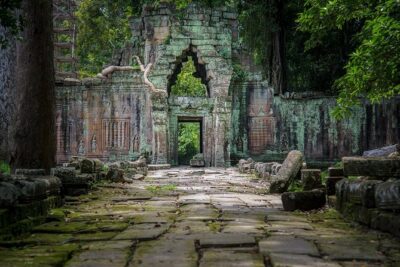
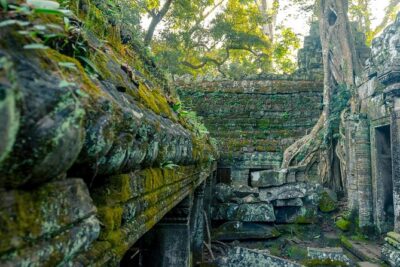
The morning pickup is listed as 8 a.m. from your Siem Reap hotel. You begin at Preah Khan, a large ruined temple where stone galleries, broken walls, and tree roots create an atmospheric first stop.
Give yourself time to look past the dramatic roots. Preah Khan was not built as a single isolated shrine. Its long corridors and layered spaces hint at the scale of the old religious complex. A guide is useful here because the site can otherwise feel like a maze of stones and doorways.
The stop lasts about an hour. Expect uneven paths, dust, and plenty of walking. Comfortable shoes matter more than stylish footwear.
Next comes Neak Pean, an unusual temple set on a circular island in the middle of the Jayatataka Baray. The site is smaller than Preah Khan, but its design is memorable. You walk out toward the artificial island and see a temple built around water and symmetry rather than towering walls.
The scheduled visit is about 40 minutes. In hot weather, this shorter stop can be welcome, though the walk to the island may have limited shade. It is a place where your guide’s explanation adds real value because the layout is not as immediately clear as Angkor Wat or Bayon.
More Temple Sunrise Tours in Cambodia
- Angkor Wat Sunrise or Sunset Tour with Guide from Siem Reap
★ 5.0 · 12,109 reviews - Siem Reap: Angkor Wat: Small-Group Sunrise or Sunset Tour
★ 5.0 · 9,444 reviews - Siem Reap: Angkor Wat 2-Day Tour with Sunrise and Sunset
★ 4.9 · 4,429 reviews
Banteay Srei is the day one highlight
Banteay Srei sits farther out in the countryside and takes more driving time to reach. That extra distance is the reason it is often left off quick Angkor visits, but it is also what gives the site a different feel.
The temple is smaller than Angkor Wat, yet its sandstone carvings are remarkably fine. Look closely at the lintels, doorways, and figures. The detail is delicate rather than massive, and the warm-colored stone can look especially striking in softer light.
You have about an hour and a half here. That is enough time to walk the main area, listen to the guide, and take photos without treating the temple like a quick roadside stop.
Banteay Srei is also a useful break in the rhythm of giant temple mountains. Angkor can become a blur when you see one huge monument after another. This smaller site gives your eyes something more precise to study.
The distance comes with a tradeoff. You spend more time in the vehicle, and day one is already long. If you want only the central Angkor circuit, this may feel like extra mileage. If you want a fuller picture of Khmer temple design, I would keep it.
Pre Rup and the sunset finish
The final listed temple on day one is Pre Rup, a brick, laterite, and sandstone temple mountain built as a state temple in the late tenth century. Its stepped form gives you a sense of how Khmer builders used height and geometry to shape a sacred center.
The scheduled stop is about 90 minutes. You will climb steps and walk on uneven surfaces, so this is not a gentle end to the day. The heat can still be heavy, especially during the warmer months.
The sunset portion involves a climb to a hilltop viewing area. The walk is worthwhile when the air is clear, but it is not effortless. One account described the incline as difficult for people with breathing problems or asthma, especially with heat and smog. Sunset quality depends entirely on the conditions. Clouds and pollution can turn a grand view into a muted one.
That uncertainty is worth accepting, but you should not treat sunset as guaranteed theater. The sunrise at Angkor Wat is the stronger of the two light experiences for most people, and the tour’s early arrival gives you a better chance of finding a good position.
Day one may be much longer than the simple two-day label suggests. Some departures have lasted until roughly 7 p.m. once sunset and the return drive are included. Bring water, but use the supplied water and towels as support rather than as a reason to skip your own hat, sunscreen, and light clothing.
Day two begins before dawn at Angkor Wat
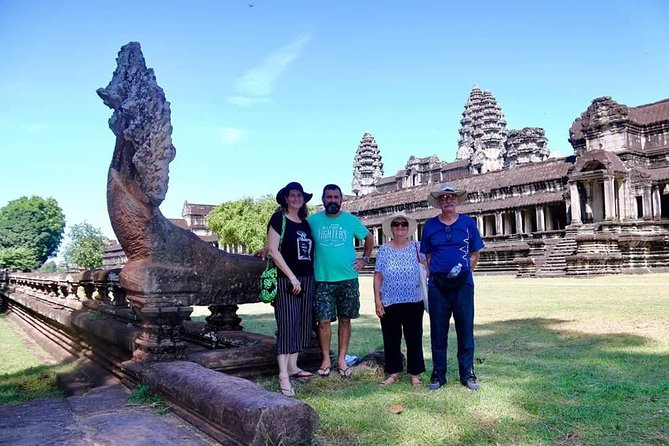
Pickup for sunrise is usually between 4:10 and 4:30 a.m., depending on the season. This is the part of the tour you need to decide on honestly. You are not simply arriving at sunrise, taking one photo, and going back to bed. You may reach the temple in darkness and wait for the sky to change.
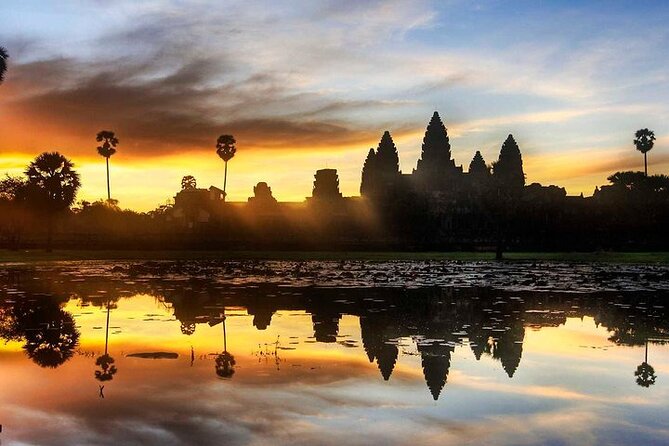
The tour enters from Angkor Wat’s eastern side, described as a less-used entrance. Moving through the temple before dawn can be wonderfully quiet, although you should be ready to use a phone flashlight and possibly sit on the ground while waiting.
The sunrise itself is never guaranteed to produce a perfect red sky. Clouds may soften the colors, and the viewing area can still be busy. Even so, watching Angkor Wat emerge from shadow is one of the strongest reasons to book this tour.
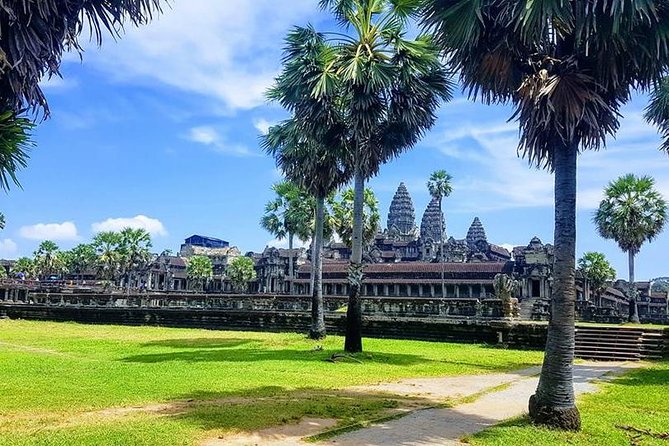
After the light improves, you have time to explore the temple itself. The three towers, long galleries, courtyards, and carved scenes deserve more than a quick walk to the famous reflection pool.
Three hours are allocated to Angkor Wat. That is a useful amount of time, especially after the early start. You can see the main approach, hear the temple’s story from the guide, and still pause for photos without being pushed through every corridor.
A practical tip: bring a light layer for the pre-dawn wait and shoes you can walk in comfortably. You will spend much of the day moving between stone surfaces, dusty paths, and steps.
More Temple Sunrise Tours in Siem Reap
- Angkor Wat Sunrise tour with Small – Group and Guide tours
★ 5.0 · 3,655 reviews - Angkor Wat Highlights and Sunrise Guided Tour from Siem Reap
★ 5.0 · 3,213 reviews - Full-Day Angkor Wat Sunrise Private Tour with Guide from Siem Reap
★ 5.0 · 2,920 reviews - Angkor Wat Sunrise & 3 Main Temples with Breakfast – Small Group
★ 5.0 · 2,857 reviews
Angkor Thom and the faces of Bayon
After Angkor Wat, the route moves to Angkor Thom, the former royal capital. The scale changes at once. Instead of one temple complex, you are entering a vast walled city with gates, roads, terraces, and several major monuments.
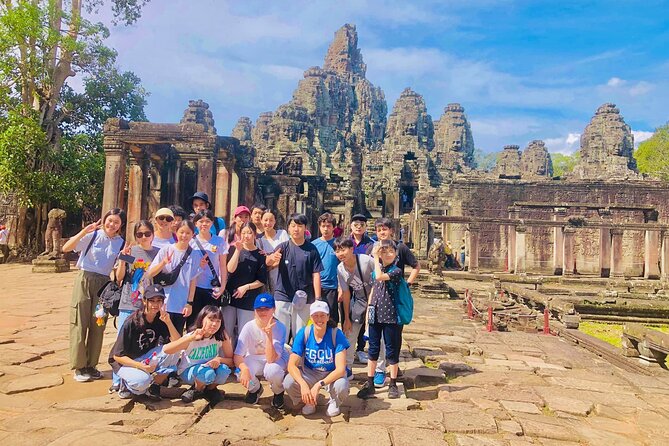
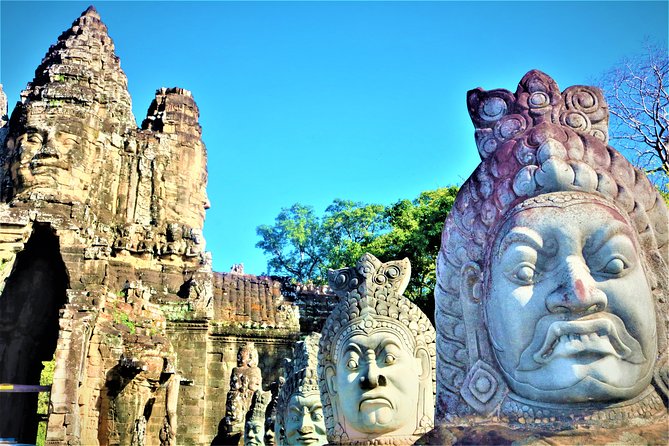
The Bayon is the star here. Its towers carry large carved faces that look in different directions, creating one of the most recognizable scenes in Cambodia. The temple can feel confusing at first because its galleries and towers crowd together. A strong guide helps you understand how to move through it and where to pause.
The visit to Angkor Thom is listed at about 90 minutes. That is enough for a useful introduction, though you may want more time if you are fascinated by the carvings. The tour is trying to cover several places in one morning, so this is not a slow archaeological study.
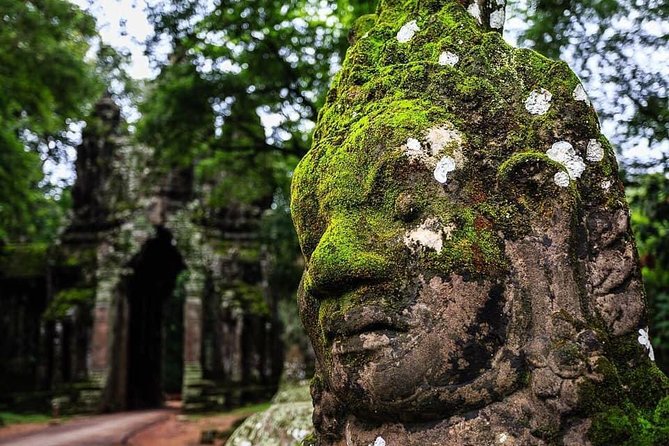
You also stop at the South Gate for about 30 minutes. The approach is lined with sculpted figures pulling a naga, giving you a memorable entrance to the city. The gate is a short visit, but it helps connect the grand plan of Angkor Thom with its religious imagery.
Terraces and Ta Prohm bring the morning to a close
The route passes the Terrace of the Leper King and the Terrace of the Elephants. These long platforms once formed part of the ceremonial center of Angkor Thom.
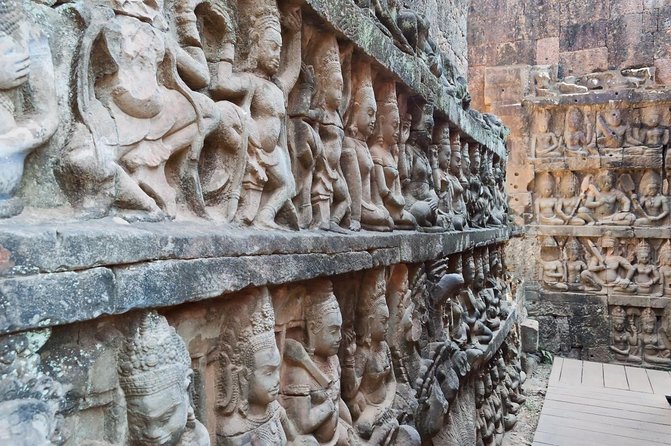
The Terrace of the Elephants is especially easy to appreciate from the outside, where the carved animals and long platform show how grand public ceremonies must have been. The Terrace of the Leper King has more enclosed reliefs and detailed figures. The itinerary allows about 90 minutes for the terrace area, though exact time can vary with the group and site conditions.
Ta Prohm is the final major stop. This is the temple most people associate with trees growing through ruins, but its appeal is not only photographic. Ta Prohm still gives you a strong sense of a working religious complex, with courtyards, galleries, collapsed sections, and roots pressing into the stone.
The temple once housed 2,740 monks, and that figure helps you picture it as more than a picturesque ruin. It was a living institution with people, rituals, and daily work.
You have about an hour at Ta Prohm. Expect narrow passages and crowded photo points. The guide can help you see details beyond the most famous tree-covered doorway, but the short visit means you will need to keep moving.
Some departures finish around noon after the sunrise and temple visits. That makes day two shorter in clock time than day one, but the 4:30 a.m. start still makes it tiring. A nap afterward is not a luxury. It is part of the plan.
The guide can make or break the temples
The best feature of this tour is not only the route. It is the guide assigned to your group. Guides named Pal, Sak, Sokpee, Pi, Chhay, Bun, and Sarak have been praised for clear storytelling, patience, humor, and strong English.
Several guides also use an iPad with images and written material. That is helpful when a carving or deity is hard to see in the stone itself. It also suits visual learners who need more than a spoken list of dates and kings.
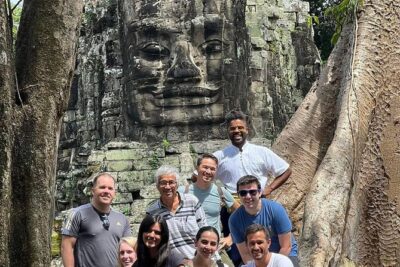
Photography help is another practical strength. Pal, Sak, Pi, and Sarak are noted for taking photos and knowing good angles. If you are traveling alone, this can save you from asking strangers at every stop. It is not a formal photography tour, but it is a welcome service.
The guide names cannot be guaranteed. You may receive one of the people mentioned above or another member of the team. The consistent thing to look for is a guide who explains the temples in context rather than simply pointing out the biggest doorway.
Air conditioning matters more than you may expect
A climate-controlled van is a major advantage here. Open-air tuk-tuks can be enjoyable for short rides, but after several hours of walking in heat, the cool vehicle gives your body a chance to recover.
Drivers such as Naro, Mao, Ha, Keal, Vichet, and Sha are praised for punctual pickups, safe driving, and keeping cold water and towels ready. The cool towels are especially useful after long walks through exposed temple grounds.
The roads can be dusty and rough in places. You may not get a perfectly smooth ride, but you do get a more protected one. The maximum group size is 15, and some departures have had only six or seven people. Smaller groups make it easier to hear the guide and rejoin the vehicle without confusion.
The tour offers hotel pickup and drop-off in Siem Reap. Confirmation is provided at booking, and the activity is near public transportation, though most people will simply use the arranged hotel pickup.
Who should book this two-day Angkor tour?
I would choose this tour if you have only two days for Angkor and want someone else to handle the route, temple order, transport, and early-morning logistics.
It suits solo visitors, couples, families with older children, and anyone who wants a clear first look at the archaeological area. Children must be accompanied by an adult, and children younger than five are not allowed. Families with children around seven or eight have managed the trip well, but the long first day and pre-dawn second day still require stamina.
I would be more cautious if you dislike early starts, long walks, heat, or fixed group timing. Day one is packed, and you may see nine or more temples depending on the precise route and timing. You will not have unlimited time at each site.
The tour also works well if you want a guide but still value some independence. One departure allowed people to wander on their own at certain points as long as they returned on time. Ask your guide what flexibility is possible on the day.
You should cover your shoulders and knees inside the temples. Comfortable walking shoes are essential. The operator can provide umbrellas in wet weather, but you should still expect dusty paths, sudden rain, and strong sun.
Should you book it?
Book this tour if you want the main Angkor sights plus Banteay Srei, prefer an air-conditioned vehicle, and value a guide who can explain the carvings and help with photos. The extra $62 temple pass is significant, but the total remains reasonable for two days of transport and guiding.
Skip it if you want a slow, private visit with long stretches at one temple. You may also prefer another plan if sunset is your main goal, since smog and clouds can spoil the view.
For most first visits, I like the balance. Angkor Wat sunrise is the centerpiece, Banteay Srei adds variety, Ta Prohm and Bayon deliver the famous images, and the cool vehicle keeps the long days manageable. Just protect your sleep, bring proper walking shoes, and go in expecting a full schedule rather than a leisurely stroll.
FAQ
How much does the tour cost?
The tour costs $49 per person. The required two to three day temple pass costs an additional $62 per person and is paid directly at the site.
What does the $49 tour price include?
It includes two days of temple touring, a licensed English-speaking guide, air-conditioned transport, hotel pickup and drop-off, bottled water, cool towels, sunset on day one, and sunrise on day two.
Are meals included?
No. Meals are not included, so you pay for food at your own choice.
What time does the tour start?
The regular first-day start time is 8 a.m. The sunrise pickup on day two is usually between 4:10 and 4:30 a.m., depending on the season.
How large is the group?
The tour has a maximum of 15 participants. Some departures may be much smaller.
Which temples are included?
The route includes Preah Khan, Neak Pean, Banteay Srei, Pre Rup, Angkor Wat, Angkor Thom, the South Gate, the Terrace of the Elephants, the Terrace of the Leper King, and Ta Prohm.
Is the temple pass included?
No. You must pay the $62 temple pass fee separately at the site.
What should I wear?
Wear comfortable walking shoes. Shoulders and knees must be covered inside the temples, and casual clothing is suitable.
Can children join the tour?
Children must be accompanied by an adult. Children younger than five are not allowed.
More Temple Sunset Tours in Siem Reap
- Siem Reap: Full Day Angkor Wat Temple Experience with Sunset
★ 4.9 · 1,490 reviews - Angkor Wat full Day ‘Small Group with sunset & Tour Guide
★ 5.0 · 1,369 reviews - 2 Days Exclusive Temple Highlights with Sunset and Sunrise Tour
★ 5.0 · 1,157 reviews - Siem Reap: 2-Day Temple Highlights Sunrise and Sunset Option
★ 4.9 · 445 reviews
More Temple Sunset Tours in Cambodia
- Siem Reap: Full-Day Angkor Wat Guided Tour with Sunset
★ 4.9 · 3,803 reviews - Angkor Wat Sunset Small Group Tour with Lunch Included
★ 5.0 · 3,059 reviews - Siem Reap: Angkor Wat Sunrise or Sunset Guided Tour
★ 4.9 · 2,123 reviews - Full-Day Guided Sunset Tour of Angkor Wat
★ 5.0 · 1,507 reviews
Just added around Siem Reap
- Ticket for Angkor Balloon Ride.★ 3.7 · 46 reviews
- Sunrise at Angkor Wat Temple: 3-Hour Private Tour★ 4.7 · 30 reviews
- Small-Group Full Day Angkor wat Guide tour with Sun set★ 5.0 · 136 reviews
- Siem Reap: Private 4-Day Angkor Wat and Phnom Kulen Tour★ 5.0 · 9 reviews
- Angkor Wat: Sunrise 2.5 Days Temples & Tonle Sap-Small Group★ 5.0 · 10 reviews
- Siem Reap : Private Tuk-Tuk Tour of the Magnificent Temples.★ 4.9 · 14 reviews
- Siem Reap: Ultimate Angkor Wat Offbeat Experience by Jeep★ 4.9 · 8 reviews
- Siem Reap: Personalized Angkor Wat Sunrise/Set by TukTuk/Car★ 4.9 · 41 reviews
Angkor Wat Tours, compared.
Angkor Wat Sunrise or Sunset Tour with Guide from Siem Reap
Read our review →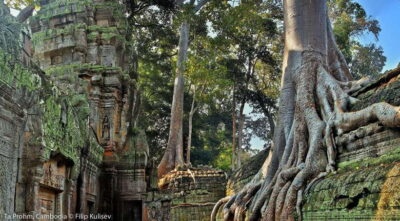
Angkor Wat: Small-Group Sunrise or Sunset Tour
Read our review →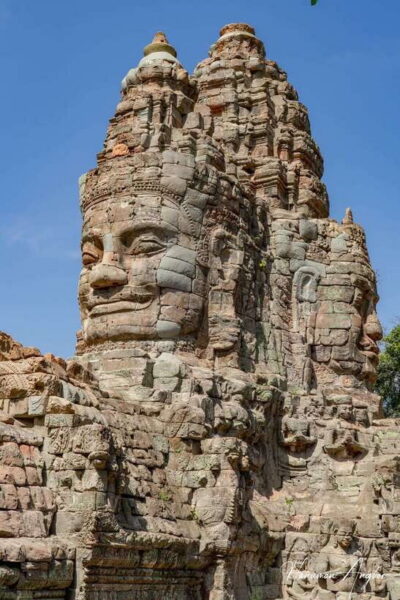
Angkor Wat 2-Day Tour with Sunrise and Sunset
Read our review →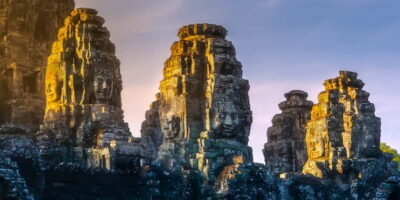
Angkor Wat Sunrise tour with Small – Group and Guide tours
Read our review →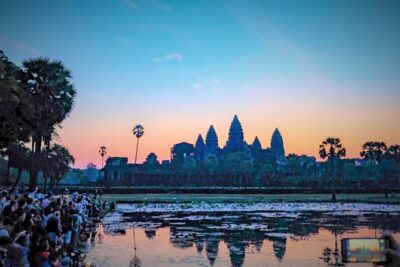
Angkor Wat Highlights and Sunrise Guided Tour from Siem Reap
Read our review →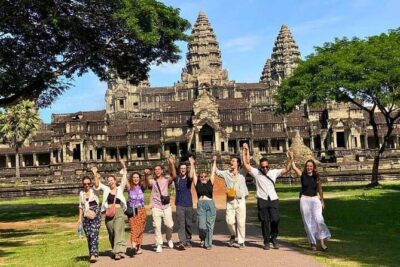
Angkor Wat Sunset Small Group Tour with Lunch Included
Read our review →