
REVIEW · GRAND PALACE & WAT PHO TOURS
Bangkok Temples Tour at Wat Arun, Wat Phoa and Wat Saket
Bangkok’s grandest temples make more sense when you see them in a smart order. This half-day trip begins at Wat Saket, moves to Wat Pho, then crosses the river by boat to Wat Arun, giving you three very different religious sites without the usual taxi negotiations.
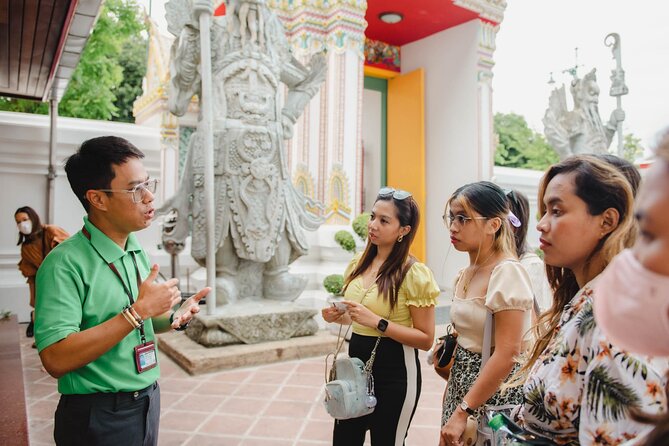
I like the small group limit of nine, which leaves room for questions and personal help. I also like the guides’ practical touch. Michael is praised for finding good photo angles, while Jojo helped a visitor with Thai language practice and temple merit-making.
The main drawback is the fixed four-hour pace. You get a useful first look, not a slow, contemplative visit, and the central pickup service applies only to selected addresses. You’ll also need to meet at National Stadium BTS Station unless your pickup is confirmed.
Key points to know before booking
- Three major temples in one morning: See Wat Saket, Wat Pho, and Wat Arun without planning separate rides.
- A small group of no more than nine: The size allows more conversation and easier questions.
- A riverboat crossing is included: The ride to Wat Arun adds a pleasant change from road traffic.
- Guides bring different strengths: Michael, Fern, Coconut, Pim, Bond, Jojo, Nicki, Rose, and Nancy are praised for clear explanations, local insight, photographs, and personal help.
- The tour lasts about four hours: It works well for a short stay or a Bangkok layover.
- Price is $95 per person: That is fair if you value transport, entry fees, a guide, and a well-planned route, but less attractive if you prefer exploring temples on your own.
Three Bangkok temples, three very different moods
I like this tour because it does not treat Bangkok’s temples as a single blur of gold, tile, and tourists. Each stop has its own character.
Wat Saket is a hilltop temple with a gold chedi and a relic said to be connected with the Buddha. Wat Pho is a major temple complex built around its enormous reclining Buddha. Wat Arun is the photogenic riverside finish, with pale spires that have become one of Bangkok’s best-known sights.
The order also makes practical sense. You begin inland, visit Wat Pho near the river, then cross to the opposite bank by boat. That saves you from arranging three separate taxi rides and gives the morning a natural finish at the Chao Phraya River.
Your guide is an important part of the experience. The tour is not simply a ride between admission gates. Guides such as Fern and Bond explain local customs and Thai life, while Jojo can help connect the visit with merit-making and basic Thai language. If you are interested in religion and daily culture, that personal exchange can be as useful as the formal facts.
More Grand Palace and Wat Pho Tours in Bangkok:
- Bangkok: Grand Palace, Wat Pho, and Wat Arun Guided Tour
★ 4.8 · 3,632 reviews - Bangkok: Grand Palace and Wat Phra Kaew Guided Walking Tour
★ 4.4 · 2,417 reviews - Bangkok: Grand Palace, Wat Pho, Wat Arun Sacred & Local Tour
★ 4.3 · 2,256 reviews
Wat Saket and the climb to the Golden Mount
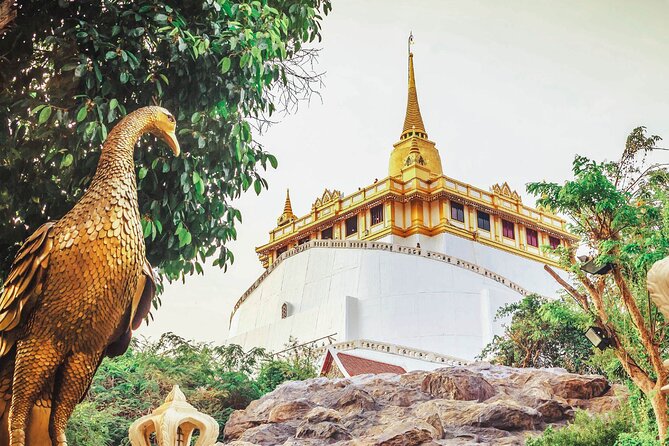
The first stop is Wat Saket, also called the Golden Mount. The temple rises on a man-made hill, topped by a gleaming gold chedi that is believed to contain a Buddhist relic.
The visit lasts about an hour and 15 minutes, making it the longest stop. That gives you time to take in the temple, climb to the higher section, and listen to the guide rather than rushing straight through.
Wat Saket is a good opening stop because it offers a sense of Bangkok from above as well as a place of worship. The site is not just a pretty structure for photographs. It remains an important pilgrimage destination, and the relic tradition gives the temple religious meaning for Thai Buddhists.
You should dress with respect at all three temples. Clothing that covers the shoulders and knees is the sensible choice, and you should be ready to remove shoes in areas where signs or temple practice require it. The exact conditions can vary by site, so follow your guide’s instructions.
The Golden Mount also sets the tone for the morning. This is a working religious place, not a museum arranged only for sightseeing. You may find bells, shrines, offerings, and worshippers sharing the same space as tour groups. Keep your voice low and ask before photographing people engaged in prayer.
Wat Pho and the 46-metre Reclining Buddha
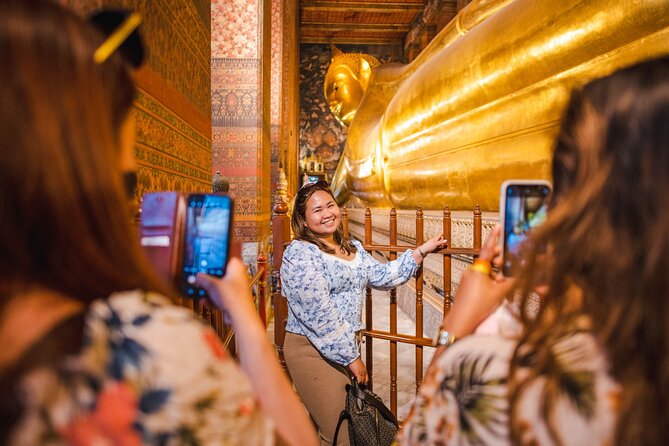
Wat Phra Chetuphon, usually called Wat Pho, receives about an hour of the tour. Its main draw is the giant reclining Buddha, a 46-metre figure covered in gold leaf.
The scale is hard to grasp from photographs. The statue fills the building, so you move through the space in stages, catching different views of the face, body, and feet. The feet are especially worth your attention, with detailed decoration that rewards a slower look.
Wat Pho is more than one statue. It is a large temple complex with courtyards, shrines, tiled buildings, and many decorative details. Your guide helps you decide what deserves attention, which matters when you have only an hour.
This is also the point where a good guide can prevent the visit from becoming a rushed photo stop. Belle is praised for being accommodating, and several guides are described as clear, friendly, and willing to answer questions. A guide can explain why the reclining pose matters in Buddhist art and how the complex fits into Bangkok’s religious life.
The one-hour limit is the tradeoff. If you want to inspect every courtyard or spend a long time photographing the Buddha, you may feel hurried. Still, for a first visit, the time is enough to see the central highlights and understand why Wat Pho is one of Bangkok’s essential stops.
The listed admission cost for Wat Pho is THB 300, and it is included in the tour. That helps the $95 price make more sense, especially when combined with the other entry fee, transport, guide service, and riverboat ride.
The riverboat ride to Wat Arun
After Wat Pho, the tour provides a boat ride to Wat Arun. This short change of pace is one of the most useful features of the route.
Bangkok’s roads can be slow and confusing, even when two sights look close on a map. Traveling by river avoids another road transfer and lets you see the city from a different angle. You may find the boat ride is less about sightseeing commentary and more about getting efficiently to the next temple, but it still adds variety to the morning.
Wat Arun sits on the opposite side of the Chao Phraya River. The approach helps you understand its setting: the temple is not simply an isolated monument, but part of Bangkok’s riverside identity.
The boat is included, and that matters because independent visitors often need to work out which pier, ticket, and crossing to use. Here, your guide handles the movement between the temples while you focus on the sights.
A few more temple visits around Bangkok worth a look
- From Bangkok: Ayutthaya Temples Guided Tour with Lunch
★ 4.7 · 10,535 reviews - Bangkok: City Highlights Temple and Market Walking Tour
★ 4.5 · 3,990 reviews - Bangkok by Night: Temples, Markets and Food Tuk-Tuk Tour
★ 5.0 · 3,752 reviews - Bangkok: Temples, Canals & Local Life Bike Tour
★ 4.9 · 3,511 reviews
Wat Arun and the white spires by the river
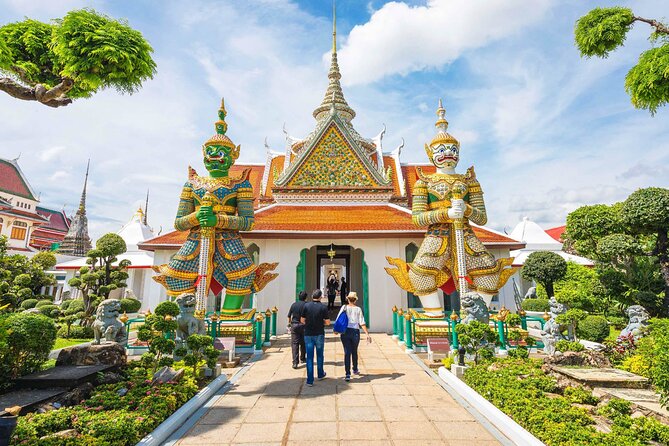
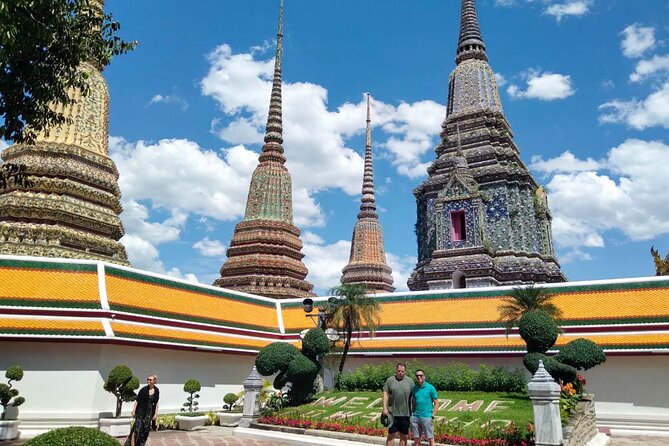
The final stop is Wat Arun, the Temple of Dawn. You have about an hour here, enough to admire the famous white spires and learn about the complex before returning to the meeting point.
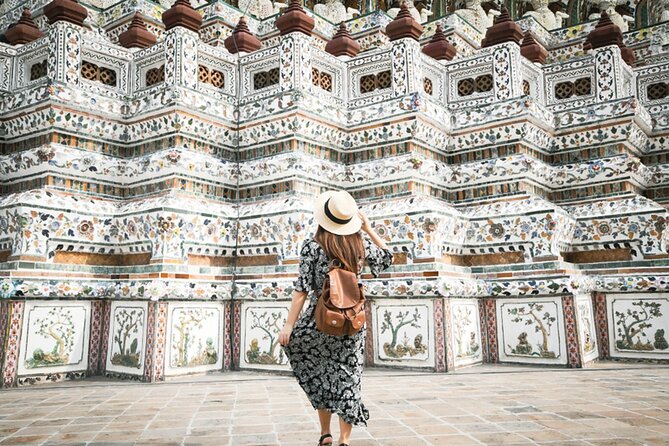
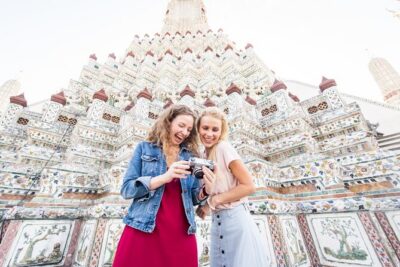
Wat Arun is especially photogenic. Its pale prang, decorated with porcelain and ceramic details, catches the light and looks different from every approach. The river setting gives it a spacious quality that contrasts with the enclosed rooms and courtyards at Wat Pho.
The temple is listed as a top landmark in Thailand, and its popularity is easy to understand. It is the most instantly recognizable stop on this route, but do not let the photographs reduce it to a backdrop. Your guide can put the architecture into religious and cultural context, making the visit more than a quick picture stop.
The tour includes THB 200 entry to Wat Arun. Like Wat Pho, this fee is already covered. You should still allow for personal spending, since lunch and other purchases are not included.
Wat Arun is also a good final stop because the boat crossing and river setting give the morning a clear sense of movement. After three temples, you return to the meeting point with a compact introduction to Bangkok’s religious architecture rather than three disconnected visits.
Why the small group size matters
The maximum group size is nine people. That is small enough for a guide to hear questions and keep the group together, but it is still a shared tour rather than a guaranteed private outing.
Several bookings may result in only one or two people joining. That can turn the experience into something close to a private tour, and the guide may have more room to adjust the conversation to your interests. Nicki and Rose are both praised for handling small bookings with personal attention, while Pim is noted for giving a particularly detailed explanation of the sites.
Do not book on the assumption that you will receive a private tour, though. The published format is shared, with a limit of nine. If the group fills, the pace and conversation will feel more structured.
The guide quality appears to be the strongest part of the experience. Michael is praised for humor, kindness, and helping with photographs. Coconut is described as helpful with translation and temple explanations. Bond offers a relaxed discussion of Thai life, and Jojo adds language and religious guidance for visitors who want more than standard facts.
Guide assignments can change, so you cannot choose one of these names when booking based on the information provided. Still, the range of positive comments suggests the company’s strength is its people rather than just its route.
Pickup, timing, and the return to National Stadium

The tour starts at 8:30 am and ends back at the meeting point. The listed meeting point is National Stadium BTS Station in Pathum Wan.
Hotel pickup and drop-off are offered from selected central Bangkok addresses. Confirm this carefully before the morning of the tour. If your hotel is outside the pickup area, plan to reach National Stadium BTS Station yourself.
An early start is sensible in Bangkok. It gives you a better chance of visiting the temples before the strongest heat of the day, and it leaves the afternoon free for lunch, shopping, museums, or a rest at your hotel.
The exact four-hour timing may vary with traffic, temple conditions, and the group. The route includes three stops, transfers, and a boat ride, so you should not plan a hard-to-miss appointment immediately afterward.
The tour is near public transport, and most people can participate. The available information does not give specific accessibility details, so ask the operator before booking if stairs, walking surfaces, or boat boarding are a concern.
Is $95 a fair price?

At $95 per person, this is not the cheapest way to see Bangkok’s temples. If you are comfortable using public transport, hiring short taxi rides, and arranging entry yourself, you may spend less independently.
The price becomes more reasonable when you count what is bundled: a guide, entry to Wat Pho and Wat Arun, the Wat Saket visit, transport between sites, the riverboat ride, bottled water, and selected hotel pickup. You are also paying to avoid the planning work and to have someone explain what you are seeing.
I would consider the tour good value for a first Bangkok visit, a short stay, or a layover. It is also useful if you want cultural context rather than a self-guided sequence of photographs.
The value is weaker for repeat visitors who already know the temples and prefer to spend as long as they like at one site. A private guide would offer more control, but this small-group format can sometimes provide a similar feel without the full private-tour cost.
The tour has a 4.9 rating from 37 reviews, with 97 percent recommending it. Those numbers point to a consistently strong experience, especially in guide service, but they do not remove the normal limits of a four-hour group itinerary.
What to bring and how to prepare
Wear light clothing that covers your shoulders and knees. Bangkok can be hot, and temple visits involve walking, stairs, and time outdoors.
Bring a small amount of water, although bottled water is supplied. You may also want cash for personal expenses or lunch, since neither is included.
A phone or camera is useful, but do not let photographs take over the visit. Michael and other guides may help you find good angles, yet the best benefit of the tour is learning what you are looking at.
Arrive ready for a morning of movement. You will visit three religious complexes, transfer between them, take a boat, and return to the starting point. Comfortable shoes will make the experience easier.
Cancellation is free up to 24 hours before the start time. Changes or cancellations made less than 24 hours before departure are not accepted for a refund. The tour requires good weather, and poor conditions may lead to a new date or a full refund.
Who should book this temple tour?
I would choose this tour if you have limited time in Bangkok, want a clear introduction to the city’s major temples, or prefer having a guide manage transport and entry.
It suits solo visitors who want company without joining a huge bus group. It also works well for couples, first-time visitors, and people who want to ask questions about Thai customs, religious practice, or local life.
I would skip it if your main goal is to linger for hours at Wat Pho or Wat Arun, take extensive photographs, or set your own pace. Independent sightseeing will give you more freedom, though you will need to organize the route yourself.
For most first-time visitors, the combination of three important temples, a riverboat crossing, and a small group makes this a practical half-day introduction. Book it for structure and explanation, not for an unhurried private exploration.
FAQ
How long does the Bangkok temples tour last?
The tour lasts approximately four hours.
What time does the tour start?
The listed start time is 8:30 am.
Where does the tour meet?
The meeting point is National Stadium BTS Station in Pathum Wan, Bangkok. Hotel pickup is also available from selected addresses.
Which temples are included?
The tour visits Wat Saket, Wat Phra Chetuphon, also called Wat Pho, and Wat Arun.
Is the boat ride included?
Yes. A boat ride to Wat Arun is included in the tour.
Are temple entrance fees included?
Yes. Entrance fees are included, including the listed THB 300 fee for Wat Pho and THB 200 fee for Wat Arun.
What is the maximum group size?
The tour has a maximum of nine participants.
Just added around Bangkok
- Visit temples in and around Bangkok with a former monk of 10 years★ 5.0 · 30 reviews
- Visit Wat Pho and Wat Arun with Local Expert★ 4.0 · 14 reviews
- Top 3 Bangkok Temples: Multilingual Private Tour [EN,ES,DE,IT,FR]★ 5.0 · 9 reviews
- 3-Hour Bangkok Walking Tour: Wat Pho and Wat Arun★ 5.0 · 102 reviews
- Thai Dance Class at Wat Arun★ 5.0 · 30 reviews
- Grand Palace & Emerald Buddha Private Tour [Optional Luxury]★ 5.0 · 27 reviews
- Shore Excursion Laem Chabang Port : Grand Palace & Famous Temples★ 4.0 · 6 reviews
- Ancient City & Temples of Ayutthaya ( UNESCO ) by River Cruise with Buffet Lunch★ 4.0 · 11 reviews
Grand Palace & Wat Pho Tours, compared.
Grand Palace, Wat Pho, and Wat Arun Guided Tour
Read our review →
Grand Palace and Wat Phra Kaew Guided Walking Tour
Read our review →
Grand Palace, Wat Pho, Wat Arun Sacred & Local Tour
Read our review →
Grand Palace & Temples of Bangkok with experienced guide
Read our review →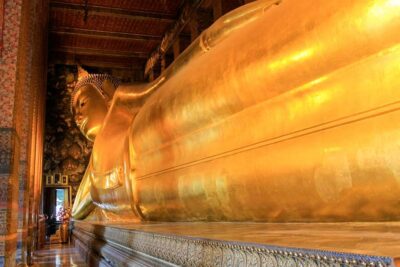
Grand Palace, Wat Pho, and Wat Arun Private Tour
Read our review →
Evening Tour with Wat Arun, Wat Pho & Tuk Tuk Ride
Read our review →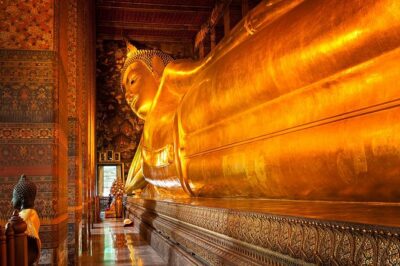
Bangkok City Highlights Tour: Grand Palace & Three Iconic Temples
Read our review →Browse the lists this tour appears in