REVIEW · TEMPLE TOURS
Ostrog Monastery from Budva and Petrovac
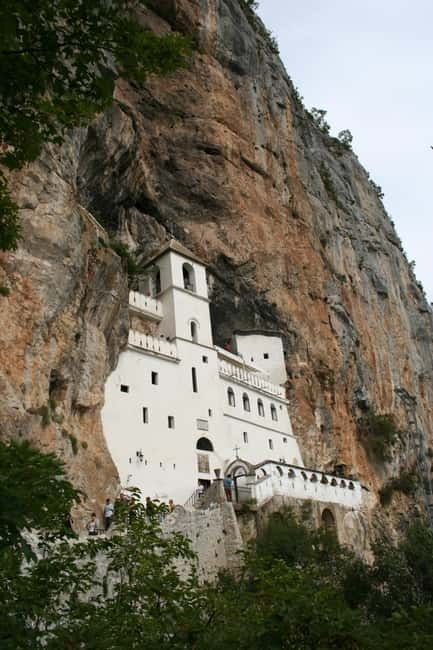
Ostrog Monastery is one of Montenegro’s most memorable sights: a white Orthodox monastery set high against a rocky mountainside, with the relics of St. Basil of Ostrog kept in the upper church. This seven-and-a-half-hour outing gives you a practical way to reach it from Budva or Petrovac without arranging your own transport.
I like two things here. Transport and a licensed guide are included, and the operator has been running excursions since 1981. I also like that you get time for both the lower and upper monastery rather than a quick roadside photograph. The main caution is the approach to the upper church. Queues, a crowded road, and a short shuttle ride can consume much of your visiting time.
Key points to know before booking
- The upper church holds the relics of St. Basil of Ostrog, making this a place of pilgrimage as well as a sightseeing stop.
- About two and a half hours are scheduled at the monastery, though waiting and road conditions can reduce the useful time.
- The final approach may involve a separate taxi or shuttle, priced at 1.50 euros per person each way.
- English and Russian are offered, but English commentary may be limited if the group is largely Russian-speaking.
- Lunch is not included, and you should also budget 1 euro per person for tourist tax.
- Modest clothing is required, with shoulders and knees covered inside the monastery.
Why Ostrog Monastery is worth the long day
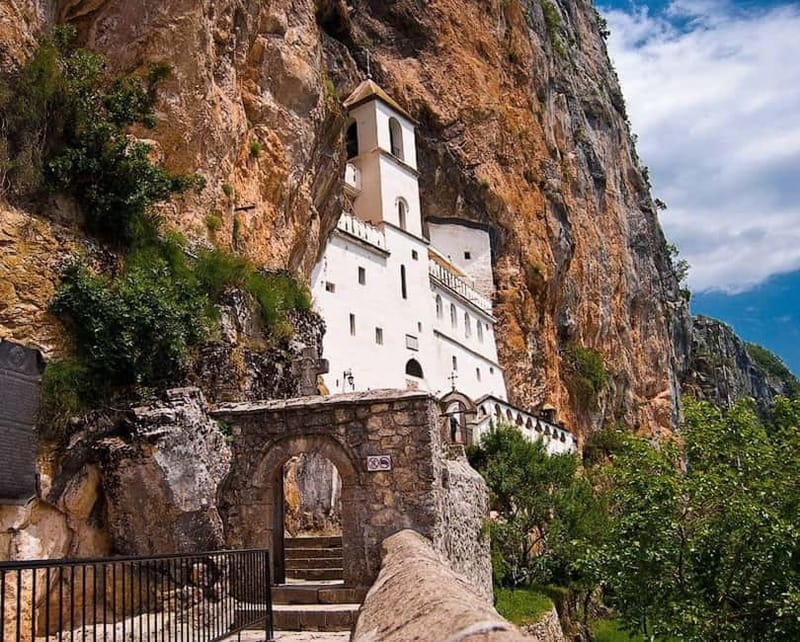
Ostrog is not simply another church stop. The monastery has two distinct parts, and the upper complex is built into the rock high above the surrounding countryside. That setting gives the visit much of its force, even before you step inside.
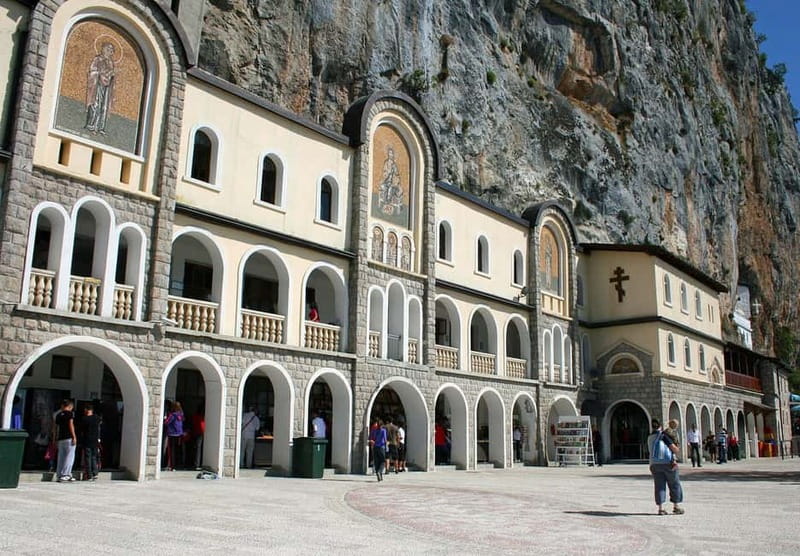
The lower monastery centers on the Church of the Holy Trinity, dating from 1824. The upper monastery includes the Church of the Holy Cross, dating from 1665, and houses the relics of St. Basil of Ostrog. You can reach the upper church on foot or by a separate vehicle service.
I would choose this trip if you want to see one of Montenegro’s major religious sites and are comfortable with a day shaped by road time, queues, and a pilgrimage atmosphere. I would not choose it simply as a quick scenic outing. The monastery matters most if you are interested in Orthodox faith, religious art, sacred places, or the unusual setting.
The day begins in Budva, with departures also available for people staying in Petrovac. The excursion returns to Budva at about 16:00, giving you a full half-day away from the coast. The advertised total duration is 7.5 hours, so leave room around the excursion rather than planning a tight afternoon appointment.
A few more temple visits around the world worth a look
- Lisbon: Jerónimos Monastery Entrance Ticket
★ 4.1 · 14,164 reviews - Angkor Wat Sunrise or Sunset Tour with Guide from Siem Reap
★ 5.0 · 12,109 reviews - Teotihuacan, Guadalupe Shrine & Tlatelolco Day Tour with Lunch
★ 5.0 · 11,603 reviews
The road from Budva to the monastery
The tour includes transport, which is the main reason to consider booking it rather than trying to piece together the journey yourself. The monastery is not a simple walk from Budva, and the final road can be demanding.
The approach to Ostrog is part of the experience, but it is also where delays can appear. The route becomes more difficult near the monastery, and vehicles may need to change before reaching the upper section. One practical account described a bus change that delivered the group directly to the upper monastery, while another reported that the final approach took around 1 hour and 15 minutes because of heavy congestion.
That difference matters. The schedule may say two and a half hours at Ostrog, but the amount of time you actually spend inside the churches depends on traffic, the number of visitors, and the current transport arrangement. If you are visiting during a busy period, expect patience to be part of the price.
You should also confirm the pickup point carefully before departure. There have been problems with unclear meeting information and a vehicle passing the expected pickup location. Get to the stated meeting point early, keep your phone available, and make sure you know what vehicle or company name to look for.
The lower monastery and Church of the Holy Trinity
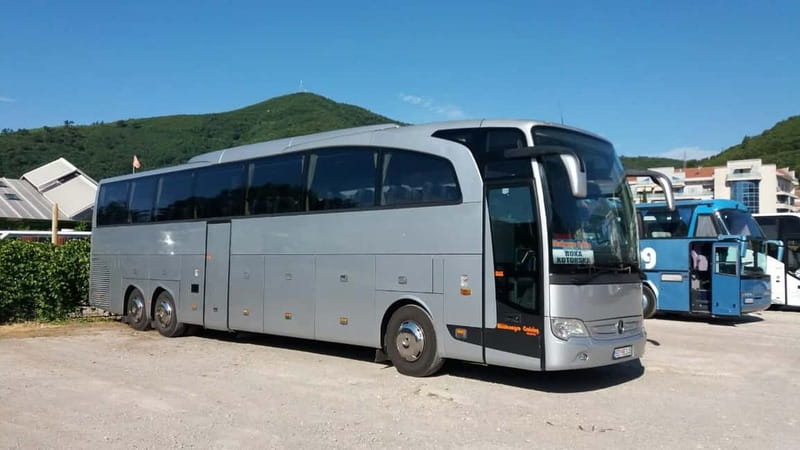
The lower monastery is the easier part of the visit. Here you find the Church of the Holy Trinity, built in 1824, along with the lower monastic complex.
This section gives you a calmer introduction to Ostrog. It helps you understand that the site is not one single chapel but a connected religious complex with upper and lower sections. Your guide can provide context during the journey and at the site, though the amount of spoken information may depend on the language mix in your group.
Allow time to look around rather than treating the lower church as a waiting area for the upper visit. The lower section is also useful if queues make the upper church difficult to reach. You will still see an important part of the monastery and gain a better sense of how the two levels fit together.
The tour is led in English and Russian. English speakers should set expectations carefully. Some departures have had commentary split heavily toward Russian, with only limited information in English. If you want detailed historical or religious explanation in English, ask the guide directly at the start of the day. A guide named Ana received especially warm praise for her work, but guide assignments can change.
The upper church and St. Basil’s relics
The upper monastery is the reason most people make this trip. The Church of the Holy Cross, dating from 1665, is built into the rock, and the relics of St. Basil of Ostrog are kept here.
The setting is striking, but the visit is not designed like a normal museum entrance. This is an active place of Orthodox worship and pilgrimage. You may need to wait to enter, move through the church with others, and follow the customs of the monastery.
You can reach the upper church on foot or use the local transport service. The listed charge is 1.50 euros per person each way. That means a return ride costs 3 euros per person if you use it both ways. The fee is small, but it is not included in the tour price, and you should carry cash for these extras.
The walk or ride is not a minor detail. The upper section is reached by a steep and difficult approach, and queues can build before you reach the church itself. One account described having only about ten minutes inside after a long wait. Another praised the direct bus access to the upper monastery, while still noting that the English information during the ride was limited.
My advice is simple: treat the upper church as a sacred visit, not a guaranteed photo stop. If you are mainly interested in architecture and views, the day may feel slow when the queue is long. If you are interested in St. Basil, Orthodox worship, or religious pilgrimage, the wait may feel worthwhile.
Same country, a different morning at the gates:
- From Bangkok: Ayutthaya Temples Guided Tour with Lunch
★ 4.7 · 10,535 reviews - Siem Reap: Angkor Wat: Small-Group Sunrise or Sunset Tour
★ 5.0 · 9,444 reviews - Athens: Cape Sounion & Poseidon Temple Sunset Half-Day Trip
★ 4.8 · 8,241 reviews - Ubud: Monkey Forest, Jungle Swing, Rice Terrace, and Water Temple
★ 5.0 · 7,160 reviews
How much time will you really have?
The planned stop at Ostrog is about 2 hours and 30 minutes. On paper, that is a reasonable amount of time for the lower monastery, the upper church, and a little breathing room.
In practice, you may lose time to road congestion, a vehicle change, the shuttle to the upper monastery, and the line to enter the church. This is the tour’s biggest uncertainty. A scheduled two-and-a-half-hour stop does not always mean two-and-a-half hours of quiet sightseeing.
Try to move efficiently once you arrive. If the guide gives instructions about the upper church, listen closely. Decide early whether you will walk or pay for the local ride. If the line is already long, do not spend too much time at the lower complex before checking the upper queue.
The itinerary includes a lunch break after the monastery visit. Lunch is not included, and the exact restaurant or meal arrangement is not specified. Bring money and do not assume a meal is covered by the 69 dollar tour price.
What the 69 dollar price covers
At 69 dollars per person, the tour offers reasonable value if you want a simple organized connection from the coast to Ostrog. You pay for transport and a guide, and you avoid arranging the route yourself.
The price does not cover everything. Plan for:
- Lunch
- A 1 euro per-person tourist tax
- Transport to the upper church, listed at 1.50 euros per person each way
If you use the upper-church transport in both directions, the known extra charges come to 4 euros per person before lunch. That is not a large addition, but it is worth knowing before you leave.
The value depends on what you want from the day. For a visitor without a car who wants a guided visit to a difficult-to-reach monastery, the price is sensible. For someone hoping for a polished sightseeing tour with detailed English commentary and plenty of free time, the value is less certain.
The company has offered excursions since 1981, and professional service and licensed guides are listed as key features. Those credentials are reassuring, but they do not remove the practical risks of busy roads, unclear pickup arrangements, or uneven commentary between languages.
Dress, walking, and the religious setting
Cover your shoulders and knees before entering the monasteries. This is not just a suggestion for looking respectful in photographs. It is a stated requirement for visiting the religious buildings.
Wear clothing that keeps you covered without making the warm part of the day uncomfortable. A light layer or scarf can help if your usual sightseeing clothes leave your shoulders exposed. You should also choose shoes suitable for a steep or uneven approach.
The activity is not suitable for wheelchair users. The upper approach, the monastery setting, and possible vehicle changes make this an unsuitable choice if you need step-free access.
You do not need to approach the visit as a religious pilgrimage, but you should understand that it is one for many people. Keep your voice low inside the churches, follow local instructions, and allow worshippers space. The atmosphere may feel more serious than at a standard historic attraction.
Language and guide quality
The tour offers live guiding in English and Russian. That is useful for many visitors, but the quality of the English portion may vary with the group.
Some departures have had commentary divided mostly between Serbian and Russian, with only a small amount in English. If English is your only language, ask at the start how the guide will divide the information. You can also request the key points about the monastery, the upper church, and the meeting time before everyone spreads out.
Ana was singled out for providing excellent guidance, which suggests that the human side of the tour can be very good on the right departure. Still, you should not assume Ana will be your guide. The experience can feel much better when the guide gives clear instructions and makes sure English speakers are included.
The transport itself is more important than a long lecture. You mainly need clear information about the road, the upper and lower churches, the time limit, and where to return. If those basics are handled well, the tour can work even when the commentary is brief.
Who should book this Ostrog excursion?
I recommend it for you if:
- You are staying in Budva or Petrovac and do not have a car.
- You want to visit Ostrog as a religious site, not just photograph it.
- You are comfortable with a long day and possible delays.
- You can walk on uneven ground and manage a steep approach.
- You are happy to pay a few small extra charges for the upper church.
- You can handle a tour where English commentary may be shorter than Russian commentary.
I would hesitate if you have limited mobility, need a carefully timed itinerary, or dislike queues. I would also think twice if you want a relaxed day with extensive English explanation at every stop.
The excursion is best viewed as a practical ride to a powerful but demanding destination. It is not a luxury coach outing, and it may not run with the precision of a museum tour. The monastery itself is the reward, while the transport and timing require flexibility.
Should you book it?
Book this tour if Ostrog is high on your Montenegro list and you want transport from Budva or Petrovac with a guide included. The upper church, the relics of St. Basil, and the unusual rock-built setting make the destination special.
Before paying, make sure you are comfortable with three points: the 69 dollar price does not include lunch or all local charges, the upper visit may be shortened by queues, and English commentary may be limited on some departures. Confirm the pickup point carefully and dress for a religious site.
Free cancellation is available up to 24 hours before departure, and you can reserve now and pay later. Those flexible terms help if your coastal schedule is uncertain. Overall, I would book it for the destination and the convenience, but only if you approach the day as a pilgrimage-style outing rather than a perfectly controlled sightseeing tour.
FAQ
Where does the tour depart from?
The tour departs from Budva, with the activity also listed for people staying in Petrovac.
How long does the excursion last?
The advertised duration is 7.5 hours, with a return to Budva at around 16:00.
How much time is scheduled at Ostrog Monastery?
You are scheduled to have about 2 hours and 30 minutes at the monastery, although queues and road conditions can affect how much time you have inside the churches.
Is transport included?
Yes. Transport from the departure area and a guide are included in the price.
Is lunch included?
No. Lunch is not included, so you should budget separately for the meal during the break.
How much does transport to the upper church cost?
Transport to the upper church is listed at 1.50 euros per person, one way.
What should I wear to Ostrog Monastery?
You should cover your shoulders and knees while visiting the monasteries.
What languages are available?
The live guide service is offered in English and Russian.
Is the tour suitable for wheelchair users?
No. The activity is listed as unsuitable for wheelchair users.
Can I cancel the booking?
Yes. You can cancel up to 24 hours in advance for a full refund.
Can I reserve the tour without paying immediately?
Yes. The reserve-now, pay-later option lets you hold a place without paying at the time of booking.
Just added around the world
- Wat Doi Suthep Temple and White Meo Hilltribe Village Half-Day Tour from Chiang Mai★ 4.0 · 27 reviews
- Visit Chiang Rai Temples and Lalitta Cafe from Chiang Mai★ 4.5 · 23 reviews
- Chiang Mai – Doi Suthep Temple and Street Food Tour★ 5.0 · 17 reviews
- Private tour] Perfect day! Sticky waterfall + ChiangDao Cave + Wat BandenTemple★ 4.5 · 6 reviews
- Private tour Chiang Dao cave ,Temples,Sticky waterfall★ 5.0 · 14 reviews
- Private Tour to Doi Inthanon including Twins Pagodas and Hiking★ 5.0 · 22 reviews
- Best Places in Chiang Rai White, Blue, Big Buddha, Tea Plantation★ 4.0 · 70 reviews
- Private Tour: Chiang Mai City and Temples★ 4.0 · 36 reviews
Temple Tours, compared.
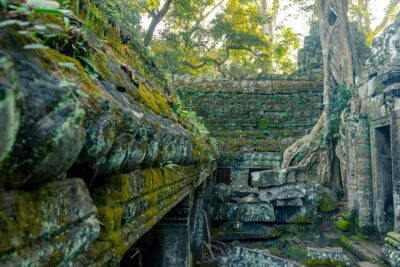
Angkor Wat Sunrise or Sunset Tour with Guide from Siem Reap
Read our review →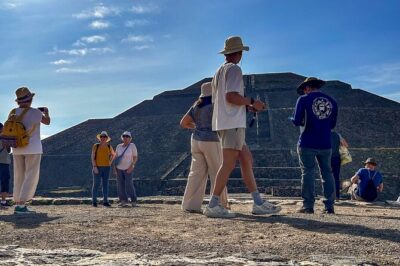
Teotihuacan, Guadalupe Shrine & Tlatelolco Day Tour with Lunch
Read our review →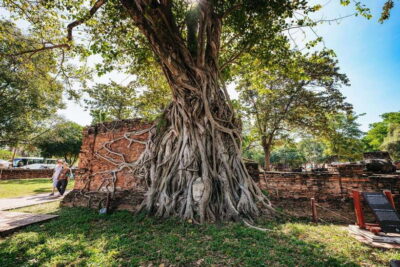
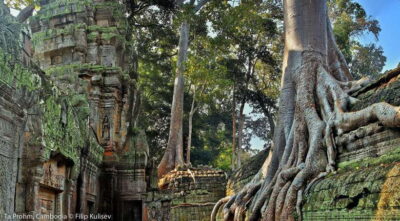
Angkor Wat: Small-Group Sunrise or Sunset Tour
Read our review →
Cape Sounion & Poseidon Temple Sunset Half-Day Trip
Read our review →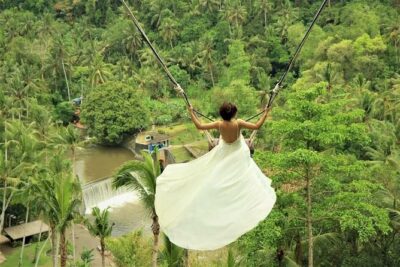
Monkey Forest, Jungle Swing, Rice Terrace, and Water Temple
Read our review →