
REVIEW · ANGKOR WAT TOURS
Siem Reap: Angkor Wat Small-Group Day Tour and Sunset
Angkor Wat is only part of this full day. You also enter Angkor Thom through its monumental South Gate, study Bayon’s stone faces, walk among the tree roots of Ta Prohm, visit a palm-sugar village, and finish above the jungle at Phnom Bakheng. The scope is impressive, and the guide helps turn a pile of ancient stones into a readable story.
I like the small-group size of up to 14 people, which gives the English-speaking guide room to answer questions and help with photos. I also like the practical care: air-conditioned transport, cold water, chilled towels, and lunch are all useful in Cambodia’s heat. The drawback is simple: this is a long, active day, and the combination of walking, stairs, heat, and a sunset climb can feel tiring.
Key points at a glance
- Angkor Thom comes first, with Bayon, Baphuon, the Terraces, Phimeanakas, and the former Royal Palace area.
- Ta Prohm keeps its jungle setting, with large roots and trees growing through the temple.
- Angkor Wat is visited in the afternoon, when you can take time with its towers, moat, carvings, and bas-reliefs.
- Preah Dak village adds a local stop, including a look at palm cake and palm sugar making.
- Cold water and towels return throughout the day, a small detail that matters in hot weather.
- The $28 tour price does not include the $37 Angkor pass, bringing the basic total to $65 per person before soft drinks.
A full day built around Angkor’s greatest hits
This tour is designed for you if you want to see the main Angkor sites in one day without arranging separate transport, a guide, lunch, and temple tickets. Pickup is scheduled between 8:00 and 8:30 a.m., followed by the purchase or verification of your Angkor pass.
The day lasts about 10 hours. That sounds generous, but Angkor Archaeological Park is spread across a large area, and the stops involve plenty of walking. You will spend time in the vehicle between temples, yet this is not a gentle sightseeing loop. Comfortable shoes, sun protection, and a reasonable level of stamina will make a real difference.
A small group capped at 14 people is a good middle ground. You get the lower cost of a shared tour, but the guide can still keep the group together and offer individual help. Some departures may be even smaller. One account describes a group of only five, which would make the day feel almost private.
More Temple Sunset Tours in Cambodia
- Angkor Wat Sunrise or Sunset Tour with Guide from Siem Reap
★ 5.0 · 12,109 reviews - Siem Reap: Angkor Wat: Small-Group Sunrise or Sunset Tour
★ 5.0 · 9,444 reviews - Siem Reap: Angkor Wat 2-Day Tour with Sunrise and Sunset
★ 4.9 · 4,429 reviews
Angkor Thom and the South Gate
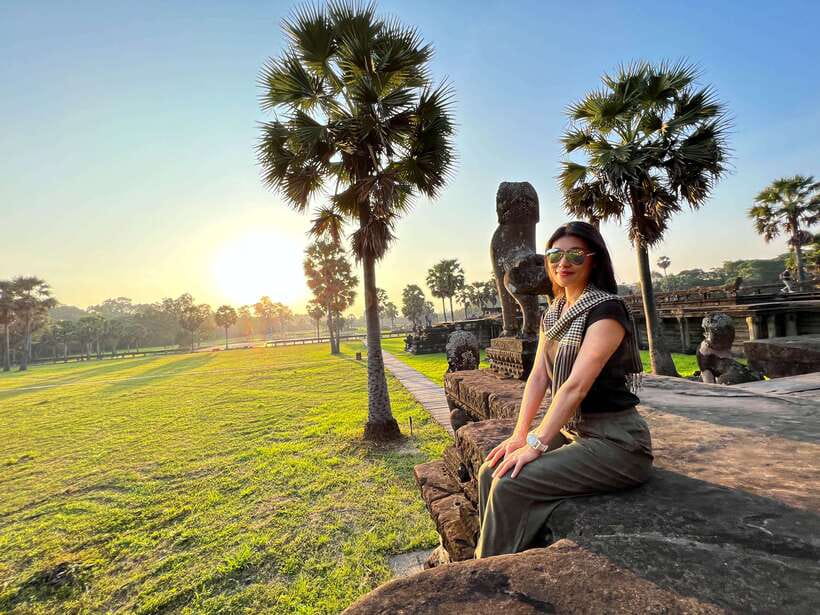
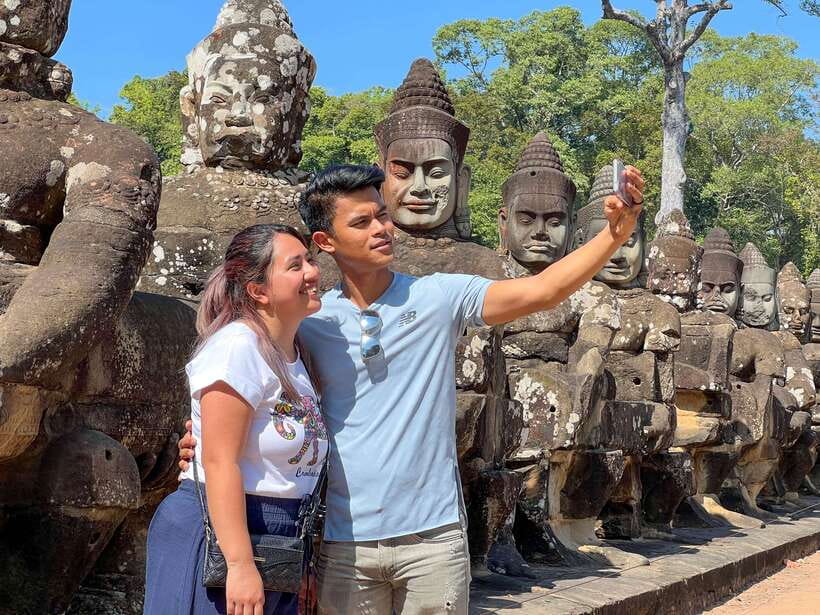
Angkor Thom means Great Royal City, and its South Gate makes a strong opening. The entrance is framed by monumental figures connected with the Hindu and Buddhist story of the Churning of the Ocean of Milk. The gate itself gives you an immediate sense of scale before you have even reached the central temples.
The tour also points out a large Avalokiteshvara figure associated with the gate and familiar to many people from the film Tomb Raider. That film connection may bring you here, but the site is more interesting when you look beyond the movie. The gate is part of a carefully planned royal city, not simply a dramatic photo stop.
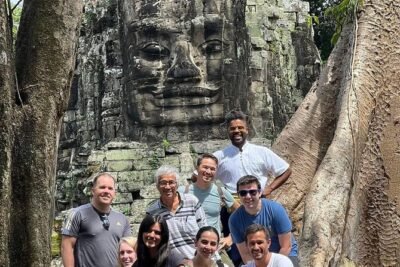
Your guide’s explanation matters here. Without context, the repeated figures, carved faces, and worn stone can blur together. Guides such as Mony, Sam, David, Saroun, Makara, Veasna, and Sean have been praised for explaining the stories and symbols in clear English. The assigned guide will vary, but the supplied guide team has a strong record for combining facts with humor and practical help.
Bayon’s stone faces and the royal complex
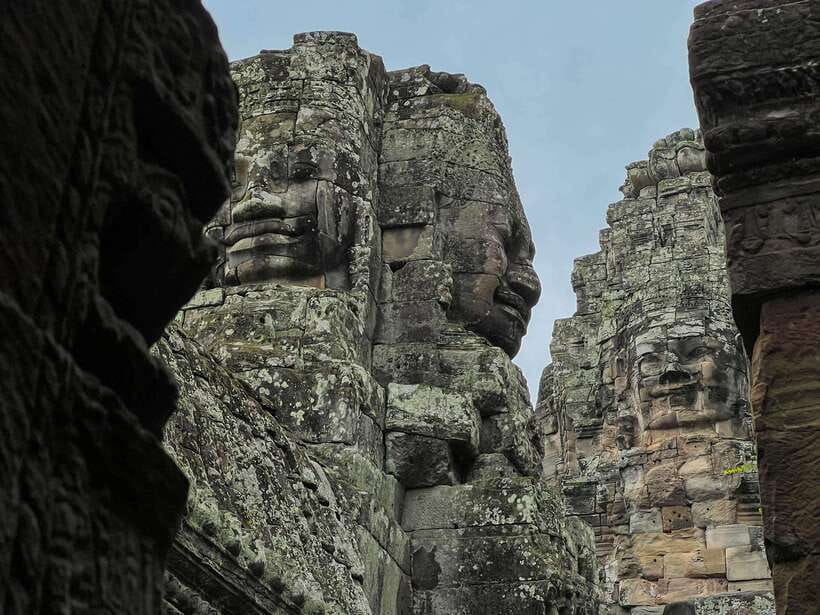
Inside Angkor Thom, Bayon is the visual star. Its towers carry large carved faces that look in several directions at once. As you walk closer, the temple becomes less like a single monument and more like a maze of corridors, galleries, stairs, and carved surfaces.
The faces are easy to admire, but I would pay equal attention to the bas-reliefs and the way the temple is arranged. Your guide can help separate religious imagery, scenes of daily life, and royal power. This is one of the places where a guided visit gives you much more than a quick circuit with a camera.
The route continues to Baphuon, a major temple that is described as the largest Hindu temple within Angkor Thom. You also see the Terrace of the Elephants, the Terrace of the Leper King, Phimeanakas, and the former Royal Palace area.
Not every stop receives the same amount of time, so you should not expect a detailed archaeological study of each structure. The strength of this itinerary is its range. In a single morning, you see royal architecture, Buddhist imagery, Hindu temple design, ceremonial terraces, and carved scenes from Khmer life.
Ta Prohm and the power of the jungle
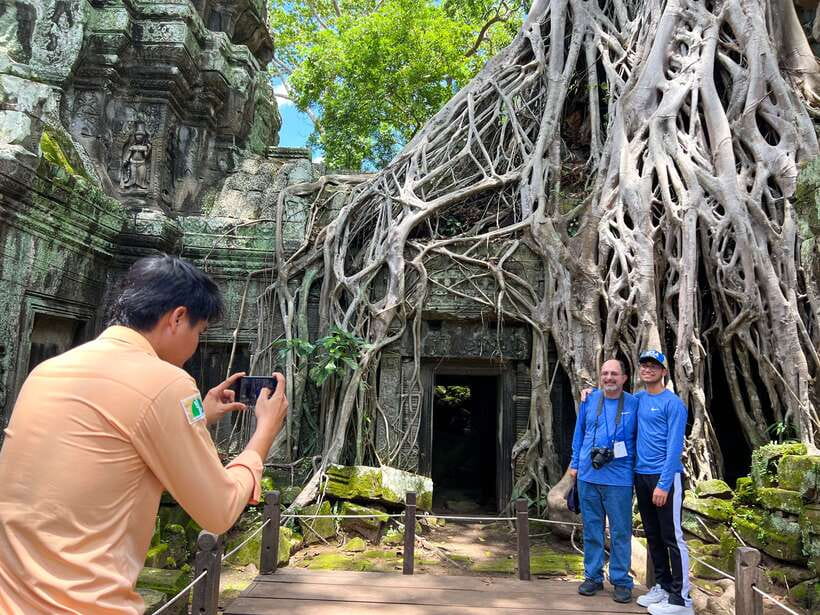
Ta Prohm is the temple many people picture when they think of Angkor. Trees and huge roots push through walls and courtyards, making the site feel wonderfully unruly. The temple has been left in a condition that preserves much of its original jungle character, although conservation work is still part of the wider Angkor experience.
This stop also has a Tomb Raider connection. You may recognize the setting from the film, but the real appeal is the tension between stone construction and living trees. The roots are not decoration added for visitors. They are part of the reason Ta Prohm feels different from the more orderly monuments nearby.
The setting creates excellent photo opportunities, and several guides are praised for knowing good places to take pictures. Makara, Veasna, Sam, Mony, and Saroun are specifically described as helpful with photography in addition to temple interpretation. That can be useful if you are traveling alone or want more than hurried group snapshots.
Ta Prohm is also a place where you need to watch your footing. Roots, uneven stone, stairs, and heat all add up. Stay with the guide’s route and wear shoes with a firm sole. The site is worth the effort, but it is not a polished indoor attraction.
More Temple Sunset Tours in Siem Reap
- Siem Reap: Full-Day Angkor Wat Guided Tour with Sunset
★ 4.9 · 3,803 reviews - Angkor Wat Sunset Small Group Tour with Lunch Included
★ 5.0 · 3,059 reviews - Angkor 2-Day Sunset & Sunrise Small-Group Tour
★ 5.0 · 2,567 reviews - Siem Reap: Angkor Wat Sunrise or Sunset Guided Tour
★ 4.9 · 2,123 reviews
Lunch, palm sugar, and Preah Dak village
After the morning temples, lunch is served at a local restaurant. A vegetarian option is available, but you should tell the operator in advance. Soft drinks are not included, while water is supplied during the tour.
The lunch stop is practical rather than a major culinary event. It gives you time to sit down, cool off, and eat before the afternoon sites. After several hours of temples, that pause is important. A schedule that tried to rush straight through without a proper meal would be harder to enjoy.
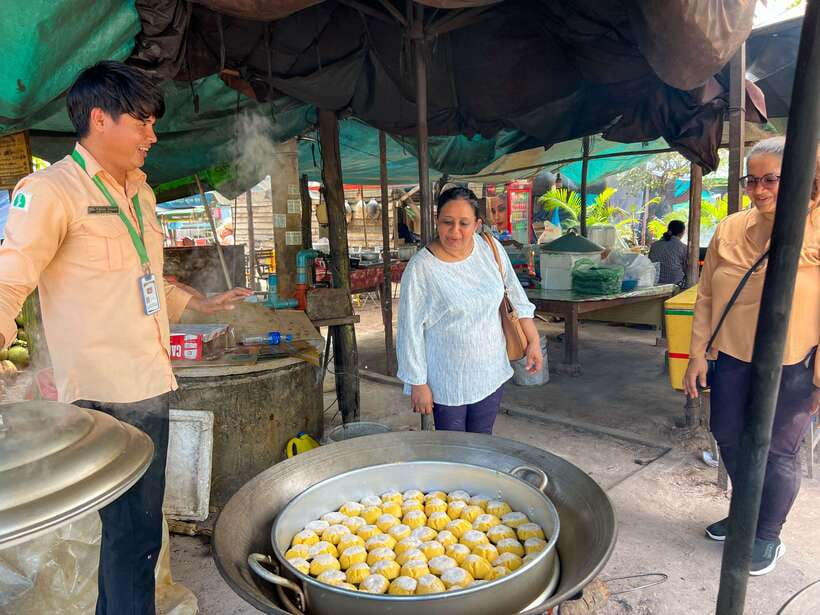
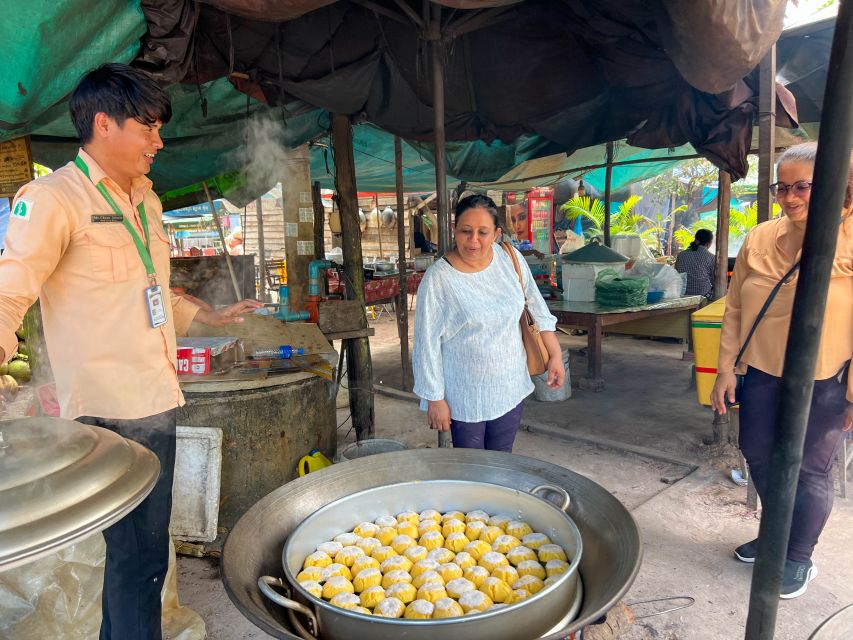
The afternoon village visit takes you to Phum Preah Dak, also called Preah Dak village. Here you can see how local people make palm cake and palm sugar. This is a welcome change of pace because it connects the region’s food traditions with everyday life outside the monuments.
The village stop should be approached with modest expectations. It is not a long cultural workshop or a full village homestay. Instead, it offers a brief look at a local product and a chance to understand that the area around Angkor is lived in, worked in, and not simply preserved for sightseeing.
Angkor Wat after lunch
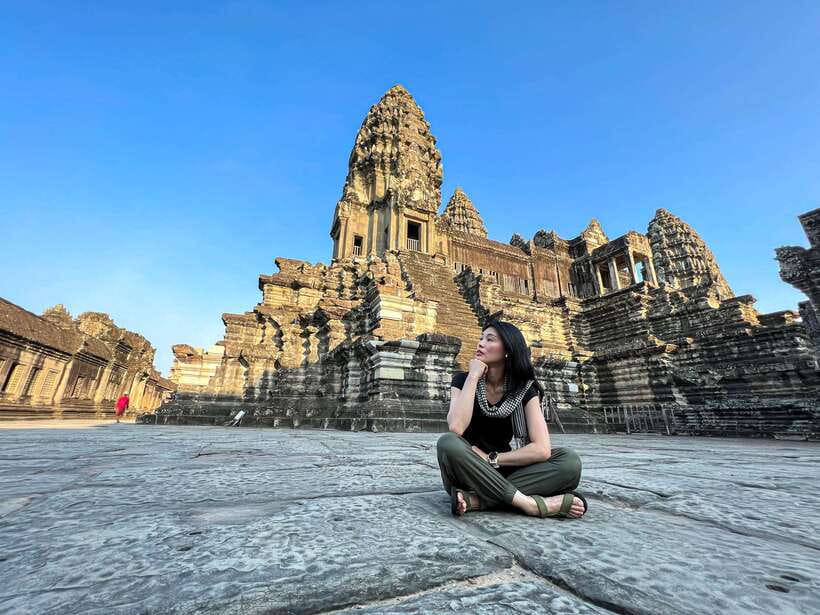
Angkor Wat is the grand finale before sunset, and the order works well. By reaching it in the afternoon, you have already learned how Khmer temple design developed at Angkor Thom, Bayon, and Ta Prohm. That background helps you read Angkor Wat as more than an oversized photograph.
Built by King Suryavarman II and dedicated to Vishnu, Angkor Wat is famous for its five towers, enormous moat, galleries, and carved walls. The towers appear on the Cambodian flag, and the building remains one of the clearest symbols of Khmer civilization.
Inside, look for the long bas-reliefs that run along the galleries. They present scenes from Hindu epics and royal or military life, with details that are easy to miss if you walk too quickly. Your guide can point out figures, stories, and symbols that would otherwise look like repeating decoration.
The scale can be hard to grasp from one viewpoint. As you cross the moat and move through the galleries, the building changes character. From a distance it is a balanced composition of towers and water. Up close, it becomes a sequence of carved corridors, courtyards, stairways, and shadowed details.
There is also a climb to an upper level, subject to the site’s access rules and conditions. Shoulders and knees must be covered, and short skirts are not allowed. Bring a light layer or clothing that meets the temple dress code while still keeping you cool.
Sunset from Phnom Bakheng
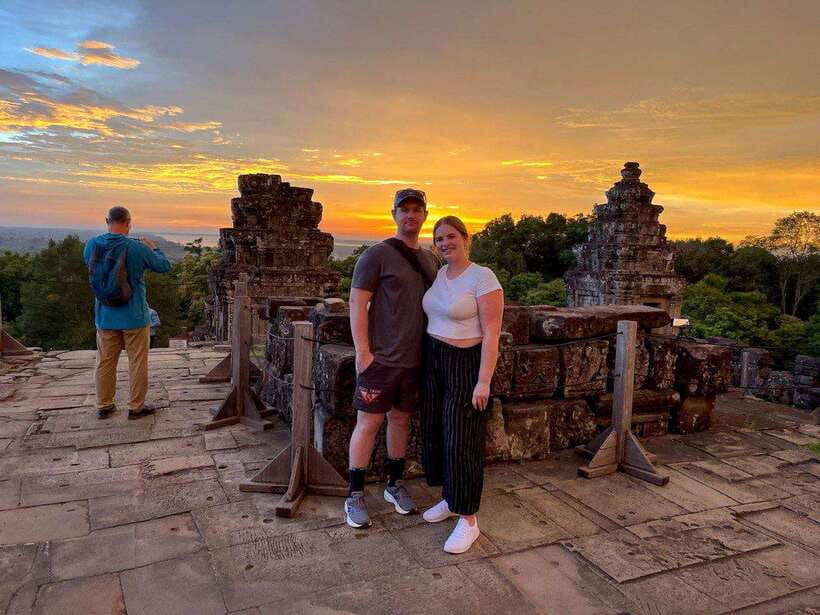
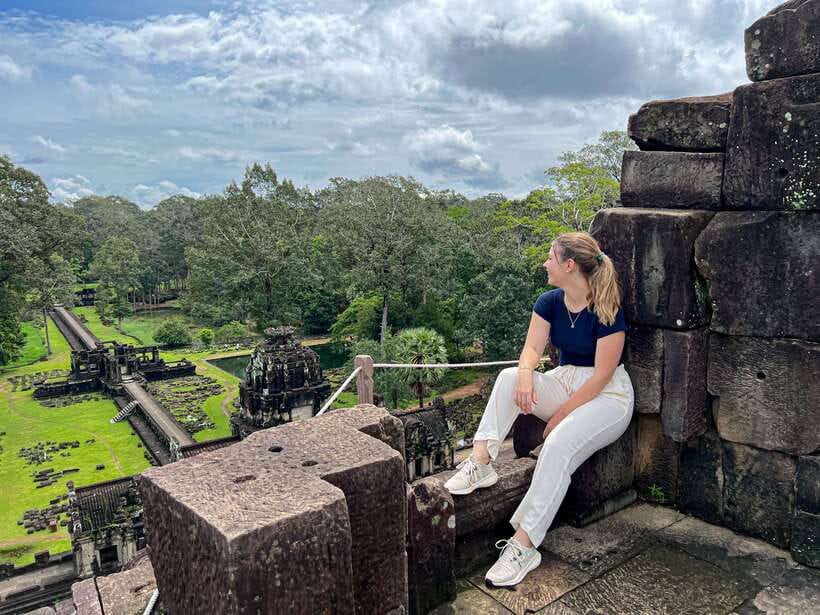
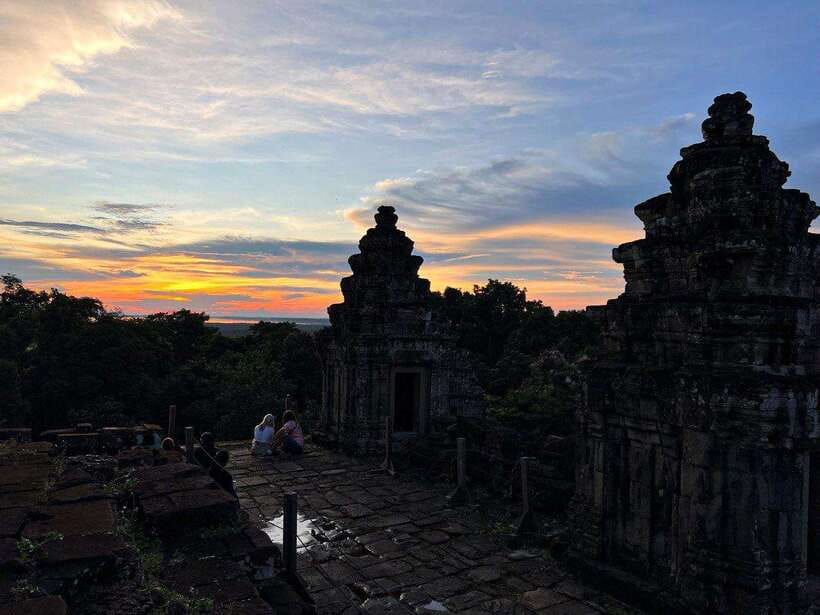
The final stop is Phnom Bakheng, where you climb the hill for sunset. From the top, you can look over the surrounding jungle and see the temples from a wider perspective. After a day spent examining walls and carvings at close range, the view gives you a useful sense of Angkor’s scale.
This is also the part of the day most likely to test your energy. You have already walked through Angkor Thom, Ta Prohm, and Angkor Wat, often in hot conditions. The climb is not a reason to avoid the tour, but it is a reason to pace yourself earlier.
Sunset timing and access can depend on site conditions and crowd management. The tour promises the visit, but it cannot promise a particular sky or an empty viewpoint. I would treat the sunset as a valuable final moment, not the sole reason to book the day.
Afterward, you return by air-conditioned vehicle to your hotel. That ride back is welcome. By then, the cold towels and water will have earned their place in the itinerary.
The guide and driver make a real difference
The strongest pattern in the feedback is the quality of the guide and driver pairing. Names repeatedly praised include Mony, Sam, David, Saroun, Makara, Veasna, Sean, Sutin, Raman, and Sam Ath. Their strengths are described in practical terms: clear explanations, fluent English, humor, patience, photography help, and care during hot or rainy weather.
That variety matters because the guide is not just there to point out buildings. A good guide explains why Bayon looks different from Angkor Wat, helps you understand the carvings, and keeps the day moving without making you feel hurried. Several guides are also described as willing to answer questions about Cambodia today, not just the ancient temples.
The drivers receive similar praise for safe, punctual service. Cold water and towels are provided when you return to the vehicle, and one account specifically describes a driver helping keep the group comfortable through heavy rain. The exact person assigned to your booking will not be known in advance, so I would judge this as a strong team feature rather than a guarantee of a particular guide.
Is $28 a good value?
The advertised tour cost is $28 per person, but the Angkor temple pass adds $37. Your basic total is therefore $65 per person, before soft drinks. That is the number I would use when comparing this tour with a private car, tuk-tuk, or a shorter temple visit.
For that total, you receive hotel pickup and drop-off, air-conditioned transport, an English-speaking guide, lunch, water, towels, and a full 10-hour route. You also avoid having to coordinate the major temples yourself. If you are visiting Angkor for the first time, the price is easier to justify because the guide provides the historical framework that transport alone cannot provide.
The tradeoff is flexibility. A shared group follows a set route and timing. You cannot linger indefinitely at one gallery or skip a stop because another site has captured your attention. The group limit of 14 keeps the experience manageable, but it does not turn the day into a private tour.
Private tours are available if you want more control. For many people, though, the shared option offers a sensible balance between cost and support, especially when the day includes so many separate sites.
Heat, clothing, and physical effort
You should prepare for strong sun and a lot of walking. Sunglasses, a sun hat, sunscreen, insect repellent, and an umbrella are all sensible items to bring. The supplied water and cool towels help, but they do not replace your own sun protection.
Wear comfortable shoes with good grip. Several temple areas have uneven surfaces, and the day includes stairs, courtyards, roots, and the climb at Bakheng. One practical note is especially important: knees and shoulders must be covered, and short skirts are not permitted.
This tour is not suitable for children under 10 or people over 70 according to the activity information. That rule may reflect the length, heat, walking, and general demands of the route. If you have limited mobility or dislike full-day sightseeing, you may prefer a shorter private itinerary with fewer temples.
The day can also feel exhausting in very hot weather. One account describes temperatures around 37 degrees Celsius and still found the experience worthwhile, but the warning is clear. Pace yourself, drink often, and use every vehicle stop to cool down.
Booking details worth knowing
Hotel pickup is included. Wait in the lobby 10 minutes before the scheduled pickup window, which is between 8:00 and 8:30 a.m. The Angkor pass must be arranged before the temple visit, and it is not included in the tour price. An online purchase is available.
The tour is conducted in English, with private and small-group formats offered. Vegetarian food is available when requested in advance. Cancellation is free up to 24 hours before the start, and you can reserve now and pay later, which helps if your Siem Reap plans are still shifting.
The experience has a listed rating of 5 from 59 reviews, and 95 percent of the transport ratings are perfect. Those figures do not remove the normal limits of a busy temple day, but they fit the specific strengths of the operation: punctual pickups, safe driving, useful cooling supplies, and guides who explain rather than simply lead.
Should you book this Angkor day tour?
Book it if you want the main Angkor highlights in one organized day and value a live English-speaking guide. The route covers the sites most first-time visitors want, then adds Preah Dak village and a sunset viewpoint. The included lunch, vehicle, water, and towels make the $28 tour price, plus the $37 pass, a fair package for the amount covered.
Skip it if you want slow, solitary temple visits or if a 10-hour day in the heat sounds unpleasant. You should also think twice if you are traveling with children under 10, are over 70, or find stairs and uneven ground difficult.
For most first visits to Siem Reap, this is a practical way to get oriented quickly. Choose comfortable shoes, cover your shoulders and knees, request vegetarian food ahead of time if needed, and arrive ready for a full day rather than a relaxed morning outing.
FAQ
Is the Angkor temple pass included in the tour price?
No. The Angkor pass costs US$37 per person and must be arranged before the temple visit. The advertised tour price is $28 per person.
What time does hotel pickup take place?
Pickup is scheduled between 8:00 and 8:30 a.m. You should wait in your hotel lobby 10 minutes before the scheduled pickup time.
How large is the small group?
The small-group option is limited to 14 participants. Private tours are also available.
Is lunch included?
Yes. Lunch at a local restaurant is included, and vegetarian food is available if you inform the operator in advance. Soft drinks are not included.
What should I wear to the temples?
Your knees and shoulders must be covered. Short skirts are not allowed. Comfortable walking shoes are recommended because the route includes uneven temple surfaces and a climb at Phnom Bakheng.
Is the tour suitable for young children or older people?
The activity is not suitable for children under 10 or people over 70. It is a long day with considerable walking, heat, temple stairs, and a sunset climb.
More Angkor Wat Tours in Siem Reap
- Angkor Wat Sunrise tour with Small – Group and Guide tours
★ 5.0 · 3,655 reviews - Angkor Wat Highlights and Sunrise Guided Tour from Siem Reap
★ 5.0 · 3,213 reviews - Full-Day Angkor Wat Sunrise Private Tour with Guide from Siem Reap
★ 5.0 · 2,920 reviews - Angkor Wat Sunrise & 3 Main Temples with Breakfast – Small Group
★ 5.0 · 2,857 reviews
Just added around Siem Reap
- Ticket for Angkor Balloon Ride.★ 3.7 · 46 reviews
- Sunrise at Angkor Wat Temple: 3-Hour Private Tour★ 4.7 · 30 reviews
- Small-Group Full Day Angkor wat Guide tour with Sun set★ 5.0 · 136 reviews
- Siem Reap: Private 4-Day Angkor Wat and Phnom Kulen Tour★ 5.0 · 9 reviews
- Angkor Wat: Sunrise 2.5 Days Temples & Tonle Sap-Small Group★ 5.0 · 10 reviews
- Siem Reap : Private Tuk-Tuk Tour of the Magnificent Temples.★ 4.9 · 14 reviews
- Siem Reap: Ultimate Angkor Wat Offbeat Experience by Jeep★ 4.9 · 8 reviews
- Siem Reap: Personalized Angkor Wat Sunrise/Set by TukTuk/Car★ 4.9 · 41 reviews
Angkor Wat Tours, compared.
Angkor Wat Sunrise or Sunset Tour with Guide from Siem Reap
Read our review →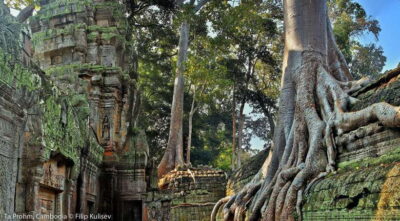
Angkor Wat: Small-Group Sunrise or Sunset Tour
Read our review →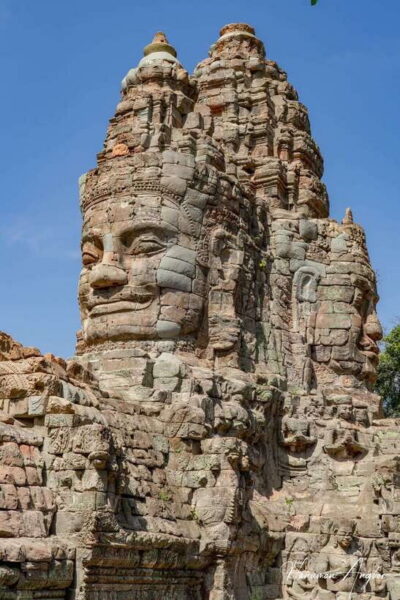
Angkor Wat 2-Day Tour with Sunrise and Sunset
Read our review →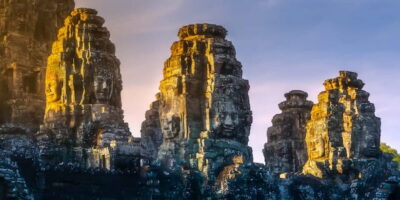
Angkor Wat Sunrise tour with Small – Group and Guide tours
Read our review →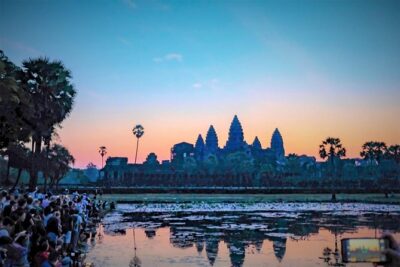
Angkor Wat Highlights and Sunrise Guided Tour from Siem Reap
Read our review →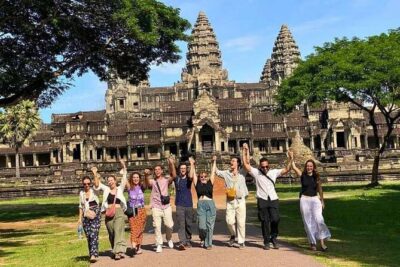
Angkor Wat Sunset Small Group Tour with Lunch Included
Read our review →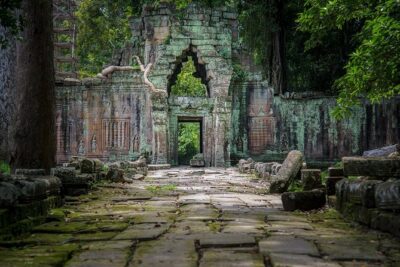
Full-Day Angkor Wat Sunrise Private Tour with Guide from Siem Reap
Read our review →Browse the lists this tour appears in