
REVIEW · ABU SIMBEL & PHILAE TEMPLE TOURS
Abu Simbel temples by Private air-conditioin Vehicle
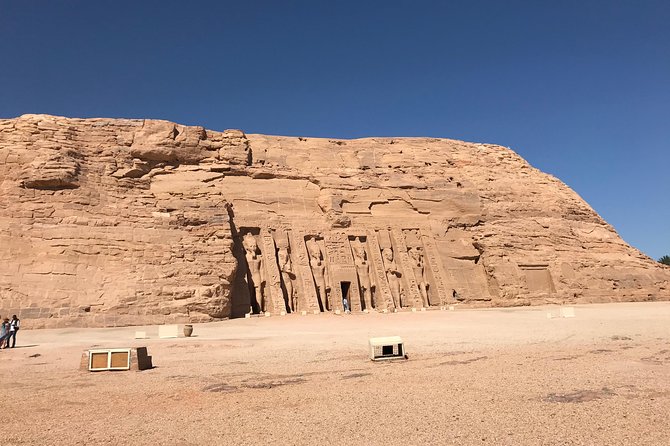
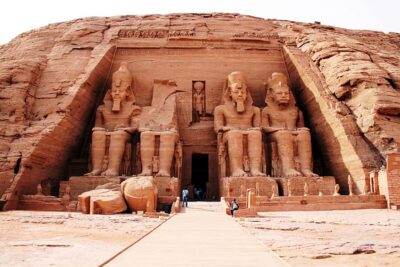
Walking into Abu Simbel means facing four huge seated figures of Ramses II carved into the rock. The temples were later cut apart and rebuilt above the rising Nile, a remarkable rescue carried out with help from Egypt and UNESCO in 1960. I like the private vehicle and the chance to travel at your group’s pace. I also like that an Egyptologist explains the carvings before you explore on your own.
The drawback is the long day from Aswan, with roughly three hours at the site and much of the schedule spent on the road. At $120 per person, this is not the cheapest way to visit Abu Simbel, but the price includes hotel pickup, private transport, admission, bottled water, soft drinks, and a private group setting.
Key points to know before booking
- The temples are the main event: See Ramses II’s great Sun Temple and the smaller Temple of Queen Nefertari.
- The private car matters: You travel from your Aswan hotel in an air-conditioned vehicle reserved for your group.
- The rescue story is part of the visit: The temples were moved in 1960 to protect them from the rising Nile.
- Expect a full day: The excursion lasts about 11 hours, with around three hours listed for the Abu Simbel stop.
- An Egyptologist leads the visit: The guide explains the site, while current rules prevent guiding inside the temple chambers.
- The price covers the basics: Entrance fees, taxes, transportation, hotel transfers, water, and soft drinks are included.
Abu Simbel is worth the long road from Aswan
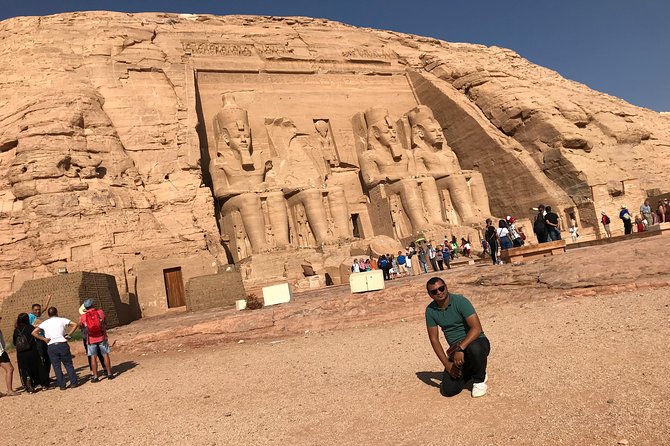
Abu Simbel is one of those ancient sites that earns its place on a demanding itinerary. The first sight is physical and dramatic: four colossal images of Ramses II sit above the entrance to the main temple, cut from the sandstone cliff. Even before you enter, the scale tells you this was built to impress.
This day trip leaves from Aswan and lasts about 11 hours. The exact road timing is not provided, so you should treat the excursion as a full-day commitment rather than a quick outing. You will be collected from your hotel and taken in a private, air-conditioned vehicle, then returned to Aswan after the visit.
I like the private setup for this particular journey. A group tour can reduce the cost, but a private car gives your party more personal space and a guide focused on your questions. That matters after a long ride, especially if your group has different interests in architecture, royal power, or ancient Egyptian religion.
The site visit itself is listed at about three hours. That is enough to see both temples properly, but you will want to manage your time. Listen carefully to the guide’s explanation at the start, then save room for your own look at the facades, halls, statues, and wall scenes.
More Private Temple Tours in Egypt
- Full Day Tour of Luxor West Bank Temples and Tombs (Private)
★ 5.0 · 722 reviews - Luxor: Abu Simbel Temple Private Guided Day Trip with Lunch
★ 4.6 · 546 reviews - Private Day Tour to Abu Simbel Temples from Aswan
★ 4.5 · 507 reviews
Ramses II’s Sun Temple and its four giant statues
The larger temple honors Ramses II, one of ancient Egypt’s most powerful pharaohs. The front is dominated by four seated figures of the king. These are not quiet memorial portraits. They are a royal statement in stone, designed to present Ramses as immense, permanent, and worthy of worship.
Inside, the temple contains scenes linked to the pharaoh’s rule. One important mural shows the Battle of Kadesh, presented as a victory for Ramses II and his army. The scene is useful because it shows how temples worked as political messages as well as religious places. The king’s military success was placed in a sacred setting, giving his rule divine weight.
Your Egyptologist should explain these themes before or during the visit. Current rules mean that guides do not provide a full talk inside the temple chambers. That is worth understanding before you arrive. The guide can give you the historical framework outside or at suitable points, then you will explore the interior without a running commentary.
I see this as a reasonable tradeoff. A guide’s explanation is most useful before you enter, when you can learn what to look for. Inside, you can take in the carvings at your own pace rather than trying to follow a long speech in a crowded or controlled space.
The temple is also a lesson in scale. Ramses II used architecture to make the visitor feel small, and the design still works. Give yourself time to look beyond the famous entrance. The interior scenes and the relationship between the outside facade and the inner rooms help explain the purpose of the whole complex.
Queen Nefertari’s temple deserves equal attention
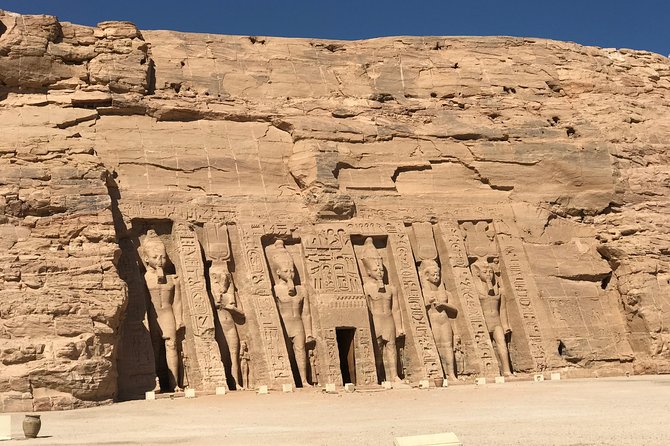
The second temple belongs to Queen Nefertari. It is smaller than Ramses II’s temple, but it should not be treated as an optional extra. Its presence shows the importance of Nefertari within the royal family and gives the visit a useful contrast.
After the massive entrance to Ramses II’s temple, Nefertari’s temple feels more intimate. The two buildings were planned together, yet they create different impressions. I recommend paying close attention to the facade, the figures, and the interior decoration rather than rushing through simply because the first temple is larger.
The tour information sometimes refers to Queen Nefertari and, elsewhere, uses the name Nefertiti. The temple at Abu Simbel is the Temple of Queen Nefertari. If you want clear historical context, use that name when discussing the site with your guide.
With only about three hours at Abu Simbel, start by hearing the explanation of both temples. Then make sure you reserve enough time for Nefertari’s building. The main temple naturally pulls your attention, but the smaller temple completes the story of the complex.
The 1960 rescue changed the location, not the power of the site
One of the most important facts about Abu Simbel is that you are not seeing the temples in their original position. In 1960, the Egyptian government and UNESCO worked together to move them because the rising waters of the Nile threatened to cover them.
The temples had already been rediscovered in 1813 after being almost completely buried in sand. Their rescue more than a century later required another major effort. The buildings were cut into sections and moved to higher ground, allowing the monuments to survive after the river levels changed.
This detail gives the visit a second story beyond ancient Egypt. You are looking at a pharaonic monument that survived both burial and a modern engineering project. Ask your guide to explain the relocation if the subject does not come up early. It helps you understand why the site looks as it does today and why its survival matters.
The rescue also explains why Abu Simbel is recognized as a UNESCO World Heritage Site. That status is not just a label for your itinerary. It reflects the importance of protecting a place that carries both ancient religious meaning and modern conservation history.
More Abu Simbel and Philae Tours in Egypt:
- From Aswan: Abu Simbel Temple Day Trip with Hotel Pickup
★ 4.4 · 2,807 reviews - Full Day tour to Abu simbel temples from aswan
★ 4.5 · 309 reviews - From Aswan: Private Guided Tour of Philae Temple with Entry
★ 4.6 · 239 reviews - Full Day Tour to Abu Simbel Temples from Aswan
★ 4.5 · 218 reviews
What the private vehicle adds to an 11-hour day
The transport is simple but important. Pickup and return to your Aswan hotel are included, and the journey is made in a private, air-conditioned vehicle. Bottled water and soft drinks are also provided on board.
Air conditioning is more than a comfort detail in southern Egypt. You will spend a large part of the day in transit, so a cooled vehicle makes the road time easier. Private transportation also means you are not sharing the vehicle with unrelated groups, and the tour is limited to your own party.
That privacy comes with a higher price. The cost is $120 per person, which includes the vehicle, driver-related transport service, taxes, entrance fees, drinks, hotel transfers, and the private guide arrangement. You still pay for your own extras and tipping, but the major costs are covered.
For one or two people, the price may feel high compared with a group excursion. For a family or a small group, the calculation improves because everyone receives the convenience of private transport and the cost is charged per person. Group discounts are offered, though the exact discount is not stated.
I would choose this option when comfort, privacy, and control matter more than finding the lowest possible fare. If your only goal is to reach the temples cheaply, compare group options before booking. If you value a quieter vehicle and direct hotel service, the added cost may be fair.
How to use the temple time well
The excursion lists about three hours at Abu Simbel. That is enough for the two temples, but not a great deal of spare time if you want to study every wall. I would use the visit in three stages.
First, listen to the Egyptologist’s explanation. You will get more from the carvings once you know the basic story of Ramses II, Nefertari, the Kadesh battle, and the 1960 relocation.
Second, visit Ramses II’s temple and focus on the overall design before getting lost in individual scenes. Look at the giant entrance figures, then move inside to the royal and religious imagery.
Third, make a deliberate visit to Nefertari’s temple. It is easy to spend nearly all your time at the larger building. Keep an eye on the clock so the second temple receives the attention it deserves.
A useful tip from the booking feedback is to allow more time if possible, especially in July, when one visitor found that staying longer helped create a quieter experience. The tour’s stated timing may not allow much flexibility, so ask about the available time before departure if lingering at the site is important to you.
The guide’s role and the limits of guiding inside
The tour includes an Egyptologist rather than only a driver. That is valuable at Abu Simbel because the walls are filled with names, gods, royal scenes, and political messages that are easy to miss without context.
The guide’s explanation is designed to help you use your free time inside. Since guiding inside the temple chambers is not permitted, you should not expect a continuous lecture among the carvings. The guide explains the history and meaning, then gives you time to see the monument independently.
That arrangement can surprise people who expect the guide to point out every scene in the interior. It is better to treat the introduction as a briefing. Take mental notes, then look for the Kadesh scene and the royal imagery yourself.
The listing does not provide the Egyptologist’s name, so you cannot choose a particular guide in advance. Confirmation is sent at booking, and the activity is private for your group.
Who will get the most from this Abu Simbel trip?
This tour suits you if you are staying in Aswan and want the simplest private way to reach Abu Simbel. It works especially well for families, couples, and small groups that prefer not to share a vehicle.
It is also a good match if you want historical context but still like some freedom to look around alone. The Egyptologist gives you the framework, while the site visit leaves room for personal exploration.
You should think twice if you dislike long road days or want a slow, highly detailed archaeological visit. The total outing lasts about 11 hours, and the temple stop is listed at about three hours. That is a strong introduction, not an all-day study session.
The trip also requires good weather and a minimum number of travelers. If the operator cancels for either reason, you are offered another date, a different experience, or a full refund.
Should you book this private Abu Simbel tour?
Book it if you want hotel pickup, a private air-conditioned car, an Egyptologist, entrance fees, and a direct return to Aswan in one package. The temples are extraordinary, and the private format makes the long day easier to manage.
At $120 per person, it is best viewed as a convenience-focused option rather than a budget trip. Compare the price with a group tour if cost is your main concern. Choose this one when privacy, comfort, and a guide dedicated to your party are worth paying for.
The strongest reason to go is the site itself. The huge Ramses II temple, Nefertari’s smaller building, the Kadesh battle scenes, and the story of the 1960 relocation give you far more than a quick photo stop. Just set realistic expectations: it is a long journey with limited time on site, and guiding inside the temples is not allowed.
FAQ
How long does the Abu Simbel tour last?
The experience lasts approximately 11 hours, including transportation from Aswan and the visit to Abu Simbel.
Where does the tour begin?
Pickup begins in Aswan, Egypt. Hotel pickup and return are included.
What temples will I visit?
You will visit the great Sun Temple of Ramses II and the Temple of Queen Nefertari at Abu Simbel.
Is transportation private?
Yes. The tour uses a private air-conditioned vehicle, and only your group participates.
Are entrance fees included?
Yes. Entrance fees to the historical sites mentioned in the program, along with taxes, are included.
What happens if I cancel?
You can cancel up to 24 hours before the start time for a full refund. Cancellations or changes made less than 24 hours before the experience are not refunded or accepted.
Just added around Egypt
- St Simon Monastery ,Cave Church , Garbage City and Coptic Cairo Private day tour★ 5.0 · 29 reviews
- Tour to Giza Pyramids, Sphinx, Valley Temple, Camel Ride & Lunch★ 5.0 · 7 reviews
- Monastery St Simon with Cave Church and Garbage City Private Tour★ 5.0 · 15 reviews
- Overnight Trip to Saint Catherine Monastery from Cairo★ 4.0 · 14 reviews
- Private Full-Day Red Sea Monasteries Tour from Cairo★ 5.0 · 17 reviews
- Overnight Tour Moses Mountain St. Catherine Monastery from Cairo★ 5.0 · 21 reviews
- Private Guided Tour to Giza Pyramids, Valley Temple and Sphinx★ 5.0 · 10 reviews
- Shared Tour To Abu Simbel Temple From Aswan★ 5.0 · 7 reviews
Abu Simbel & Philae Temple Tours, compared.
Abu Simbel Temple Private Guided Day Trip with Lunch
Read our review →
Private Day Tour to Abu Simbel Temples from Aswan
Read our review →
Private Guided Tour of Philae Temple with Entry
Read our review →
Philae Temple Sound & Light Show with Entrance Fees
Read our review →Browse the lists this tour appears in