
REVIEW · HUE TEMPLE TOURS
Hue Royal Tombs Tour: Visit Best Pagodas & Mausoleums
Hue’s royal tombs are not simple burial sites. They are grand gardens, temple compounds, and political statements, spread outside the city among quiet roads and wooded hills. I like that this tour lets you choose the tombs that fit your day instead of forcing every group through one fixed route. I also like the private car, since the sites are far apart and awkward to connect on your own.
The main drawback is cost clarity. The advertised price is only $15 per person, but entry tickets are extra, and the number of tombs included can vary by booking option. Check the exact package before paying, especially if you want to visit all five mausoleums.
Key points to know before booking
- Five royal tombs are available: Minh Mang, Tu Duc, Khai Dinh, Gia Long, and Dong Khanh, though the exact number included depends on your selected option.
- Private transport saves time: Pickup and return are available from hotels in Hue city center or Hue Train Station.
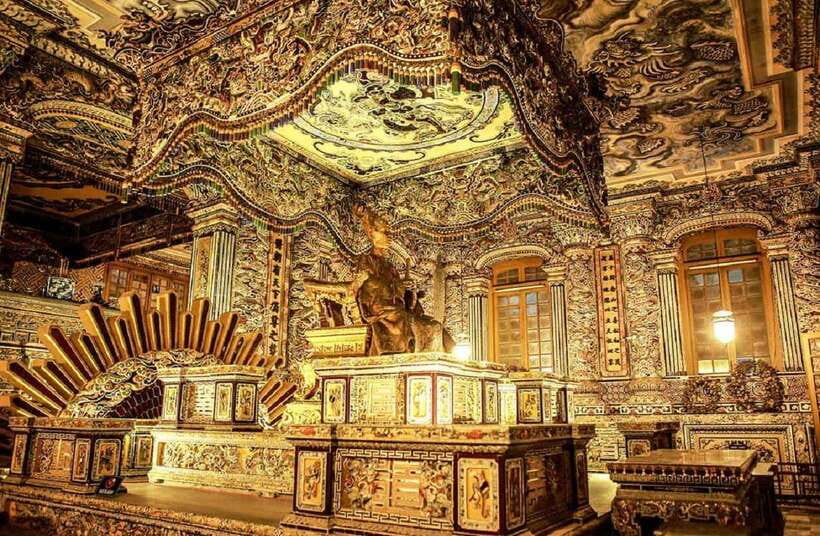
- The tombs are very different: Minh Mang is formal and balanced, Tu Duc is reflective, and Khai Dinh is ornate and European-influenced.
- Pagodas add a living religious side: Thien Mu and Tu Hieu show why Buddhism remains important in Hue.
- Guides can add useful local detail: Bi, Ba, Duy, David, and Tra My have all led recent departures, with praise for timing, advice, and friendly service.
- Budget for tickets: Tomb admission is listed at 150,000 VND per tomb, while combination tickets may offer better value.
Why Hue’s tombs deserve a full morning
The Nguyen emperors built their mausoleums outside the old imperial center, where they could create large compounds for worship, ceremony, gardens, and burial. That setting makes a car useful. You are not just ticking off monuments inside one compact district. You are moving between separate sites, each with a different mood and design.
This tour works best when you treat the tombs as portraits of the emperors who built them. Tu Duc’s complex feels like a retreat planned by a ruler who spent much of his life surrounded by court troubles. Minh Mang’s site reflects strict order and ceremony. Khai Dinh’s mausoleum looks like a royal project filtered through French colonial taste.
A guide helps connect those differences. The service is offered with an English-speaking guide, though you can also choose an option with transportation and a driver only. Recent departures have been led by Bi, Ba, Duy, David, and Tra My. Duy was noted for arriving on time, explaining sights passed on the road, and allowing plenty of time at each stop. Ba was also praised for practical help with money exchange, transport prices, and local coffee.
A few more temple visits around Vietnam worth a look
- Small-Group Mekong Delta Day Trip: Boat Ride, Cottages & Pagoda
★ 5.0 · 1,327 reviews - Hanoi: Ninh Binh, Trang An, Mua Cave and Bai Dinh Pagoda
★ 4.7 · 345 reviews - Linh Ung Pagoda – Marble Mountains – Hoi An Ancient Town Daily Ingroup Tour
★ 5.0 · 299 reviews
Tu Duc Tomb, a royal retreat as much as a grave
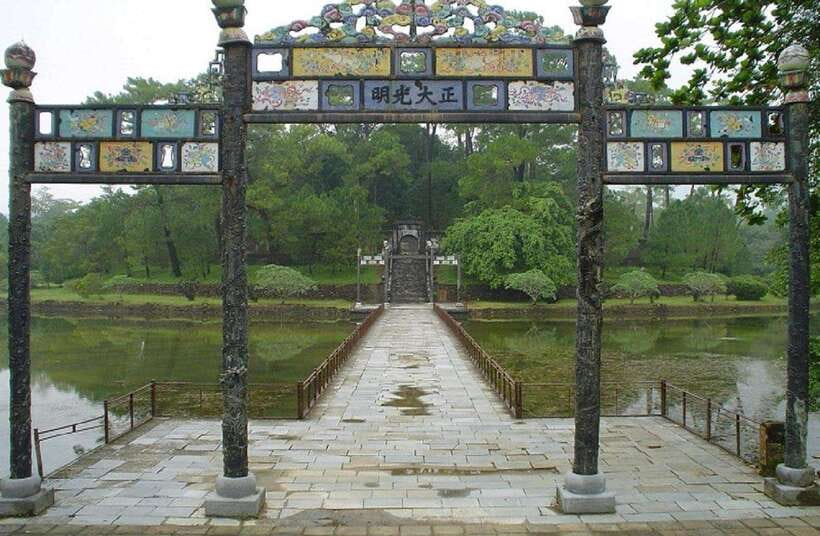
Tu Duc Tomb is scheduled for about 45 minutes, though a private itinerary may give you more or less time. King Tu Duc built the complex between 1864 and 1867, while he was still alive. He sometimes lived and worked there, so the site was more than a final resting place.
The compound covers about 12 hectares and has two main parts: a temple area and a burial area. That division matters. The temple section reflects ongoing worship and royal memory, while the burial section has a quieter and more formal purpose.
Tu Duc had many wives and concubines, and the complex also became a place where minor wives, concubines, and eunuchs lived after his death in 1883. Your guide can help explain the strict social structure around the court, including the lives of people who rarely appear in a basic monument description.
I would give Tu Duc serious priority if your time is limited. Its story is more personal than the grand scale suggests. The main limitation is that 45 minutes can feel short if you want to study every gate, pavilion, and garden area.
Minh Mang Tomb, the most ordered imperial setting
Minh Mang Tomb usually receives another 45-minute visit. Construction began in 1840, after Minh Mang started planning the site for himself, and was completed in 1843 by his son, King Thieu Tri, after Minh Mang died during the work.
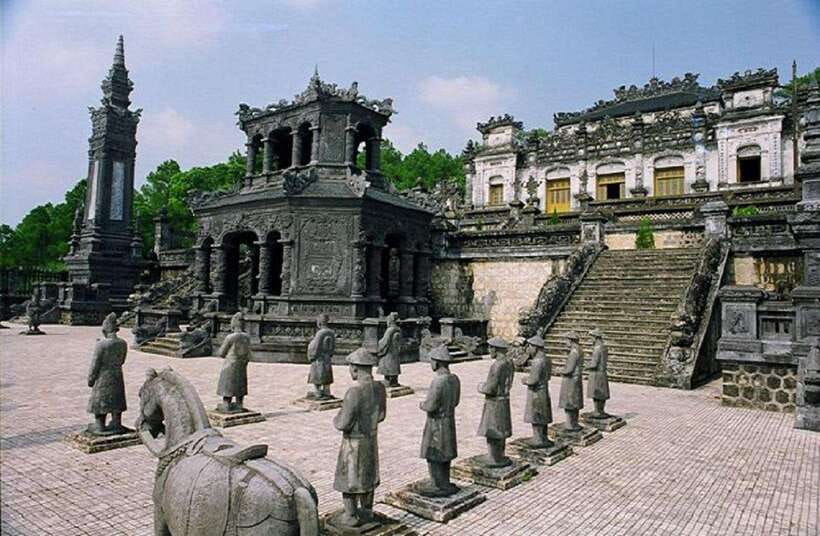
The complex covers about 15 hectares and includes 26 buildings serving different purposes. The layout reflects order, symmetry, and ceremony. Minh Mang was a ruler concerned with administration and royal authority, and the design fits that image.
This is one of the best stops for understanding how an imperial mausoleum could function as a complete ceremonial world. The buildings are not random additions. They form a sequence that guides you through courtyards, worship spaces, and burial areas.
The grounds are spread out, so expect walking. You may appreciate the open setting after the tighter, more decorated spaces at Khai Dinh. If you have mobility concerns, the tour is described as wheelchair accessible, but confirm the practical route and access at each individual tomb before booking.
Khai Dinh Tomb, the Nguyen dynasty’s boldest style shift
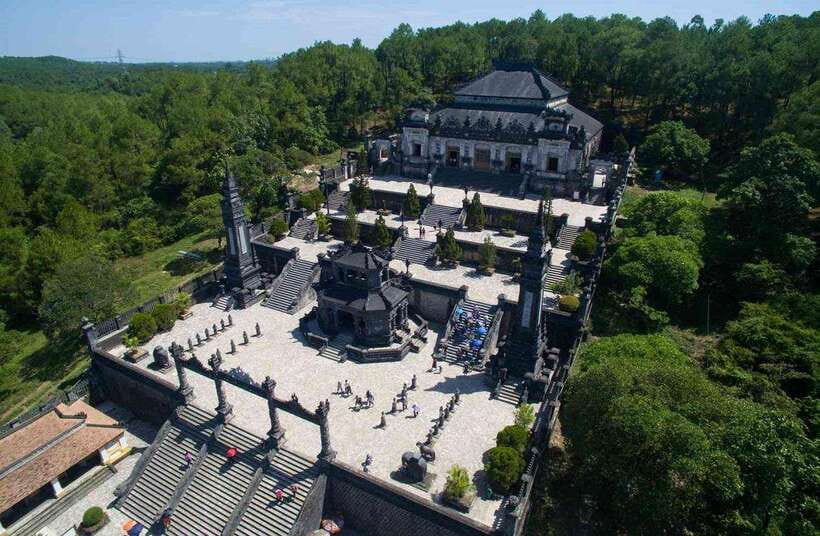
Khai Dinh Tomb receives about 30 minutes in the stated itinerary. Construction began in 1920 and was completed in 1931, six years after Emperor Khai Dinh died. The project was continued by his child.
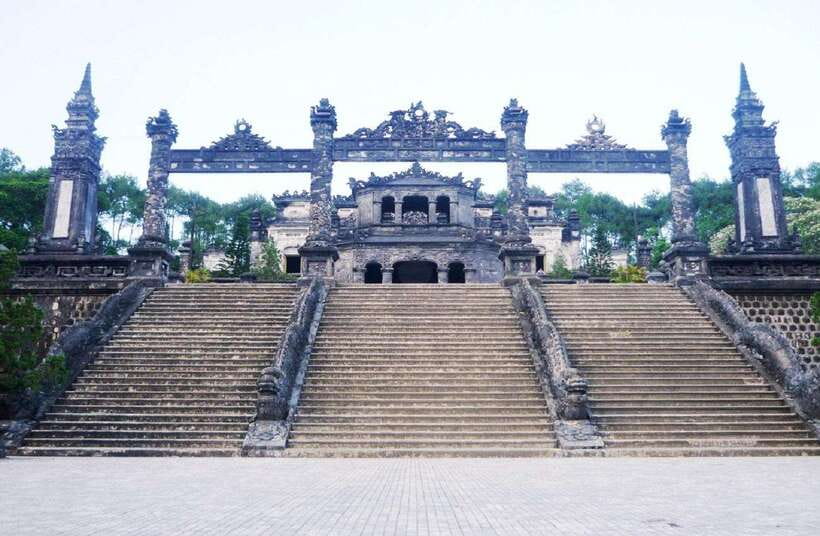
This mausoleum is unlike the others. It blends Asian design with European influence and uses a more compact, heavily decorated form. The listed dimensions are about 48.5 meters by 117 meters, making it smaller in area than Minh Mang or Tu Duc but visually much more concentrated.
Khai Dinh is also identified as the only Nguyen royal tomb in this group where you know the emperor was buried beneath the mausoleum. That gives the site a direct connection to the person it honors, even though the elaborate decoration can make the place feel more like a ceremonial monument than a peaceful garden.
I would not rush this stop, despite the shorter scheduled time. The decoration rewards a careful look, especially if your guide explains how the design differs from earlier Nguyen tombs. On the other hand, travelers who prefer open gardens and quiet courtyards may like Minh Mang or Tu Duc more.
Same country, a different morning at the gates:
- 1-Day Mekong Delta Cai Rang Floating Market-Ancient House-Pancake
★ 5.0 · 653 reviews - HCM City: 1-Day Cu Chi Signature Tunnels & Liberated Village
★ 5.0 · 523 reviews - Tay Ninh – Cao Dai & Ba Den Mountain + Optional Cu Chi Tunnels
★ 5.0 · 275 reviews - Hue: Royal Tombs & Pagoda Private Tour By Dragon Boat & Car
★ 4.9 · 257 reviews
Gia Long Tomb, the founder’s spread-out mausoleum
Gia Long Tomb is allocated about an hour, the longest stop in the stated route. Construction began in 1814 and finished in 1820. It is the mausoleum of Emperor Gia Long, founder of the Nguyen dynasty.
The name describes a complex of royal mausoleums rather than one single structure. It is located in Long Ho Ward, Phu Xuan District, within Hue City. That broader arrangement makes this stop useful for understanding the scale of royal burial grounds and the importance of family compounds.
The extra time is welcome because the complex is not presented as a quick single-building visit. You can expect a more spread-out stop, with time for walking, photos, and explanation. Its place in the tour also gives you a chronological anchor: Gia Long represents the dynasty’s beginning, while the later tombs show how royal design changed over time.
Because the tour has flexible options, confirm that Gia Long is included if it is a priority. The standard information lists it among the available sites, but also warns that different prices include different numbers of tombs.
Dong Khanh Tomb, a smaller and denser royal complex
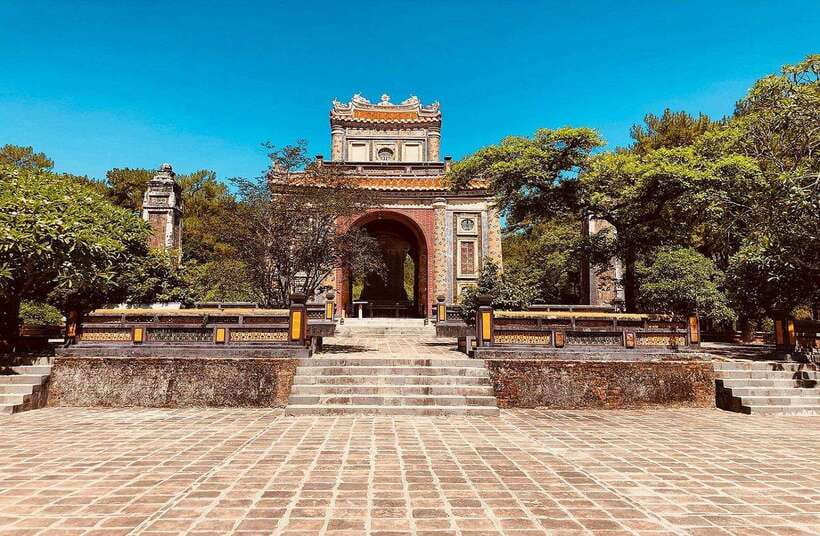
Dong Khanh Tomb, also called Tu Lang, is scheduled for about 30 minutes. It is part of the Hue ancient capital relic complex and lies in a rural area of Thuong Hai village, in Thuy Xuan Ward.
The site contains about 20 large and small structures arranged at relatively high density. It is divided into a palace area and a tomb area, giving you another chance to see the two roles these royal compounds played: honoring the emperor through ceremony and marking his burial place.
Dong Khanh may suit you if you want a less repetitive route. After the broad spaces of Minh Mang or the decoration at Khai Dinh, a smaller and denser complex changes the pace. The short visit means you should listen closely to the guide and avoid spending the entire stop on photos.
Thien Mu Pagoda, Hue’s best-known religious stop
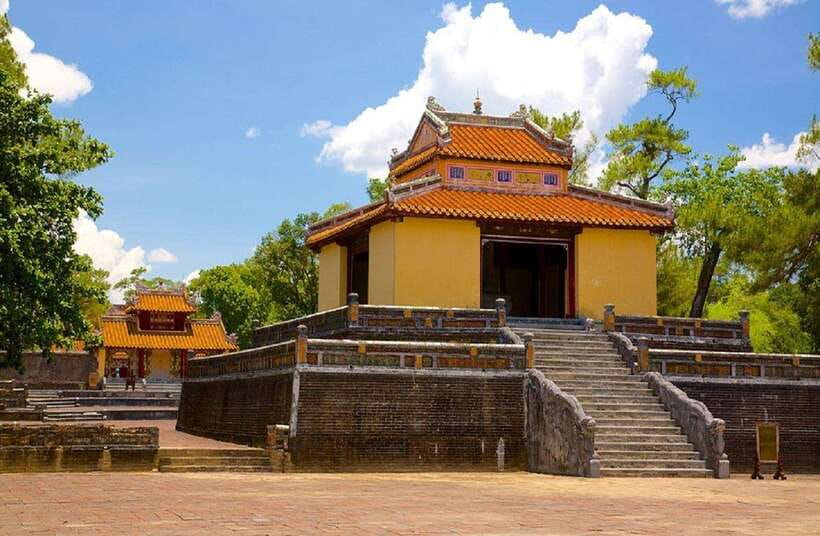
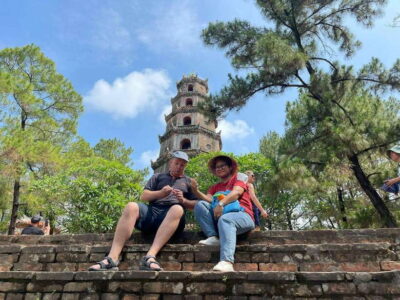
Thien Mu Pagoda, also called the Pagoda of the Celestial Lady, is planned for about 30 minutes. It was built in 1601 by the founder of the Nguyen family in central Vietnam, before the Nguyen dynasty reached its later imperial form.
The pagoda is tied to a local dream and has become one of Hue’s best-known religious sites. That origin story gives you a useful way to understand the place. It is not simply another old building. It reflects the mix of belief, local tradition, and political identity that shaped Hue.
I like including Thien Mu after several imperial tombs because it changes the focus from royal death to living faith. You can learn why Buddhism matters to local people and see a religious site that remains important beyond its role as a sightseeing stop.
The itinerary allows walking, sightseeing, and scenic driving, with some options mentioning a scooter ride. The actual transport depends on your booking, so do not assume a scooter is included if you reserve the private car option.
Tu Hieu Pagoda, a quieter connection to Buddhist life
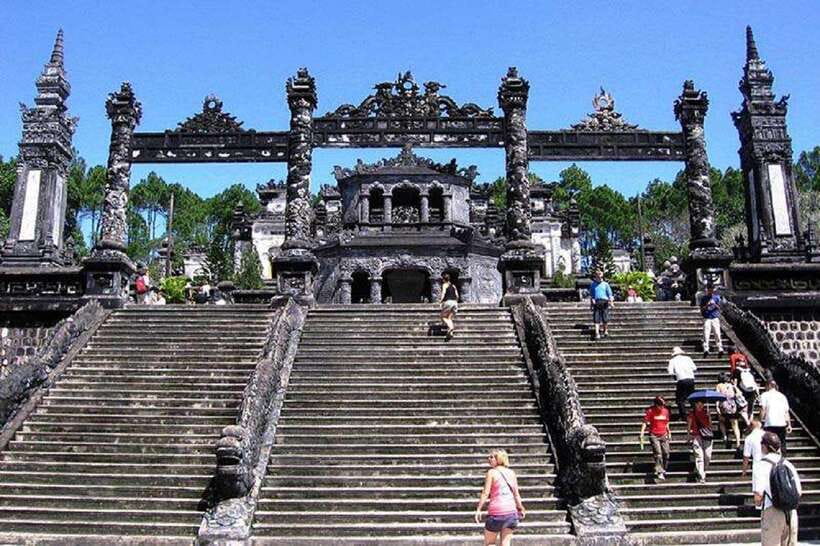
Tu Hieu Pagoda is also planned for about 30 minutes. It is known as the Root Temple and is described as one of Hue’s major temples and a cultural and historical site.
The pagoda is linked with Zen Master Thich Nhat Hanh, the Vietnamese spiritual leader, poet, and peace activist known worldwide for his teachings on mindfulness, ethics, and peace. The supplied information describes it as the place where he was living after returning to Vietnam from the United States.
This stop gives the tour a modern human connection. The royal tombs focus on emperors, court hierarchy, wives, concubines, and eunuchs. Tu Hieu shifts the subject toward monastic life and Buddhist teaching. If that contrast interests you, keep both pagodas in your plan.
As with Thien Mu, you should expect walking. The route information lists many possible activity labels, including hiking, cycling, motorcycle, and yoga, but those labels do not mean every activity is part of every booking. Confirm the transport and included services before you go.
How the private car changes the day

The car is not a minor convenience here. The tombs are spread around Hue, and the route includes several separate stops. A private vehicle means you can set the pace, return to your hotel afterward, and avoid trying to link distant sites with uncertain local transport.
Pickup is available from a hotel in Hue city center or from Hue Train Station. The service also returns you to your hotel at the end. You need to provide the exact hotel name and address so the pickup runs smoothly.
The tour is listed as lasting from two to eight hours. That wide range reflects the different options. A short outing might cover only selected tombs, while a longer day can add more mausoleums and both pagodas.
I would ask three questions before booking:
- Which tombs are included in this exact price?
- Is an English-speaking guide included, or only a driver?
- How many hours of private transport are provided?
Those answers matter more than the low headline price.
What the $15 price really covers
At $15 per person, the tour can be good value if you want a private car and only a few selected stops. You are paying for transport, city-center pickup and drop-off, and a guide when the chosen option includes one. For a couple or small private group, that can be easier than arranging several separate rides.
Admission is not included. The listed fee is 150,000 VND per tomb per person. If you visit all five tombs, individual entrance charges can add up quickly.
Combination tickets may be cheaper. The information provided lists a 420,000 VND ticket for the Imperial City and two tombs, or 530,000 VND for the Imperial City and three tombs, with validity for two days. Ask whether one of these fits your plan before buying separate tickets. Food and drinks are also not included.
The low base price is therefore best viewed as a starting point, not the full cost of a full-day sightseeing package. Still, the value is strong if you select two or three key sites and use the car to avoid transport hassle.
Guides, timing, and the feel of the service
The strongest part of the service is the personal attention made possible by a private group. Duy was praised for arriving on time, explaining old sites along the road, and giving enough time at each stop. Bi was described as accommodating and helpful with a flexible schedule. David was praised for attentive driving, which matters on a day with many separate monuments.
Ba received particular praise for practical local advice, including transfer prices, money exchange, and a stop for Hue’s distinctive salted coffee. That kind of help can make the tour more useful than a basic ride between monuments.
You should not assume you will receive a particular guide, since assignments can change. But the named guides give you a sense of the service style to expect: friendly, practical, and focused on keeping the day comfortable.
Who should book this Hue tour?
I would recommend it to you if you want to see several royal tombs without arranging transport yourself. It also suits couples, families, and small private groups that want to pause for photos or change the order of the sites.
It is a good choice for first-time visitors who want context about the Nguyen emperors and the court system. The guide can explain not only the buildings but also royal family life, including the roles of wives, concubines, and eunuchs.
You may prefer a shorter custom option if you dislike long sightseeing days. Five tombs plus two pagodas can become tiring, especially with walking and heat. Pick the sites that match your interests instead of trying to collect every entrance stamp.
Should you book it?
Book this tour if you value private transport, flexible timing, and a guide who can explain the people behind Hue’s monuments. Minh Mang, Tu Duc, and Khai Dinh make a strong core route, while Gia Long and Dong Khanh reward a longer day. Add Thien Mu or Tu Hieu if you want Buddhist culture alongside imperial history.
Before booking, confirm the exact tomb count, guide inclusion, duration, and ticket plan. At $15, it is a useful starting price, but admission fees and optional sites change the final bill. With those details clear, this is a practical way to see Hue’s far-flung royal sites without spending your day arranging rides.
FAQ
Where does the tour begin?
Pickup is available in Hue city center or at Hue Train Station. For a hotel pickup, provide the exact hotel name and address.
Where does the tour finish?
The driver or guide returns you to your hotel after the sightseeing route.
Is an English-speaking guide included?
A live English-speaking guide is included with the option that provides a guide. Check the selected option carefully, since some choices may focus on transportation only.
Which royal tombs can I visit?
The available tombs are Tu Duc, Minh Mang, Khai Dinh, Gia Long, and Dong Khanh. The number included depends on the option you choose.
Which pagodas are included?
The tour can include Thien Mu Pagoda, also called the Pagoda of the Celestial Lady, and Tu Hieu Pagoda.
Are entrance tickets included?
No. The listed price excludes entrance tickets, with the fee stated as 150,000 VND per tomb per person.
Are combination tickets available?
The information lists a 420,000 VND combination ticket for the Imperial City and two tombs, and a 530,000 VND ticket for the Imperial City and three tombs. Both are valid for two days.
How long does the tour last?
Available durations range from two to eight hours. The exact length depends on the option and the number of sites selected.
Is transportation private?
Yes. The tour provides private transportation by car or van for a private group.
Are meals and drinks included?
No. Food and drinks are not included, so plan to purchase them separately if needed.
Just added around Vietnam
- Sacred Nights at Bai Dinh Pagoda: A Spiritual Escape★ 4.9 · 16 reviews
- Ninh Binh Jeep Tour: 4 hours visit Tam Coc, Bich Dong pagoda★ 3.4 · 7 reviews
- Ninh Binh Jeep tour:2 hours visit Bich Dong, Thai Vi temple★ 3.8 · 38 reviews
- From Hoi An: Day Tour of My Son Temples and Marble Mountain★ 4.8 · 44 reviews
- Marble Mountains, Am Phu Cave, Linh Ung Pagoda Group Tour★ 4.8 · 14 reviews
- Hue: Explore the Royal City Customize with Dragon Boat★ 5.0 · 7 reviews
- Hue : Royal Tombs- Thien Mu Pagoda- Dragon Boat Private Tour★ 4.3 · 12 reviews
- Hue: Private Dragon Boat, Pagoda, and Royal Tomb Tour★ 4.8 · 141 reviews
Hue Temple Tours, compared.
Royal Tombs & Pagoda Private Tour By Dragon Boat & Car
Read our review →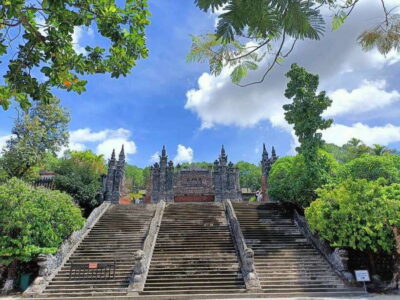
Royal Tombs Private Tour with 3 Best Tombs & Pagoda
Read our review →
Custom Tour with Dragon Boat, Private Car & Motorbike
Read our review →
Dragon Boat, Perfume River, Pagoda & Royal Tomb Tour
Read our review →
Hue Royal Tombs Tour Visit 3 Best Tombs & Pagoda
Read our review →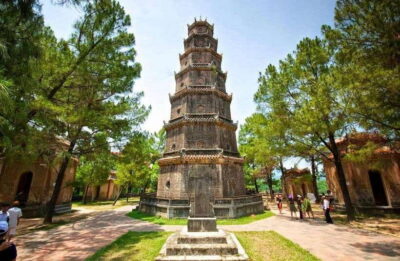
Private Dragon Boat, Pagoda, and Royal Tomb Tour
Read our review →
Royal Tombs and Thien Mu Pagoda Private Guided Tour
Read our review →Browse the lists this tour appears in